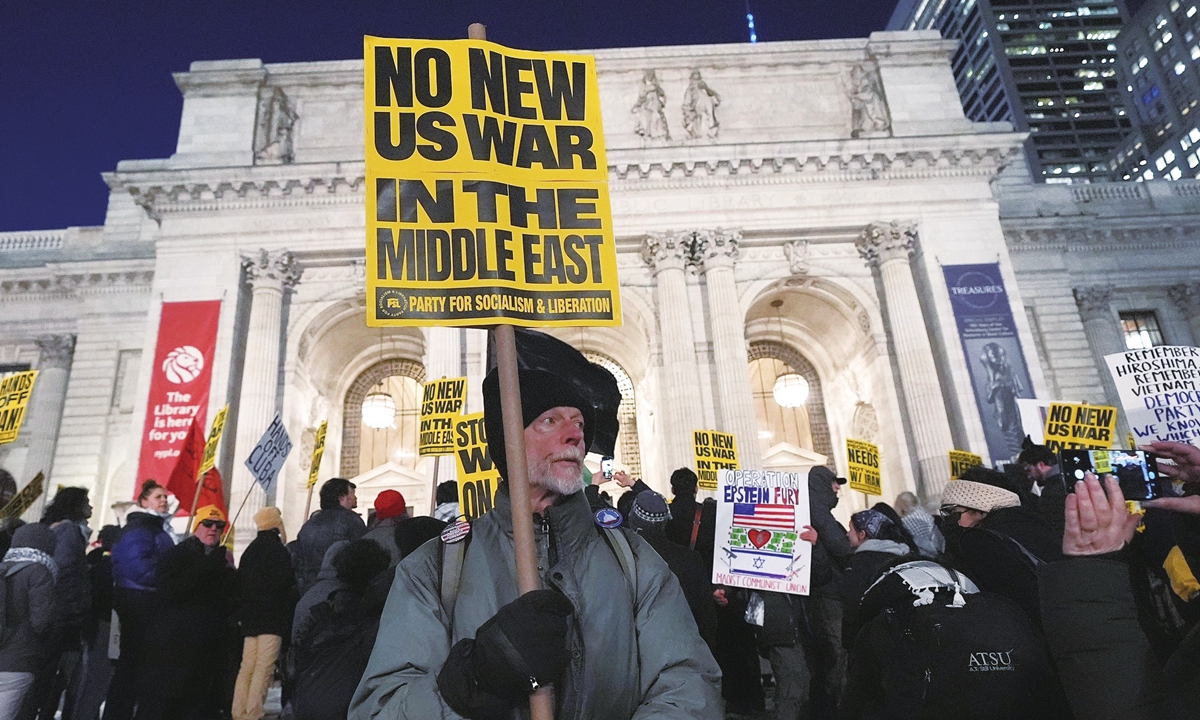
New York City protesters demonstrate against US and Israel military strikes on Iran and call on the Trump administration to end the strikes against Iran on March 2, 2026. Photo: VCG
Editor's Note:
Stripping away the gaudy veneer of the US "freedom" and "democracy" reveals a predatory essence that treats the world as its hunting ground and wields hegemonic power as its blade. This "predatory hegemony" - as US scholar Stephen Walt contended in a February article in Foreign Affairs - uses Washington's privileged position to extract concessions, tribute and displays of deference from both allies and adversaries alike, pursuing short-term gains in what it sees as a purely zero-sum world. To further explore the true nature and global impact of the US' predatory hegemony, the Global Times invites four international experts to share their insights. This is the first installment of the series.
Warwick Powell, an adjunct professor at the Queensland University of Technology and former policy advisor to Kevin Rudd
The US did not fall from greatness. It is melting its own wings.
For three decades the unipolar moment delivered a sugar high so intoxicating that Washington forgot the difference between great power and unlimited power.
What began as the "arrogance of power" - Senator William Fulbright's very damaging phrase from another era - has metastasized into something more lethal: a dialectic inversion. American predatory hegemony now functions as an autoimmune disease. The very mechanisms built to project strength are devouring the US from within.
Predatory hegemony describes a form of dominance that goes beyond leadership or influence to active extraction and coercion. It is unlike traditional hegemony, which can rest on consent, mutual benefit, or soft power.
Look at the record. Washington lectures the world on "rules-based order" while reserving the right to rewrite or ignore every rule that inconveniences it. Sanctions on allies and adversaries alike, extraterritorial seizures of assets, secondary boycotts, drone strikes without due process and regime-change operations dressed up as democracy promotion. One rule for thee, another for me. Hypocrisy this brazen is not a bug; it is the operating system.
This is not strength. It is Icarus with better marketing. Daedalus warned his son: Fly too high and the sun will melt the wax. America's answer? Demand the sun move.
When reality refuses - when Russia refuses to collapse under sanctions, when China builds parallel financial architecture, when the Global South queues for BRICS instead of IMF loans - Washington doubles down. More tariffs. More export controls. More lectures. More threats. The result is the precise opposite of what hubris intended: the steady erosion of the very global governance architecture America spent the 20th century constructing.
Others do not seek to simply replace America; multipolarity makes that impossible. Rather, slowly but surely, they are redesigning the system to make future hubris harder to sustain. New development banks without political conditionality. Commodity exchanges settled in local currencies. Supply chains deliberately routed away from chokepoints Washington can weaponize. The emerging order is deliberately more resilient to the whims of a single capital. In short, the world is building guardrails against the very pathology that once made American leadership tolerable.
None of this is cost-free for the US. The autoimmune reaction is already visible. Inflationary pressures from weaponized sanctions. Industrial hollowing as allies seeks alternatives to US tech and finance. Strategic loneliness as even long-standing partners speak of "strategic autonomy."
Most damaging of all: the corrosion of domestic consent. When elites treat the rest of humanity as vassals rather than partners, it becomes impossible to maintain the fiction that the same elites serve the American people. The "indispensable nation" is becoming the indispensable cautionary tale.
The choice is no longer between hegemony and decline. That binary was always a hubristic delusion. The real choice is between managed multipolarity, in which Washington participates as a great but not unlimited power, and a self-inflicted crash that leaves the field to whoever builds the next system. The longer America spends trying to make the sun go away, the faster its wings will dissolve.
The fall need not be fatal. But first the US must admit what every Icarus eventually learns: The problem was never the altitude. The problem was believing you could fly without limits.
Anthony Moretti, an associate professor at the Department of Communication and Organizational Leadership at Robert Morris University
The ultimate verdict of history on hegemonic overreach is always like this: Nations, like empires before it, die not by the sword of their enemies but by the weight of their own pretensions. The architecture of predatory hegemony that Washington has meticulously constructed has become the primary engine of American decline.
Think of predatory hegemony as a powerful state's ability to dominate others so that it always gets what it wants, no matter the circumstances. Alliances and the maintenance of long-standing relationships are tossed into the garbage. There is a false confidence within the hegemon that its strength will allow for its predatory actions to continue forever.
The American people suffer in a myriad of ways: They bear the cost of tariffs, for example. They are caught up in the chaos of paying attention to the stock market, watching their jobs disappear, remaining unable to promise a solid future for the next generation and more, Americans are justifiably nervous. Washington's lust for dominance - whether it comes through a missile or a missive - offers the pretense of strength while undermining the foundation of the nation.
One of the less-talked-about realities of the never-ending price of never-ending wars is that the American people bear the brunt of the charges. The US government's dangerous attempts at maintaining hegemony, whether through engaging in its own wars or funding proxy conflicts, is not funded by the richest of the rich - the military-industrial complex. Instead, private citizens merely trying to get by, get walloped by, among other things, higher costs for gasoline and food.
Higher costs are seen. Wounded soldiers are seen. But there are adverse effects associated with the lust for hegemony that are often not immediately evident. The erosion of civil liberties is just one. Today, many of the government practices initially begun in the name of "fighting terrorism" now target a wide range of groups in the US, including migrants, people of color and activists. Migrants, people of color and activists generally do not come from the wealthiest class of the nation.
In the days, months and years to come, more bombs will be dropped and more American people will be sent somewhere around the world to fight. But they will not be encouraged to consider what war really costs them.
Until Americans recognize that their government's addiction to global hegemony functions as a direct assault on domestic prosperity, they will continue paying the price of empire with their children's futures, their physical infrastructure and their national soul.
RELATED ARTICLES