IN-DEPTH / IN-DEPTH
Gaining millions of fans through expertise: how Gen Z influencers unlock new career paths in the youth-driven economy
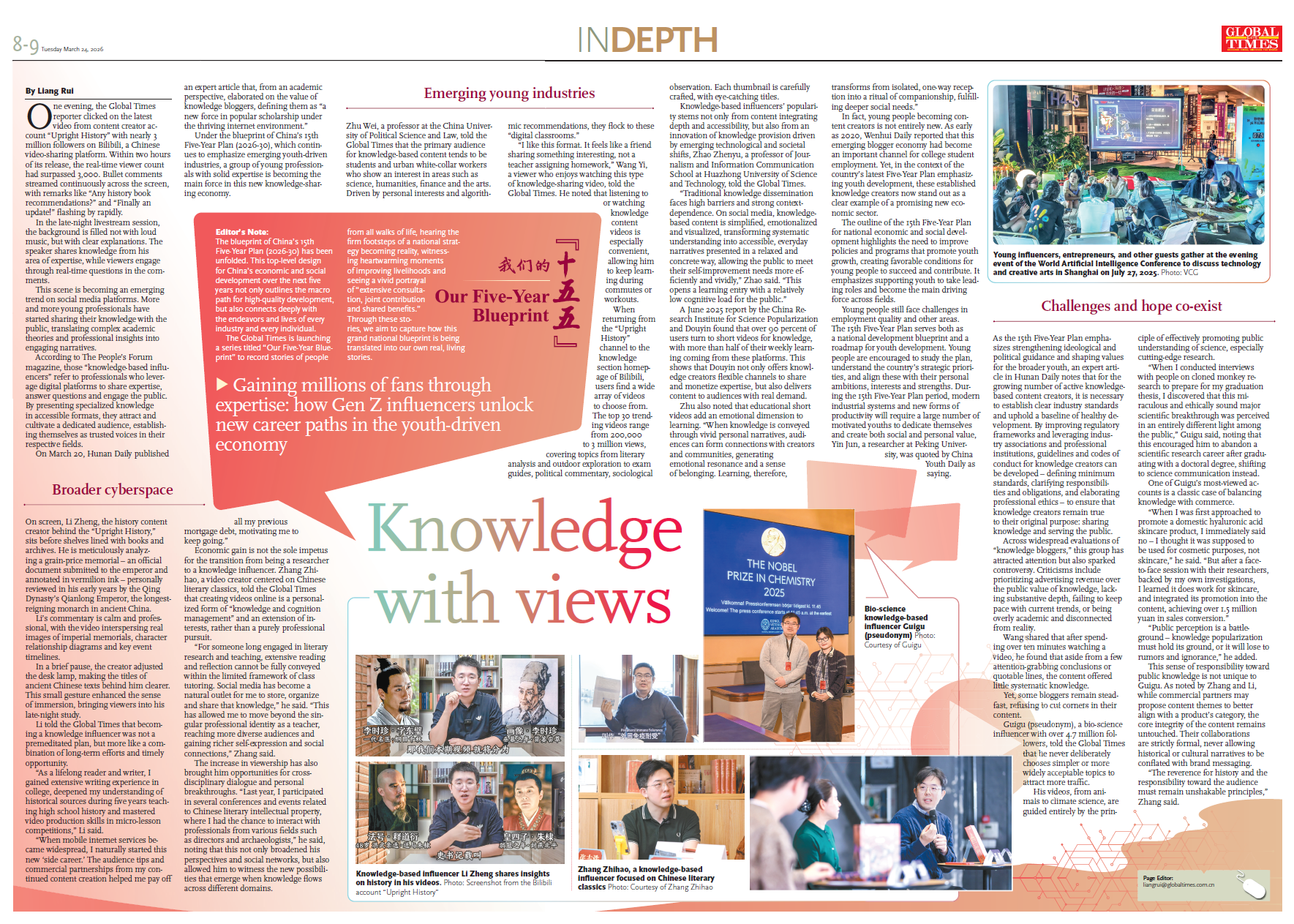
Knowledge with views
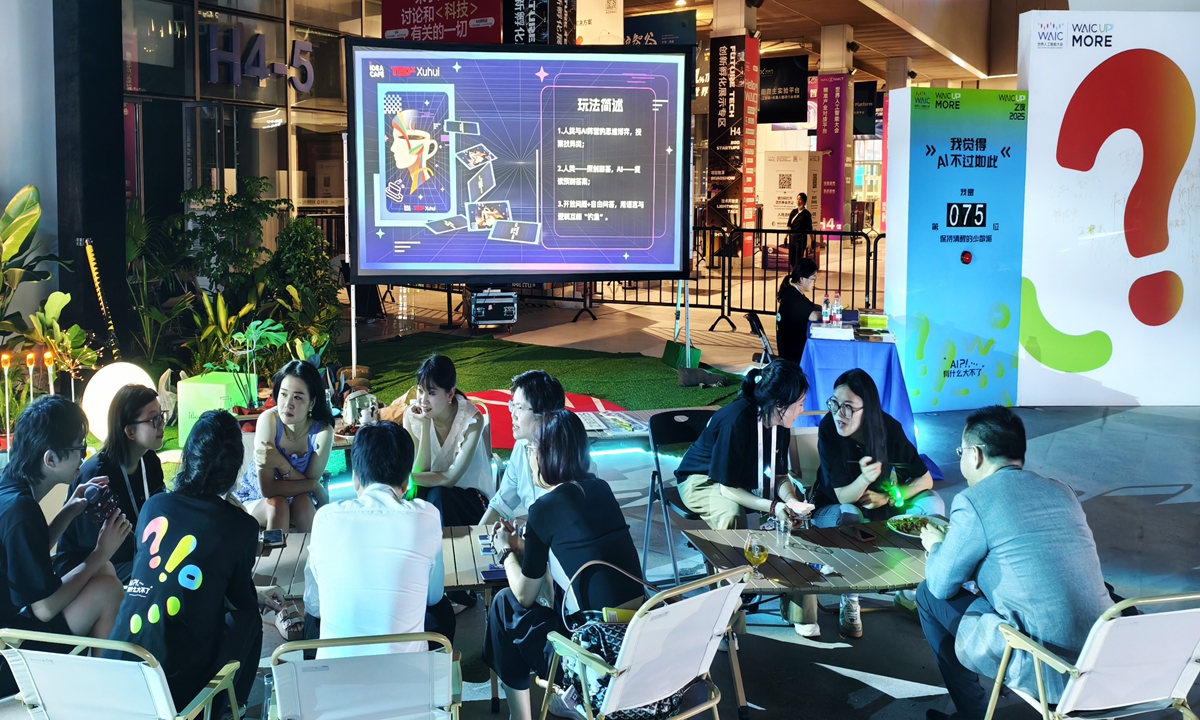
Young influencers, entrepreneurs, and other guests gather at the evening event of the World Artificial Intelligence Conference to discuss technology and creative arts in Shanghai on July 27, 2025. Photo: VCG
Editor's Note:
The blueprint of China's 15th Five-Year Plan (2026-30) has been unfolded. This top-level design for China's economic and social development over the next five years not only outlines the macro path for high-quality development, but also connects deeply with the endeavors and lives of every industry and every individual.
The Global Times is launching a series titled "Our Five-Year Blueprint" to record stories of people from all walks of life, hearing the firm footsteps of a national strategy becoming reality, witnessing heartwarming moments of improving livelihoods and seeing a vivid portrayal of "extensive consultation, joint contribution and shared benefits." Through these stories, we aim to capture how this grand national blueprint is being translated into our own real, living stories.
One evening, the Global Times reporter clicked on the latest video from content creator account "Upright History" with nearly 3 million followers on Bilibili, a Chinese video-sharing platform. Within two hours of its release, the real-time viewer count had surpassed 3,000. Bullet comments streamed continuously across the screen, with remarks like "Any history book recommendations?" and "Finally an update!" flashing by rapidly.
In the late-night livestream session, the background is filled not with loud music, but with clear explanations. The speaker shares knowledge from his area of expertise, while viewers engage through real-time questions in the comments.
This scene is becoming an emerging trend on social media platforms. More and more young professionals have started sharing their knowledge with the public, translating complex academic theories and professional insights into engaging narratives.
According to The People's Forum magazine, those "knowledge-based influencers" refer to professionals who leverage digital platforms to share expertise, answer questions and engage the public. By presenting specialized knowledge in accessible formats, they attract and cultivate a dedicated audience, establishing themselves as trusted voices in their respective fields.
On March 20, Hunan Daily published an expert article that, from an academic perspective, elaborated on the value of knowledge bloggers, defining them as "a new force in popular scholarship under the thriving internet environment."
Under the blueprint of China's 15th Five-Year Plan (2026-30), which continues to emphasize emerging youth-driven industries, a group of young professionals with solid expertise is becoming the main force in this new knowledge-sharing economy.
Broader cyberspace
On screen, Li Zheng, the history content creator behind the "Upright History," sits before shelves lined with books and archives. He is meticulously analyzing a grain-price memorial - an official document submitted to the emperor and annotated in vermilion ink - personally reviewed in his early years by the Qing Dynasty's Qianlong Emperor, the longest-reigning monarch in ancient China.
Li's commentary is calm and professional, with the video interspersing real images of imperial memorials, character relationship diagrams and key event timelines.
In a brief pause, the creator adjusted the desk lamp, making the titles of ancient Chinese texts behind him clearer. This small gesture enhanced the sense of immersion, bringing viewers into his late-night study.
Li told the Global Times that becoming a knowledge influencer was not a premeditated plan, but more like a combination of long-term efforts and timely opportunity.
"As a lifelong reader and writer, I gained extensive writing experience in college, deepened my understanding of historical sources during five years teaching high school history and mastered video production skills in micro-lesson competitions," Li said.
"When mobile internet services became widespread, I naturally started this new 'side career.' The audience tips and commercial partnerships from my continued content creation helped me pay off all my previous mortgage debt, motivating me to keep going."
Economic gain is not the sole impetus for the transition from being a researcher to a knowledge influencer. Zhang Zhihao, a video creator centered on Chinese literary classics, told the Global Times that creating videos online is a personalized form of "knowledge and cognition management" and an extension of interests, rather than a purely professional pursuit.
"For someone long engaged in literary research and teaching, extensive reading and reflection cannot be fully conveyed within the limited framework of class tutoring. Social media has become a natural outlet for me to store, organize and share that knowledge," he said. "This has allowed me to move beyond the singular professional identity as a teacher, reaching more diverse audiences and gaining richer self-expression and social connections," Zhang said.
The increase in viewership has also brought him opportunities for cross-disciplinary dialogue and personal breakthroughs. "Last year, I participated in several conferences and events related to Chinese literary intellectual property, where I had the chance to interact with professionals from various fields such as directors and archaeologists," he said, noting that this not only broadened his perspectives and social networks, but also allowed him to witness the new possibilities that emerge when knowledge flows across different domains.

Zhang Zhihao, a knowledge-based influencer focused on Chinese literary classics Photo: Courtesy of Zhang Zhihao
Emerging young industries
Zhu Wei, a professor at the China University of Political Science and Law, told the Global Times that the primary audience for knowledge-based content tends to be students and urban white-collar workers who show an interest in areas such as science, humanities, finance and the arts. Driven by personal interests and algorithmic recommendations, they flock to these "digital classrooms."
"I like this format. It feels like a friend sharing something interesting, not a teacher assigning homework," Wang Yi, a viewer who enjoys watching this type of knowledge-sharing video, told the Global Times. He noted that listening to or watching knowledge content videos is especially convenient, allowing him to keep learning during commutes or workouts.
When returning from the "Upright History" channel to the knowledge section homepage of Bilibili, users find a wide array of videos to choose from. The top 30 trending videos range from 200,000 to 3 million views, covering topics from literary analysis and outdoor exploration to exam guides, political commentary, sociological observation. Each thumbnail is carefully crafted, with eye-catching titles.
Knowledge-based influencers' popularity stems not only from content integrating depth and accessibility, but also from an innovation of knowledge provision driven by emerging technological and societal shifts, Zhao Zhenyu, a professor of Journalism and Information Communication School at Huazhong University of Science and Technology, told the Global Times.
"Traditional knowledge dissemination faces high barriers and strong context-dependence. On social media, knowledge-based content is simplified, emotionalized and visualized, transforming systematic understanding into accessible, everyday narratives presented in a relaxed and concrete way, allowing the public to meet their self-improvement needs more efficiently and vividly," Zhao said. "This opens a learning entry with a relatively low cognitive load for the public."
A June 2025 report by the China Research Institute for Science Popularization and Douyin found that over 90 percent of users turn to short videos for knowledge, with more than half of their weekly learning coming from these platforms. This shows that Douyin not only offers knowledge creators flexible channels to share and monetize expertise, but also delivers content to audiences with real demand.
Zhu also noted that educational short videos add an emotional dimension to learning. "When knowledge is conveyed through vivid personal narratives, audiences can form connections with creators and communities, generating emotional resonance and a sense of belonging. Learning, therefore, transforms from isolated, one-way reception into a ritual of companionship, fulfilling deeper social needs."
In fact, young people becoming content creators is not entirely new. As early as 2020, Wenhui Daily reported that this emerging blogger economy had become an important channel for college student employment. Yet, in the context of the country's latest Five-Year Plan emphasizing youth development, these established knowledge creators now stand out as a clear example of a promising new economic sector.
The outline of the 15th Five-Year Plan for national economic and social development highlights the need to improve policies and programs that promote youth growth, creating favorable conditions for young people to succeed and contribute. It emphasizes supporting youth to take leading roles and become the main driving force across fields.
Young people still face challenges in employment quality and other areas. The 15th Five-Year Plan serves both as a national development blueprint and a roadmap for youth development. Young people are encouraged to study the plan, understand the country's strategic priorities, and align these with their personal ambitions, interests and strengths. During the 15th Five-Year Plan period, modern industrial systems and new forms of productivity will require a large number of motivated youths to dedicate themselves and create both social and personal value, Yin Jun, a researcher at Peking University, was quoted by China Youth Daily as saying.
Challenges and hope co-exist
As the 15th Five-Year Plan emphasizes strengthening ideological and political guidance and shaping values for the broader youth, an expert article in Hunan Daily notes that for the growing number of active knowledge-based content creators, it is necessary to establish clear industry standards and uphold a baseline of healthy development. By improving regulatory frameworks and leveraging industry associations and professional institutions, guidelines and codes of conduct for knowledge creators can be developed - defining minimum standards, clarifying responsibilities and obligations, and elaborating professional ethics - to ensure that knowledge creators remain true to their original purpose: sharing knowledge and serving the public.
Across widespread evaluations of "knowledge bloggers," this group has attracted attention but also sparked controversy. Criticisms include prioritizing advertising revenue over the public value of knowledge, lacking substantive depth, failing to keep pace with current trends, or being overly academic and disconnected from reality.
Wang shared that after spending over ten minutes watching a video, he found that aside from a few attention-grabbing conclusions or quotable lines, the content offered little systematic knowledge.
Yet, some bloggers remain steadfast, refusing to cut corners in their content.
Guigu (pseudonym), a bio-science influencer with over 4.7 million followers, told the Global Times that he never deliberately chooses simpler or more widely acceptable topics to attract more traffic.
His videos, from animals to climate science, are guided entirely by the principle of effectively promoting public understanding of science, especially cutting-edge research.
"When I conducted interviews with people on cloned monkey research to prepare for my graduation thesis, I discovered that this miraculous and ethically sound major scientific breakthrough was perceived in an entirely different light among the public," Guigu said, noting that this encouraged him to abandon a scientific research career after graduating with a doctoral degree, shifting to science communication instead.
One of Guigu's most-viewed accounts is a classic case of balancing knowledge with commerce.
"When I was first approached to promote a domestic hyaluronic acid skincare product, I immediately said no - I thought it was supposed to be used for cosmetic purposes, not skincare," he said. "But after a face-to-face session with their researchers, backed by my own investigations, I learned it does work for skincare, and integrated its promotion into the content, achieving over 1.5 million yuan in sales conversion."
"Public perception is a battleground - knowledge popularization must hold its ground, or it will lose to rumors and ignorance," he added.
This sense of responsibility toward public knowledge is not unique to Guigu. As noted by Zhang and Li, while commercial partners may propose content themes to better align with a product's category, the core integrity of the content remains untouched. Their collaborations are strictly formal, never allowing historical or cultural narratives to be conflated with brand messaging.
"The reverence for history and the responsibility toward the audience must remain unshakable principles," Zhang said.
Knowledge with views
RELATED ARTICLES