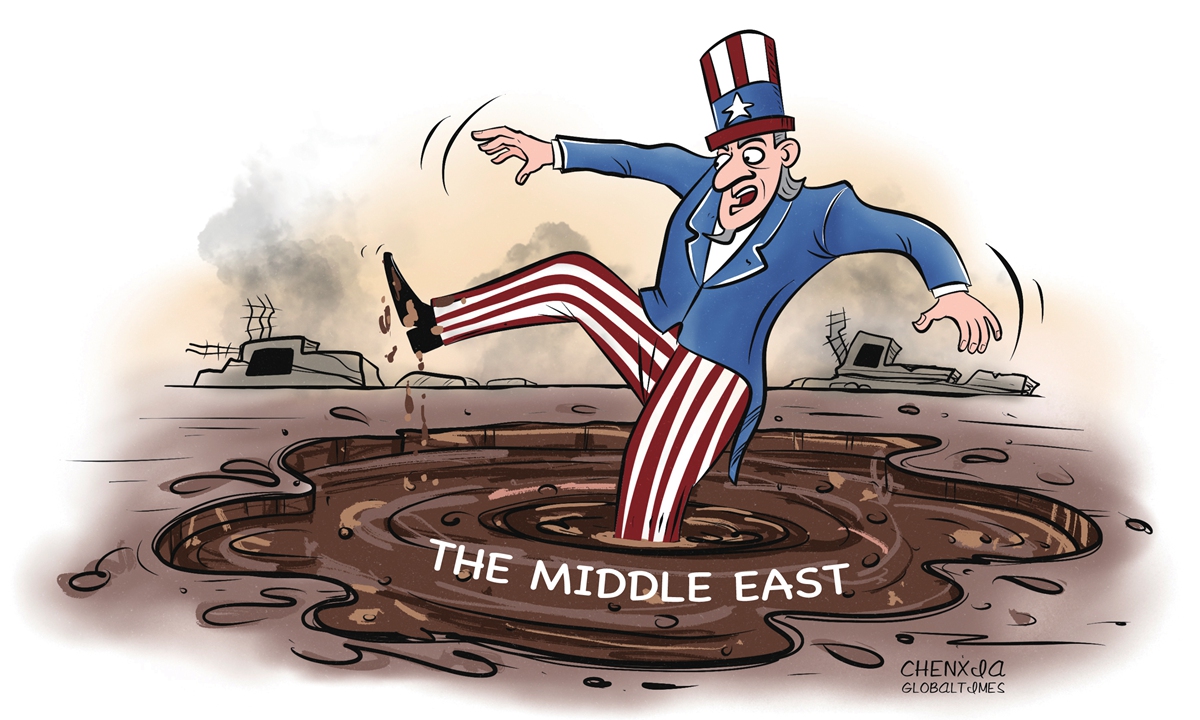
Illustration: Chen Xia/GT
The US-Israel-Iran conflict has entered its fourth week. What began as lightning "decapitation strikes" against Iran aimed at quick victory is turning into a full-scale quagmire.Citing "productive" talks to halt war, the US is postponing strikes on Iran's power plants. Yet observers remain cautiously optimistic, viewing it as merely a temporary expedient - the White House simply doesn't want to blow up the war right now. As of press time, Tehran has not confirmed any talks with the US.
On Monday, mainstream US media outlets voiced deep concern that Washington is losing grip on the war. The Associated Press reported that the US is cycling through an increasingly desperate list of options as it searches for a solution to the crisis in the Strait of Hormuz, ranging from calls to secure the waterway to lifting sanctions, and now escalating to a direct threat against civilian infrastructure in Iran.
The Economist bluntly laid out the US' "four bad options for the war in Iran." Negotiating is the least likely scenario as both sides have almost zero trust in each other and neither is in the mood to make concessions. Unilaterally declaring victory would leave Iran choking the Strait and pocketing enriched uranium. Pressing ahead with several more weeks of air strikes might lead to Iran's attacks on critical infrastructure in the Gulf. Escalating the conflict, including conducting amphibious landings to seize Kharg Island, would bring even greater peril. The conclusion is stark: None of the options may actually end the war.
Four weeks in, missiles are flying, oil prices are soaring, civilians are dying, and no one knows how this war will end. Washington can threaten to obliterate Iran's power plants, then delay action by five days, yet somehow lacks a workable plan for a ceasefire.
The initial "decapitation strikes" against Iran on February 28 appeared at first to be a "decisive victory" for the US. By now, reality has turned upside down. Analysts point out the paradox: The strikes were "too successful" - they wiped out certain key Iranian figures to the point that it has become difficult to find someone to negotiate with - and "too unsuccessful" - Iran's Revolutionary Guard command structure has survived. This allows missile and drone counterattacks to escalate from military bases, critical infrastructure, and now a de facto blockade of the Strait of Hormuz, dragging the US and Israel into a war of attrition.
Even if Washington seeks an off-ramp, it still needs the other two parties - Iran and Israel - to be on the same page. Iran views this as an existential fight for national survival. After repeated assassinations and heavy losses, Tehran has lost trust in negotiating with the US. Israel, meanwhile, is escalating strikes on Iran, which effectively blocks the possibility of a swift American withdrawal, according to observers.
Discussions of a landing in Iran are now actively on the table in Washington. At least 2,000 US Marines, constituting the 31st Marine Expeditionary Unit (MEU), headquartered in Japan, have been dispatched toward the Middle East. And 2,500 Marines from the 11th MEU in California and the USS Boxer amphibious ready group will go in April. The 82nd Airborne Division is also reportedly preparing for a pre-planned Middle East deployment.
The US reportedly is having Kharg Island, a huge crude export hub of Iran, in its sights. "The Marines could seize the island so the US could use it as leverage to reopen the strait, according to experts and former officials," reported the Wall Street Journal.
However, the idea has sparked internal pushback. Joe Kent, who recently resigned as the national counter-terrorism center director, warned that it would "essentially be giving Iran a bunch of hostages on an island that they could barrage with drones and missiles."
Whether a limited amphibious landing in Iran, a nation vastly larger than Iraq, may yield the results Washington is hoping for - only time will tell. History, however, has already delivered a lesson: In 2003, the US invaded Iraq under the pretense of "weapons of mass destruction." After a swift military "victory," no such weapons were found, yet the resulting chaos in Iraq lasted over 20 years. The Iraq War seriously undermined the Bush administration's public approval ratings and left an enduring stain on its historical legacy.
In Iran's case, the US now finds itself caught between a rock and a hard place: On the front line, Iran fights back with fierce determination; in the rear, domestic support is eroding and allies are distancing themselves.
Worse, the US is trapped in a profound strategic dilemma: terrified of sinking into a full-scale war quagmire yet unwilling to give up dominance in the Middle East; desperate to defeat Iran completely yet reluctant to pay the enormous price that would entail.
One can start a war, but ending it is another matter entirely.
RELATED ARTICLES