Friendly ties with all regional countries China’s advantage in mediating Middle East issues: Chinese special envoy tells GT
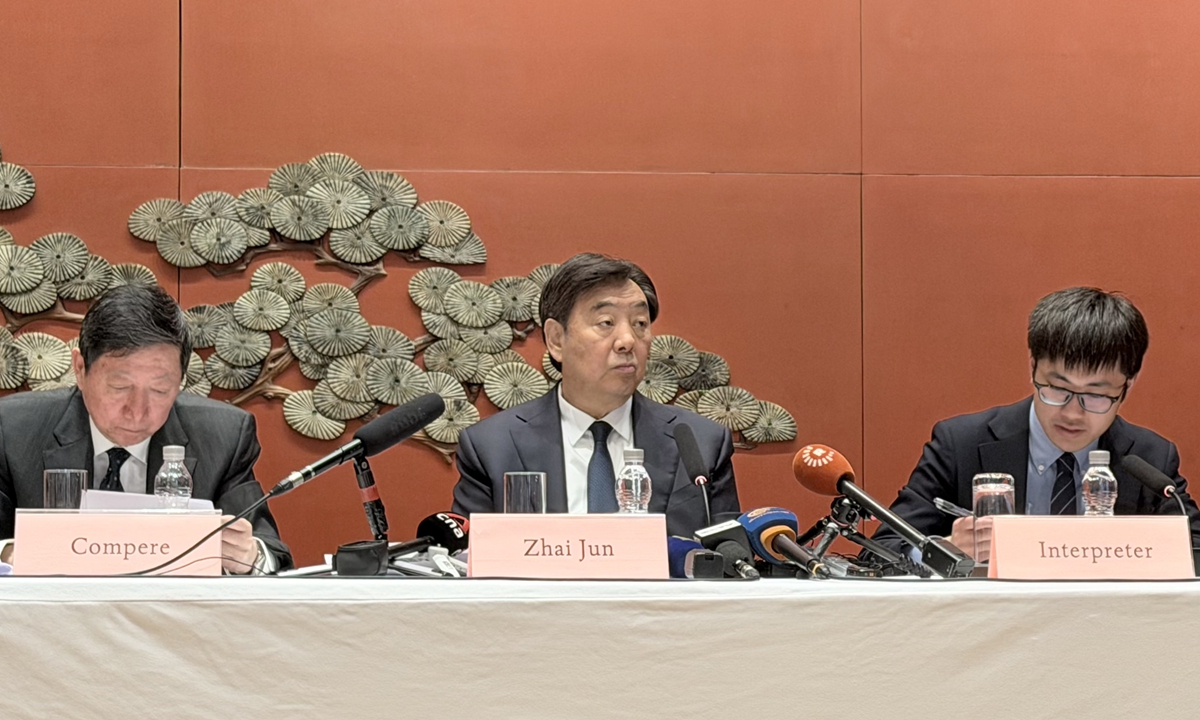
Zhai Jun (C), Special Envoy of the Chinese Government on the Middle East Issue, attends a media briefing held by the China Public Diplomacy Association in Beijing on March 23, 2026, where he takes media inquiries from Chinese and foreign journalists on Middle East issues. Photo: Shen Sheng/GT
With regard to China's special advantages in mediating Middle East issues, China has maintained friendly relations with all countries in the region, Zhai Jun, Special Envoy of the Chinese Government on the Middle East Issue, told the Global Times on Monday. His remarks came as the military strike launched by US and Israel entered its fourth week."We have never interfered in the internal affairs of countries in this region. We have never sought selfish gains in the region, and we have never stoked bloc confrontation. We have always supported regional countries in strengthening solidarity and independence."
Zhai made these remarks in response to a Global Times inquiry asking what special advantages China has in mediating Middle East issues compared with the US and European countries, and why China is accepted by many countries in the region.
"As we always say, we act as a builder of peace and a promoter of development," the special envoy stressed at a media briefing held by the China Public Diplomacy Association on Monday, where he answered questions from Chinese and foreign journalists on Middle East issues.
Citing a traditional Chinese saying, Zhai said at the briefing that "He who tied the bell should untie it," meaning those who created the problem should be the ones to undo it, when asked about the biggest obstacles to a ceasefire and the possibilities for de-escalation at present.
The Middle East situation witnessed a new twist on Monday. According to multiple media reports, US President Donald Trump backed down on targeting Iran's power network on Monday, saying the US and Iran have held constructive talks and that he would postpone any strikes on power plants and energy infrastructure.
Reuters also cited a source briefed on Israel's war plans against Iran as saying that Washington had kept Israel informed of its talks with Tehran, and that Israel would likely follow the US in suspending any targeting of Iranian power plants and energy infrastructure.
Barak Ravid, Global Affairs Correspondent for Axios, cited US sources on his X account claiming that Turkey, Egypt, and Pakistan have been passing messages between the US and Iran over the past two days in an effort to de-escalate tensions. His X post also claimed that senior officials from the three countries held separate talks with White House envoy Steve Witkoff and Iranian Foreign Minister Abbas Araghchi.
He said that sources claimed "the mediation is ongoing and making progress. The discussion is about ending the war and resolving all outstanding issues. We hope to have answers soon."
However, an Iranian source said that there was no contact — direct or indirect — with the US, the Tehran Times reported in an X post Monday.
Kremlin spokesman Dmitry Peskov issued warning on Middle East nuclear power plant security. He said US-Israeli strikes near the Bushehr nuclear power plant in Iran are extremely dangerous and Russia has shared its concerns with the US.
The Kremlin spokesman said that the conflict in Iran "as recently as yesterday" should have been channeled towards a political and diplomatic settlement, according to the Reuters. "This is the only thing that can effectively help defuse the catastrophically tense situation that has now developed in the region."
At the Monday event, the special envoy also briefed Chinese and foreign journalists on China's recent mediation and de-escalation efforts, saying, "China's position is very clear on the current situation: the core is to call for a ceasefire and an end to hostilities, and to launch dialogue and negotiations," Zhai said that he had recently conducted shuttle visits to regional countries including Saudi Arabia, the United Arab Emirates, Bahrain, Kuwait and Egypt, where he held in-depth exchanges with the foreign ministers of those countries as well as the secretaries-general of the Gulf Cooperation Council and the Arab League on the regional situation.
Zhai further noted that during his recent trip to the Middle East he elaborated on China's position to regional countries, which could be summarized into six key points. He noted that this war should not have happened in the first place, and the nature of the current crisis is clear. The US and Israel launched strikes on Iran without authorization from the UN Security Council, in violation of the UN Charter and international law, which China firmly opposes and condemns. He added that any effort to resolve the crisis must take into full account the root causes and overall context of the conflict.
Further escalation must be resolutely prevented, as the ongoing conflict has severely jeopardized security and stability in the Middle East, disrupted the global economy, energy supplies and shipping lanes, and threatened the well-being of all countries, Zhai stressed, adding that the security of international waterways including the Strait of Hormuz must not be undermined. China condemns all attacks that indiscriminately target civilians and non-military targets.
He went on to say that an immediate ceasefire is the pressing priority, while dialogue and negotiation are the fundamental way out. He added that unilateralism must be firmly resisted.
"All parties highly appreciated China's fair stance on the current regional situation and its continued diplomatic mediation efforts since the outbreak of the conflict, and expressed hope that China will play a greater role in promoting de-escalation," Zhai said, referring to the reactions of regional countries during his visit.
At the end of his remarks, the special envoy shared a detail from his recent shuttle diplomacy trip. "Due to the ongoing conflict, this visit was quite unusual. Several of the countries I planned to visit had closed their airspace, leading to flight cancellations, so my colleagues and I had to travel by vehicles across multiple countries," he said.
"Along the way, we experienced air raid sirens and witnessed missile interceptions, which gave us a more direct and profound sense of the tremendous impact the war has had on countries in the region."
He added that Chinese people traditionally believe that "peace is most precious," and that the cornerstone of China's Middle East policy is to promote reconciliation and peace in the region. "I want to stress that as long as the conflict continues, China's diplomatic mediation efforts will not stop," he said.
RELATED ARTICLES