ARTS / CULTURE & LEISURE
Writing from the land: Chinese online writers draw inspiration from county life to share stories with the world
Writing from the land
By Published: Mar 23, 2026 11:23 PM

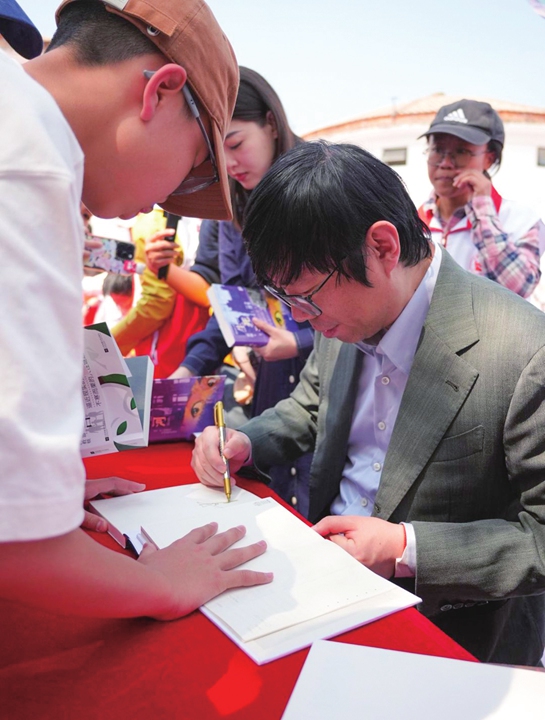
Writer Cai Jun signs books for readers. Photo: Courtesy of the China Writers Association
Entering March, Kaiping in South China's Guangdong Province is already warm and full of gentle breezes.Amid traditional dwellings and old alleys, well-known Chinese online literature writers such as Cai Jun, Tiancantudou, Xiao Ding, and Shachongdui Duiyuan sat among readers, listening to their voices. At the same time, these writers shared their own creative insights in online novel writing and discussed new trends such as artificial intelligence (AI)-assisted creativity with more people.
Together with other writers, author Shachongdui Duiyuan (lit: insecticide squad member) participated in a "Books for Vegetables" exchange during the event. The writers exchanged their signed books with local readers for fresh local farm produce and specialties.
"People brought all kinds of local specialties. I remember dried tangerine peels and fermented bean curd were among them. The entire activity was a lot of fun," the writer told the Global Times. He remarked that the mix of the "fragrance of ink" and vegetable aroma left a deep impression, making him feel grounded, as if his feet were firmly planted in the earth.
Following previous events in areas such as Xiushui in East China's Jiangxi Province and Xixia in Central China's Henan Province, this was the first stop in 2026 for the event series, organized by the China Writers Association with the aim of bringing literature to county towns.
As the writers said at the event, visiting these counties was not just about meeting readers; it was a way to draw creative nourishment from the land of realism and confirm the close relationship between their writing and a much wider world.
"As living museums of traditional Chinese culture, counties carry the original life logic and emotional structure of the Chinese people. Narratives dug from here become the core content that makes Chinese online literature different from Western fantasy stories," Zhang Peng, an associate professor at Nanjing Normal University, told the Global Times. "This in-depth exploration of China's spiritual world is an irreplaceable cultural resource for Chinese web novels."
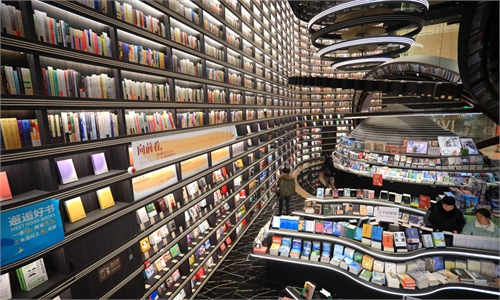
Right next to the event venue, five old granaries stood quietly. Once storage warehouses for rice, they now function as a bookstore, showing the bond between literature and the earth. From this spot, the writers set out to explore the depth of local diaolou (a type of defensive village house), fields, and old streets. As Shachongdui Duiyuan put it, "We came to truly learn about the many diverse Chinese stories."

A reader explores books in a bookstore transformed from an abandoned grain warehouse dating back to the 1970s in Kaiping, South China's Guangdong Province, on February 21, 2026. Photos: VCG
Taking root"If you don't observe the world, how can you gain a worldview?" Shachongdui Duiyuan said. "The world of a writer is a huge web, woven from person to person."
This online literature writer known for his popular novel Ten Day Ultimatum, which has drawn more than 5 million followers on digital platforms, looked for stories of human connection during his journey to Kaiping. He said that these experiences are the real key to writing appealing works.
During a visit to the region's unique diaolou, he touched bullet marks left on the walls. Imagining the turbulent times residents had to face, he saw how the people used these towers to resist bandits and protect their families. He also noticed that the cook stoves inside the towers were much lower than adult height. After asking around, he discovered this was because adults had to defend the home against outsiders, leaving children to do the cooking and chores.
"The real history and stories of this land might not appear exactly as they are in our novels, but they certainly become the sources of inspiration," he told the Global Times. For instance, inspired by what he has seen, the next time Shachongdui Duiyuan develops a character, the courage locals had in the face of adversity could become that character's defining trait.
"Kaiping's diaolou is a witness of China's meeting with the world. No matter what genre a writer works in, this is a powerful subject," said Cai Jun, a suspense novelist, sharing his creative insights at the foot of one of the towers. "The diaolou is a blend of Chinese and Western architecture, so stories - be they sci-fi, time travel, or mystery - arise naturally from the meeting of civilizations. I believe these structures are a treasure trove of inspiration."
In Cai's view, writers cannot stay locked up in their ivory towers. This is especially true for online novelists, whose writing tends to drift further away from real life. They urgently need to step outside and experience different cultures and civilizations.

An exterior view of the bookstore established in old granaries
Going overseasAccording to the China Writers Association's online literature center, there are currently about 200 million active overseas readers of Chinese web literature. Readers in the Asian region account for 80 percent of the global total, with a market share exceeding 50 percent. This achievement demonstrates that online literature has become a prominent calling card for the international dissemination of Chinese culture and literary innovation.
Tiancantudou, another popular online novelist, said that the key to touching overseas readers lies in universal emotional themes complemented by the unique charm of traditional Chinese culture.
Xie Youshun, head of the Guangdong Writers Association, noted in his speech that he was moved to see a new generation of online writers consciously inherit fine Chinese traditions and blend sincere patriotism and deep cultural ties into their works.
"Today's online literature is sailing abroad with a clear Chinese cultural imprint, making it an important carrier for telling China's stories to the world," he said, as reported by the Guangzhou-based Southern Metropolis Daily.
Although writers everywhere now face the challenge brought by AI tools, Shachongdui Duiyuan noted that truly good stories with cultural significance cannot be replaced. At present, AI is still just a helpful tool for proofreading and polishing.
"In the context of Chinese online literature expanding abroad, these writers visiting counties and towns is not simply an exercise in gathering rural color. It is a way to translate small town Chinese experiences into stories that resonate with a global audience," Zhang Peng of Nanjing Normal University said.
RELATED ARTICLES