SDF member broke into Chinese Embassy in Japan; intrusion exposes growing far-right ideology in SDF: Chinese expert
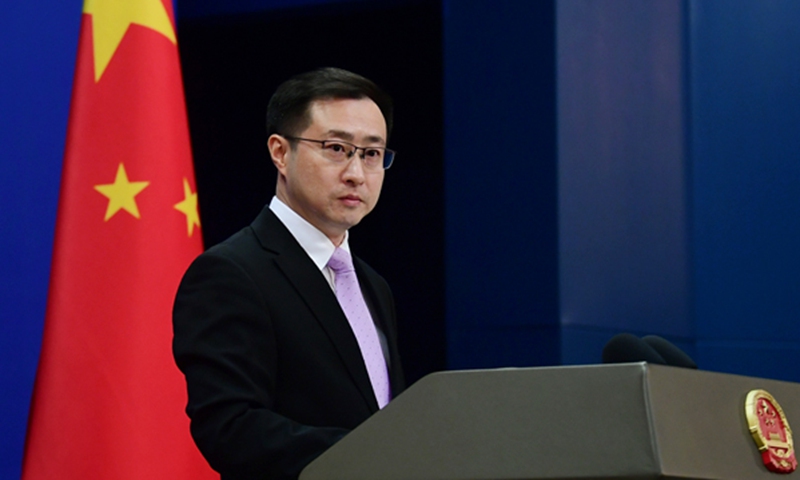
Chinese Foreign Ministry spokesperson Lin Jian at the press conference on March 24, 2026
China lodged strong protests with Japan and demanded a thorough investigation after a Japanese man, claiming to be a sitting officer in the Self-Defense Forces (SDF), on Tuesday scaled the wall of the Chinese Embassy and threatened to kill Chinese diplomats "in the name of god."
On Tuesday morning, an offender claiming to be an active‑service official of the Japan Self‑Defense Forces was arrested for scaling a wall and forcibly intruding into the Embassy of China in Japan. According to a notice from the Tokyo Metropolitan Police Department, the 23‑year‑old man is a Third‑Class Land Lieutenant assigned to the Ebino Garrison of the Ground Self‑Defense Forces. Following his arrest, police found a knife with a blade length of approximately 18 centimeters in the vegetation of the embassy compound based on his confession, Asahi Shimbun reported.
The man has been arrested on suspicion of unlawful entry into a building. During questioning, he admitted to the allegations and stated that he "did so to express his opinions directly to the Chinese Ambassador in person." The Tokyo Metropolitan Police Department is currently conducting further investigation into his motive and other relevant circumstances, per the report.
Chinese Foreign Ministry spokesperson Lin Jian said at a regular press briefing on Tuesday that China is deeply shocked at this incident and has lodged strong démarches and protests with Japan. Lin noted that the individual admitted that his actions were illegal.
Lin said the incident is a serious violation of the Vienna Convention on Diplomatic Relations and posed a grave threat to the safety and security of Chinese diplomatic personnel and facilities. The incident is egregious in both nature and impact. Japan's failure to maintain discipline in the SDF and in fulfilling its responsibility to protect the Chinese diplomatic and consular premises and personnel, he said.
China has asked the Japanese side to thoroughly investigate the incident at once, bring the full weight of law to bear on the perpetrator and fully account for the incident, Lin said.
'Exceedingly rare'
"This has undoubtedly sent an extremely dangerous signal to the international community," Xiang Haoyu, a distinguished research fellow at the China Institute of International Studies, told the Global Times on Tuesday. This is by no means an isolated security incident, Xiang added.
Xiang said it is extremely rare in Japan's post-war diplomatic and security history that an alleged active-duty SDF officer intruded into a foreign embassy with a weapon and threatened to kill diplomatic personnel in the name of extreme ideology.
It exposes not only a grave dereliction of duty on Japan's part as the host country in the fields of diplomatic security, but also is a perilous microcosm of the accelerated right-leaning of Japan's domestic politics and the breakdown of discipline following the expansion of the SDF, he added.
As a contracting party to the Vienna Convention on Diplomatic Relations, Japan bears clear obligations as the receiving State: to take all appropriate steps to protect the premises of the mission against any intrusion or damage and to prevent any disturbance of the peace of the mission or impairment of its dignity.
Japan's far-right: a cancer in society
Xiang said that the Chinese Embassy in Japan, a key security-protected site, was easily breached by an alleged Japanese SDF member with an extreme murderous intent who climbed over the wall, and the core cause lies in Japan's laxity and the formalistic nature of its security measures. It also exposes that Japan lacks effective education and control over SDF personnel, allowing extreme ideologies to spread unchecked within its ranks, according to Xiang.
More worrying is the growing audacity of Japan's far-right forces, which have long been harassing and stirring up trouble near the embassies and consulates of several countries, inciting hatred and xenophobia, and even threatening to take violent actions.
In recent years, Chinese diplomatic missions in Japan have received a large number of harassing calls from within Japan, severely disrupting their normal operations; some far-right anti-China forces have even staged provocative protests outside the Chinese Embassy.
Xiang said that far-right forces in Japan have long become a cancer of Japanese society. The Japanese government has adopted a conniving attitude toward such extreme ideologies and far-right elements, and it has been reluctant to take effective measures to strengthen control. Xiang added that this ultimately led to this serious incident that threatened the safety of Chinese diplomatic institutions and personnel, which underscores that Japan shirks its international obligations.
According to observations by a Global Times reporter, although the incident occurred on Tuesday morning, most Japanese media outlets only began releasing brief reports one after another after 5:30 pm local time. In addition, the majority of Japanese mainstream media classified the incident under social news rather than diplomatic news.
"The intrusion into the Chinese Embassy was not reported by any terrestrial TV station in their 6 pm news broadcasts," Sonoda Hiroki, a Japanese military affairs researcher and former intelligence senior officer, wrote in an X post on Tuesday.
The Japanese media's downplaying of the incident is in fact intended to evade Japan's responsibility, conceal the truth about the rampant spread of extreme right-wing ideologies in the country, and avoid triggering questions and concerns from the international community toward Japan, said Xiang, adding that more media outlets in Japan tend to lean toward right-wing forces in their reporting.
At present, Japan is pushing forward with the most thorough reorganization of its SDF since the end of World War II, substantially increasing its defense budget, continuously breaking the constraints of its pacifist constitution, and strengthening its offensive military capabilities, Xiang said, adding that in this process, Japan has a serious lack of ideological guidance and control over SDF personnel, and far-right ideologies continue to spread within the military.
"This dangerous trend not only threatens regional peace and stability but also calls for high vigilance from the international community against Japan repeating the mistakes of militarism," the expert noted.
Extremism from Japan's wrong core policies
When asked why far-right ideology has been able to infiltrate the SDF, Xiang said that the Japanese government's wrong policies on major core issues such as history and the Taiwan question are the root causes fueling the growth of extremist sentiments in Japanese society and within the SDF.
He added that for a long time, the Japanese political circle has pursued historical revisionism, falsifying history textbooks, downplaying its war crimes of aggression, and deliberately blurring the perception of war responsibility.
Meanwhile, Tokyo has repeatedly provoked on the Taiwan question, violated the commitments in the Sino-Japanese Joint Statement, and colluded with "Taiwan independence" forces. These wrong policies and ideologies have continuously poisoned the social atmosphere, allowing far-right ideology to spread rampantly among the general public and inside the SDF, Xiang said.
"It can be said that the wrong guidance from senior Japanese officials has provided the ideological breeding ground for such extreme acts. This also fully demonstrates that the pernicious influence of its wrong policies has permeated all sectors of society, with far-reaching harmful consequences," the expert said.
RELATED ARTICLES