ARTS / CULTURE & LEISURE
Reshaping, not replacing: AI will bring new prosperity to film and TV industry
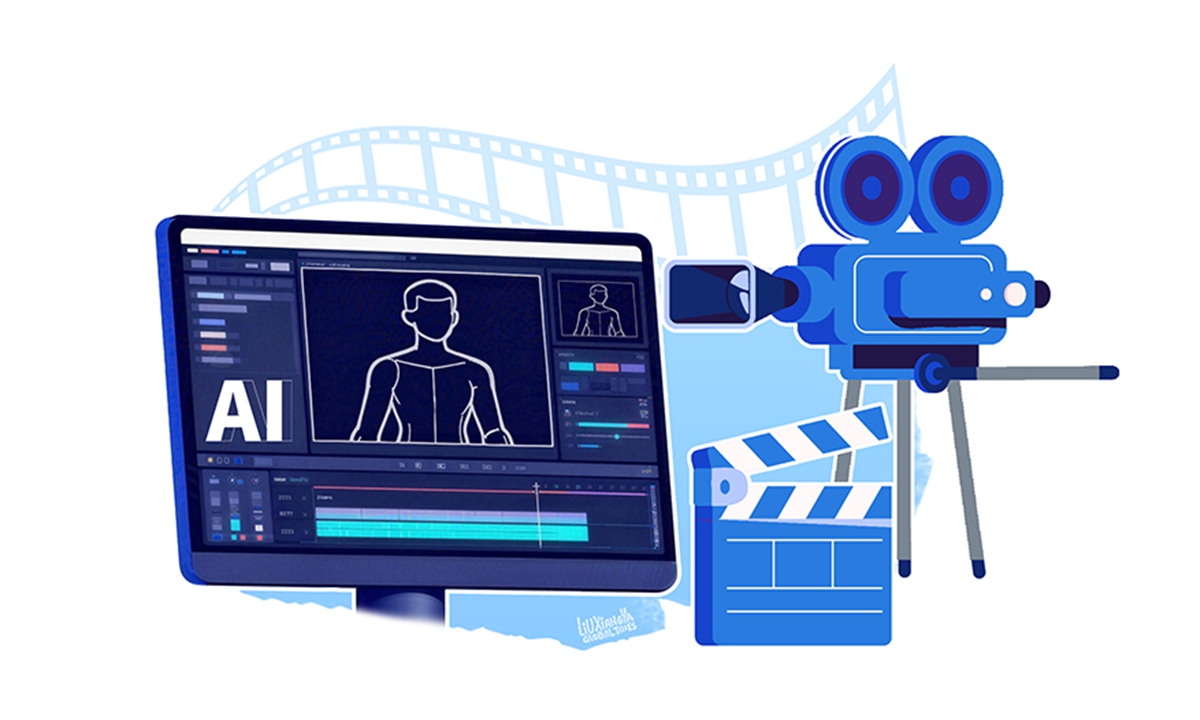
Illustration: Liu Xiangya/GT
AIGC (artificial intelligence generated content) technology has become a hot topic as it advances and starts to generate film and television content. This has caused waves of anxiety in the traditional film and TV industry. Some fear that AI films will overturn traditional films, while others worry that AI actors will completely replace real actors. At the same time, AI-generated films are also sparking controversy over issues like copyright infringement.Film and TV works are not only about technology - they are a complex mix of technology, economics, society, and art. Throughout over a century of development, the industry has experienced waves of technological change, so what is happening today is not truly surprising. Instead of panicking, it might be wiser to open our minds to broader possibilities.
AI in film and TV will not replace traditional methods but will redefine their boundaries and forms. From a technological perspective, traditional filmmaking relies on "certainty." Every pixel, every step in the creative process, can be precisely controlled by artists. Today's AIGC approaches are still "probabilistic" - more like opening a mystery box. The same prompt can produce slightly different results each time, and creators do not have full certainty or control.
Economically, with AI, the marginal cost of generating new content is close to zero, which means that content supply will surge dramatically. In terms of social structure, both Hollywood's vertical system and the industrialized system of traditional film are being remodeled. Old power structures are dissolving, and new centers of power have not yet fully formed.
Artistically, the modeling and genre strategies that were once based on traditional archetypes have now been fully learned by AI and will be reorganized. The traditional sense of shared ritual - collective viewing and emotional resonance in the theater - may also gradually fade. However, no matter how stories might be generated by algorithms or how storytellers might change, the human need for stories and for new forms of narration will not disappear. So, AI may end outdated or rigid filmmaking, but it will not replace film as an art form.
Given current trends, it is true that AI performers might be a threat to real-life performers, but this "threat" is also a creative force. Whether it is virtual idols in the past or film companies signing contracts with AI performers today, these innovations push the acting industry to evolve. New technology brings cheaper costs and higher efficiency. Some more formulaic or stereotypical roles will be easily replicated by AI. Performers who see themselves as "expression makers" or "line readers" do face real risk of being replaced. But for those performers who bring value that AI cannot offer - real life experience, unique personal charm, true emotional connection with the audience, and spontaneous creative sparks - AI is not a threat. Instead, it highlights what makes these performers irreplaceable.
So, the true risk for actors is not about competing with AI, but turning themselves into "tools that can be copied by algorithms." Real job security lies in always asking: "What can I bring as an actor that AI will never be able to give?"
AI's copyright controversy is a natural result when technology meets legal and ethical boundaries. The solution lies in building a new framework for distributing rights and benefits. Whether in China or abroad, the massive data needed to train AI models usually consists of copyrighted works, and whether AI-generated content itself is eligible for copyright protection is also an open question. When AI crafts an actor's likeness, it might even lead to unfair competition. These are legal questions but are also tied to economic interests over digital assets.
What's needed is a lawful, clear mechanism for data training, a rethinking of fair use in copyright law, and new ways to share profits, helping the market for data licensing move from piecemeal trades to a more standardized, large-scale system.
In short, the impact of AI on the film and TV industry is not just another case of technology replacing human work, but a sweeping change that touches the roots of human storytelling and civilization.
Looking back at progress in storytelling - from oral myths to writing, from copies by hand to printing, and from live stage performances to the silver screen - every leap has been met with fears that the old would die out and that the new would bring chaos. But every time, it has led to cultural flourishing far greater than before.
So, rather than fearing replacement, we should embrace this reshaping. In this new leap of storytelling civilization, it is time to find our own new place.
The author is a screenwriter, director, and film critic. life@globaltimes.com.cn
RELATED ARTICLES