Getting to know China firsthand a lesson US officials desperately need to learn: Global Times editorial
Listen
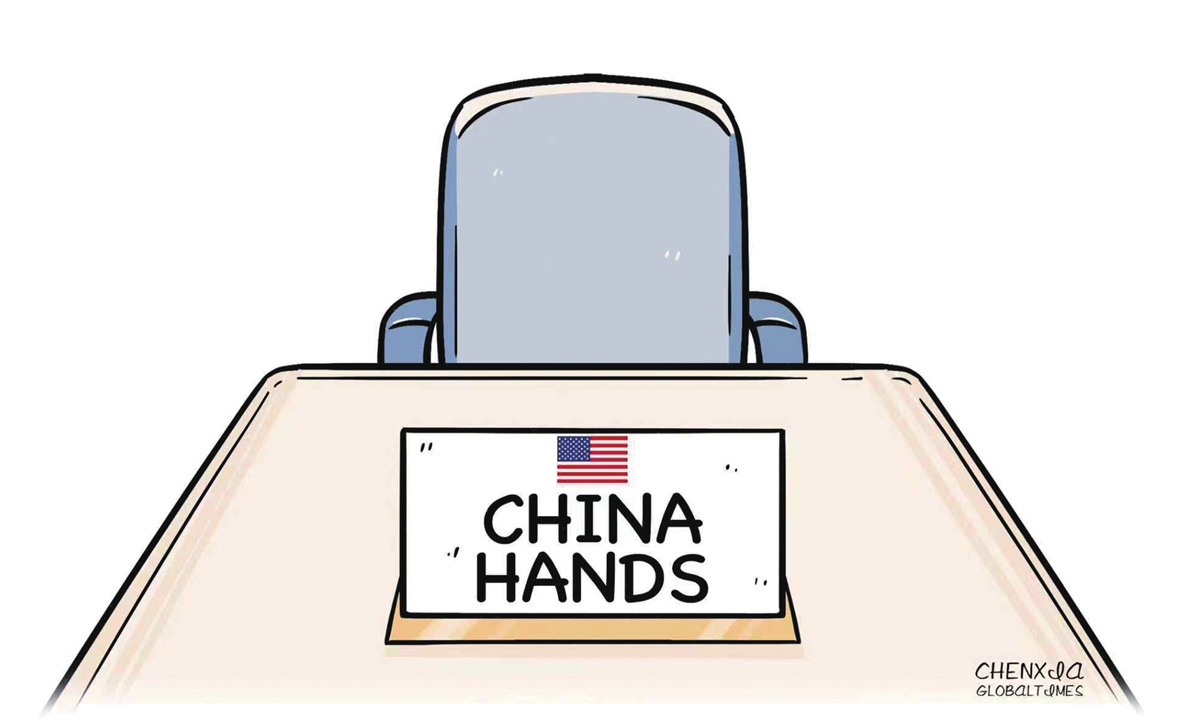
Illustration: Chen Xia/GT
Recently, The New York Times published an article titled "U.S. Leaders Need to See What's Happening in China," arguing that US policymakers should make regular travels to China. The article noted that "many US policymakers have never been to China" and that US policies "are based on stale assumptions, secondhand impressions and an incomplete understanding of what China is building." Although the discussion remains rooted in competition with China, the very fact that this viewpoint has been raised speaks volumes.
Almost simultaneously with the publication of this article, an in-depth research report titled "America's China Talent Challenge" was released in Washington. Written by "a group of top US experts," the report points out that the US is facing an unprecedented crisis of a talent gap in "China expertise," noting that "the United States is losing its bench of China expertise at a moment when it can least afford to."
Previously, an article in The Washington Post titled "Where have all the American China experts gone?" also highlighted the same issue, noting that this talent shortage has further exacerbated the problem of US policymakers "knowing nothing about China." How to objectively understand China has become a major issue that the US urgently needs to address.
People-to-people exchanges between China and the US, the world's most important bilateral relationship, have remained at a low level for many years, and the last time a US president visited China was nearly a decade ago. This is abnormal and should not be the case. The root cause of this situation lies in the increasingly toxic atmosphere toward China in Washington.
As The New York Times acknowledged, China has become "toxic" in Washington, and visiting there risked inviting a political backlash. "The political climate has also sharply curtailed the number of Americans going to China for tourism, study and scholarly exchange." Due to a lack of objective understanding and insight, most US politicians today tend to focus on ideology and political systems when talking about China, even blaming China for everything. This has influenced the judgment and implementation of many US policies toward China, causing the bilateral relations to encounter setbacks repeatedly.
This year marks a pivotal moment in China-US relations, as the relationship enters a new critical phase. A return to pragmatic and rational US policy toward China should serve as a crucial prerequisite for ensuring the long-term stability of bilateral relations; meanwhile, establishing a correct understanding of China is an essential foundation for avoiding misunderstandings and misjudgments.
US political culture is marked by a strong "Messiah complex." As a result, many US political elites believe there is little need to invest effort in cross-national political and cultural exchange, and that it is sufficient for other countries simply to understand and accept US institutions and ideas. This diplomatic "arrogance" has long accompanied the formulation of US foreign policy. US policymakers once found themselves caught in a vicious cycle of constantly asking, "Who lost China?" This is, in fact, a reflection of the US' lack of self-reflection and its difficulty in viewing China on equal terms.
The rigidity and insularity of US' decision-making culture further complicate the development of an accurate understanding of China. Domestic think tanks, lobbying groups, media, interest groups, and members of Congress often engage in heated disputes over major policy issues, creating the impression of a chaotic "policy marketplace." While there are some rational perspectives, genuinely objective and accurate views rarely translate into actual government decisions. In foreign policy, the paradox of being "clear-headed out of power but muddled in power," along with the reality that "mistakes are hard to correct and tend to multiply," is closely tied to this decision-making culture. Often described as a "monster that devours and assimilates dissent," this distorted system is also linked to entrenched biases among US politicians in their perceptions of China.
History has repeatedly shown that both China and the US stand to gain from cooperation and lose from confrontation. China has emphasized on many occasions that the issue of strategic perception is always fundamental to the China-US relationship, just like the first button of a shirt that must be put right. If that button is misaligned, all subsequent efforts will go astray. China's policy toward the US has remained consistent, stable, and predictable, emphasizing mutual respect, peaceful coexistence, and win-win cooperation, and serving as a steady and reliable force for improving bilateral relations. Washington needs to make greater efforts to discard its biases toward China, better understand China's realities, and recognize the long-term trajectory of China's economic and social development.
In fact, the business communities and civil organizations of China and the US have maintained close communication, and the people from both countries share a strong desire for mutual understanding and friendly interaction. Hopefully, US policymakers will spend more time visiting and observing China firsthand. Only when "seeing what's happening in China" becomes action rather than advice can US decision-makers shed arrogance, correct biases, and recalibrate their perceptions through direct engagement. Even if the US political system itself is difficult to change, such efforts would still inject valuable rationality into bilateral exchanges and make it possible for China-US relations to move toward a more stable and constructive direction. This concerns not only the interests of both countries, but also the broader international community's expectation that major powers share responsibilities.
RELATED ARTICLES