Armed intrusion and death threats – a dangerous act driven by Japan’s far-right extremism: People's Daily Rui Ping
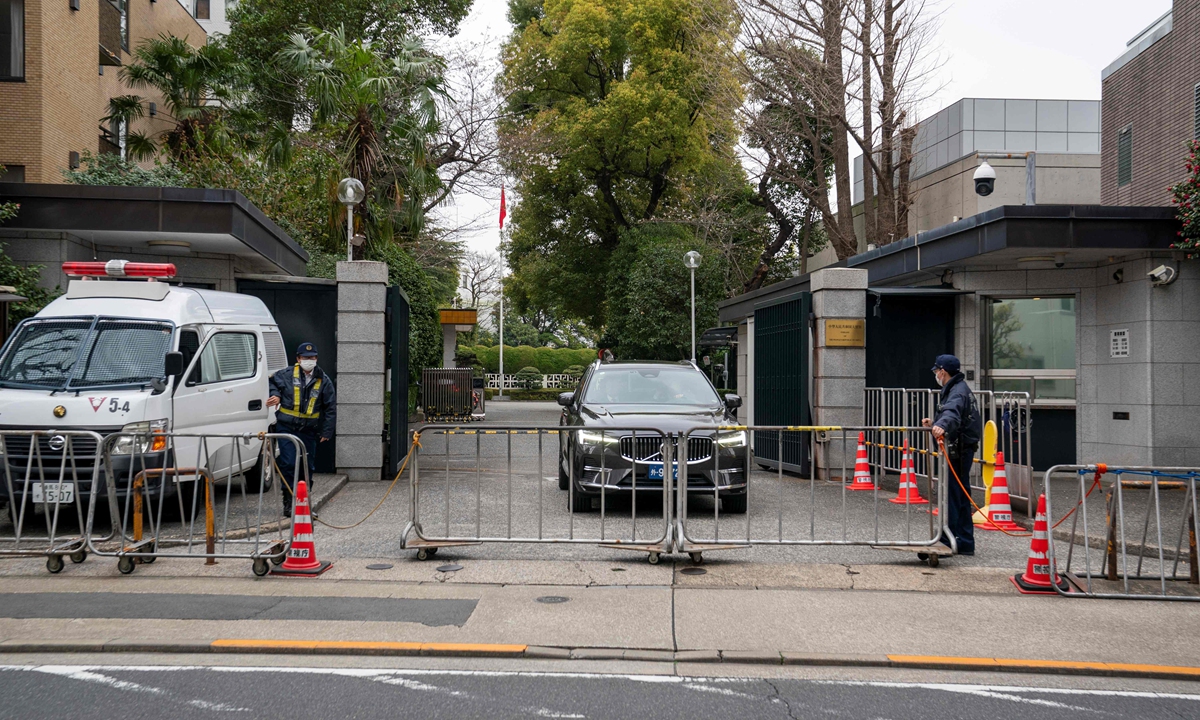
An entrance to the Chinese embassy is seen in Tokyo on March 25, 2026. A man was apprehended in Tokyo March 24 after he trespassed onto the grounds of the Chinese embassy in Tokyo. Photo: VCG
"Have you ever seen an individual who, armed with a knife, entered the embassy without permission to convey opinions to the ambassador?" This rhetorical question, posed by a Chinese Foreign Ministry spokesperson at a Wednesday press briefing in response to a question from Japanese media, stripped away the pretense of a so-called "remonstration with a blade" and exposed the egregious nature of what was, in fact, an illegal intrusion.On March 24, a sitting officer of Japan's Self-Defence Forces, scaled the wall and broke into the Chinese embassy with a knife with a 18-centimeter-long blade, threatening to kill Chinese diplomats. This is an extremely rare, incomprehensible, and deeply shocking incident. It is by no means an "isolated public security case," but rather an eruption of deeper pathologies tied to Japan's rightward political drift. The spread of far-right extremism and the lingering specter of militarism have not only permeated Japanese society but are increasingly translating from misguided ideology into dangerous actions.
Diplomatic security is clearly protected under international law, notably the Vienna Convention on Diplomatic Relations. As an active-duty member of Japan's Self-Defense Forces, the individual involved should have been subject to strict organizational discipline and fully aware of the consequences of such actions. The red lines are clear. Why, then, does the lawbreaker act with such impunity? How can Japan claim to be governed by the rule of law? How can it call itself a civilized society?
This incident tears apart the national image the Japanese government seeks to project. Safety, order, and rationality appear to have failed, while the underlying logic of militarism - provoking confrontation and embracing reckless adventurism - has been laid bare for the world to see.
Every action has its ideological roots. For years, the Japanese government has pursued misguided policies on core issues in China-Japan relations, such as historical interpretation and the Taiwan question. It has revised history textbooks, sparing no effort to downplay, beautify, or even deny its past aggression, while amplifying the so-called "China threat" narrative. Since the Sanae Takaichi administration assumed power, these tendencies have only intensified, with belligerent practices, military expansion, historical revisionism, high-profile pushes for constitutional revision, and even tentative exploration of securing "independent nuclear capabilities," all while stoking domestic extremist sentiment.
Such practices, which divert limited resources toward political ambition and military expansion, have fueled the spread of far-right ideology and the resurgence of militarism in Japan. In such a political and social environment, the erosion of rules and the rule of law, along with the rise in violent and extreme incidents, should come as no surprise.
The toxic influence of far-right extremism is pushing the Japanese society into a dangerous situation. Political polarization is intensifying, and extremist violence is becoming a persistent social ill. Incidents involving attacks from butsukari otoko or "bumping men," are occurring with alarming frequency, while public security continues to deteriorate. Meanwhile, the economy remains sluggish, innovation lacks momentum, infrastructure is aging, and public welfare is neglected. Rather than pursuing a path of sustainable development, the Japanese government appears increasingly absorbed in political maneuvering and military expansion.
If this trajectory continues, Japan risks becoming ever more deeply divided, ultimately suffering the consequences of the very forces it has unleashed and sinking into a quagmire of its own making. The reckless actions of far-right forces in Japan are not only self-destructive but also pose a serious threat to regional and global peace.
In modern history, Japanese militarism inflicted devastating suffering on the peoples of Asia, leaving nations shattered and countless lives destroyed. Today, with signs of "neo-militarism" on the rise and extremists emerging in greater numbers, the alarm bells of repeating past mistakes are ringing once again. History moves inexorably forward. Today's world is no longer the old era of colonial expansion. China and other Asian countries that once suffered will never permit past tragedies to be repeated, and the forces of justice in the international community will not stand idly by as "neo-militarism" gains momentum.
How this incident is handled will serve as a test for Japan. This year marks the 80th anniversary of the commencement of the Tokyo Trials, offering Japan yet another opportunity for reflection. Should the Japanese government persist in its course toward "neo-militarism," it will inevitably face firm resistance from the forces of justice worldwide - and the judgment of history once again.
This article was originally published by the Opinion Department of the People's Daily. opinion@globaltimes.com.cn
RELATED ARTICLES