Why has China remained stable amid soaring global oil prices?: People's Daily Rui Ping
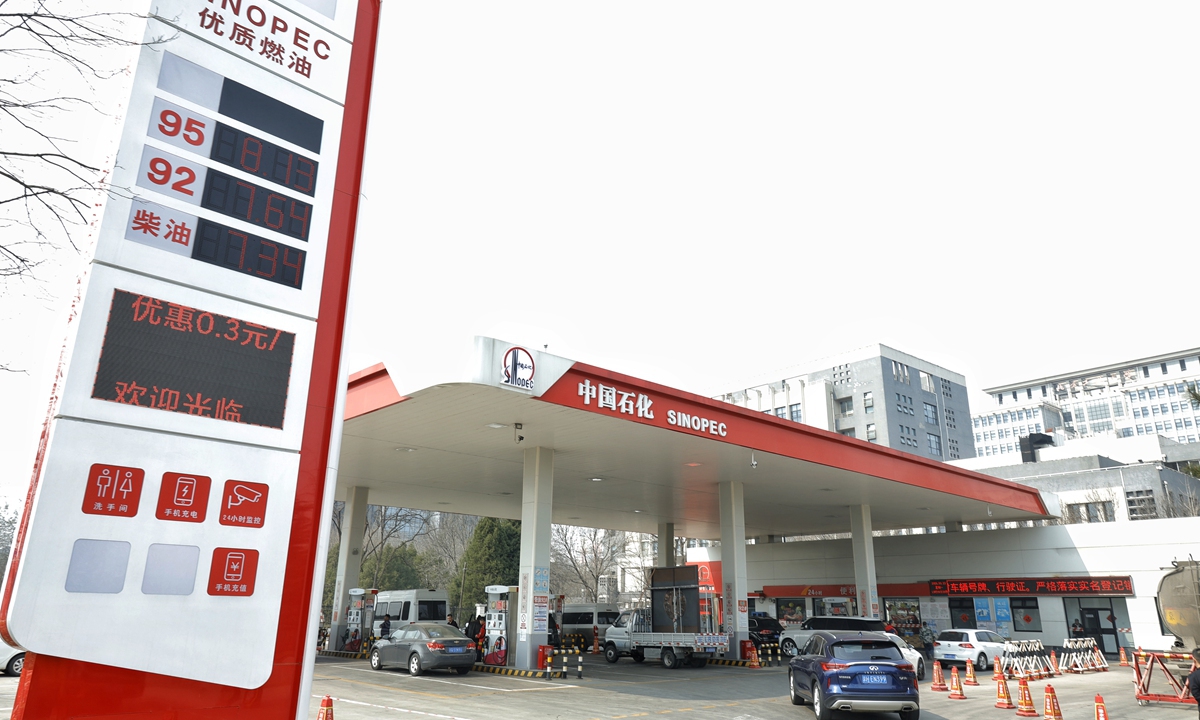
Car owners refuel at a gas station in Shijingshan district, Beijing on March 23, 2026, the day when the National Development and Reform Commission announced a temporary adjustment to refined oil prices. Photo: Li Hao/GT
In recent days, heightened tensions in the Middle East have driven a sharp surge in global oil prices, with impacts felt worldwide. How a country responds to soaring oil prices not only tests the resilience of its economic development but also reflects its value priorities in handling crises.China began to implement temporary regulatory measures on domestic refined oil prices at 24:00 on March 23. Based on the existing pricing mechanism, gasoline and diesel prices would have risen by 2,205 yuan (about $319) and 2,120 yuan per ton, respectively. Thanks to the regulation, the actual increases were 1,160 yuan and 1,115 yuan per ton - 1,045 yuan and 1,005 yuan less than what they would have been. For a 50-60 liter fuel tank, filling up with gasoline would cost 40-50 yuan less per tank, effectively easing the pressure of rising global oil prices on domestic consumers.
A cross-regional comparison makes this regulation even more striking. Currently, oil prices in many regions have risen by more than 40 percent, while in the Middle East they have surged to over $150 per barrel, with an increase exceeding 130 percent. Average gasoline prices in the US and Japan have been climbing for more than 20 consecutive days. As a major crude importer, with over 70 percent of its crude sourced from abroad, China faces severe external pressures. Yet it has managed to avoid dramatic domestic price swings in line with global markets, reducing the burden on consumers while ensuring stable economic and social operations. Behind this lies profound institutional strengths and a forward-looking energy strategy that underscore a people-centered value pursuit.
A well-developed refined oil pricing mechanism has served as a key buffer against global price shocks.
In simple terms, by setting a price control ceiling and floor, when international oil prices exceed $130 per barrel, China's domestic retail prices for gasoline and diesel are generally not raised or are raised only minimally; when international prices fall below $40, domestic prices are not reduced; and when prices fluctuate between $40 and $130, domestic prices adjust in line with global trends.
The price floor helps ensure a certain scale of domestic crude oil production capacity, safeguarding the bottom line of national energy security, while the price ceiling takes into account the interests of both enterprises and consumers, maintaining the stable operation of the national economy. This pricing mechanism represents the coordinated interplay of the "visible hand" and the "invisible hand," creating an effective buffer between the international and domestic markets. It is akin to installing the most stable "damper" on a skyscraper, preventing violent swings caused by storms and protecting everyone inside.
From a broader perspective, this reflects strategic clarity in securing energy supplies and proactive planning for energy security.
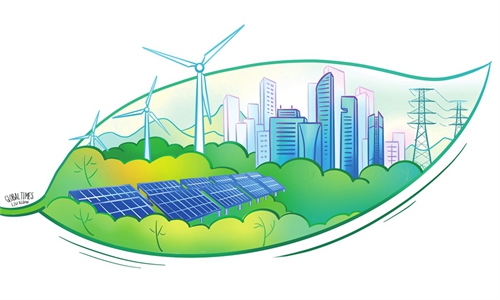
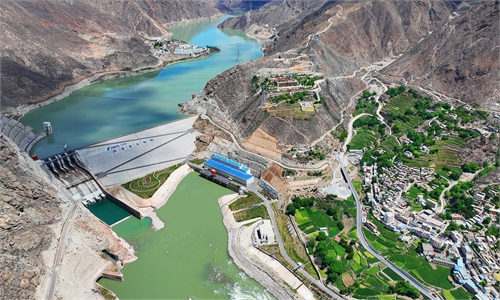
From building a diversified energy import structure to reduce reliance on any single source, to steadily advancing the robust development of green energy sources such as solar, wind and hydropower - thereby creating a resilient, multi-energy complementary system with strong risk resistance - and constructing the world's largest and technologically advanced power grid, where "the end of electricity lies in China," this series of forward-looking plans form a solid cornerstone of energy security, giving China the confidence and capacity to withstand shocks and maintain overall stability.
This confidence extends far beyond the energy sector, manifesting across all aspects of national governance.
From strictly upholding the red line of farmland protection and continuously improving the grain reserve system to always keeping food security at the forefront; to refining price regulation mechanisms for essential consumer goods and firmly safeguarding the public's "vegetable basket" and "fruit plate" - it is precisely by daring to seize the initiative and taking proactive measures, focusing on the present while planning for the long term, that China in the new era has maintained steady economic performance and ensured strong livelihood security amid global turbulence.
Despite uncertainties and risks in the external environment, there is a deep sense of confidence and stability within. Looking ahead, with the support of our Party and country, the strength of institutional advantages, and the joint efforts of hundreds of millions of people, there are no challenges that cannot be overcome.
This article was originally published by the Opinion Department of the People's Daily. opinion@globaltimes.com.cn
RELATED ARTICLES