China-UK economic, trade cooperation should not be subjected to attacks through over-politicization: FM on UK’s rejection of Chinese firm’s proposed investment
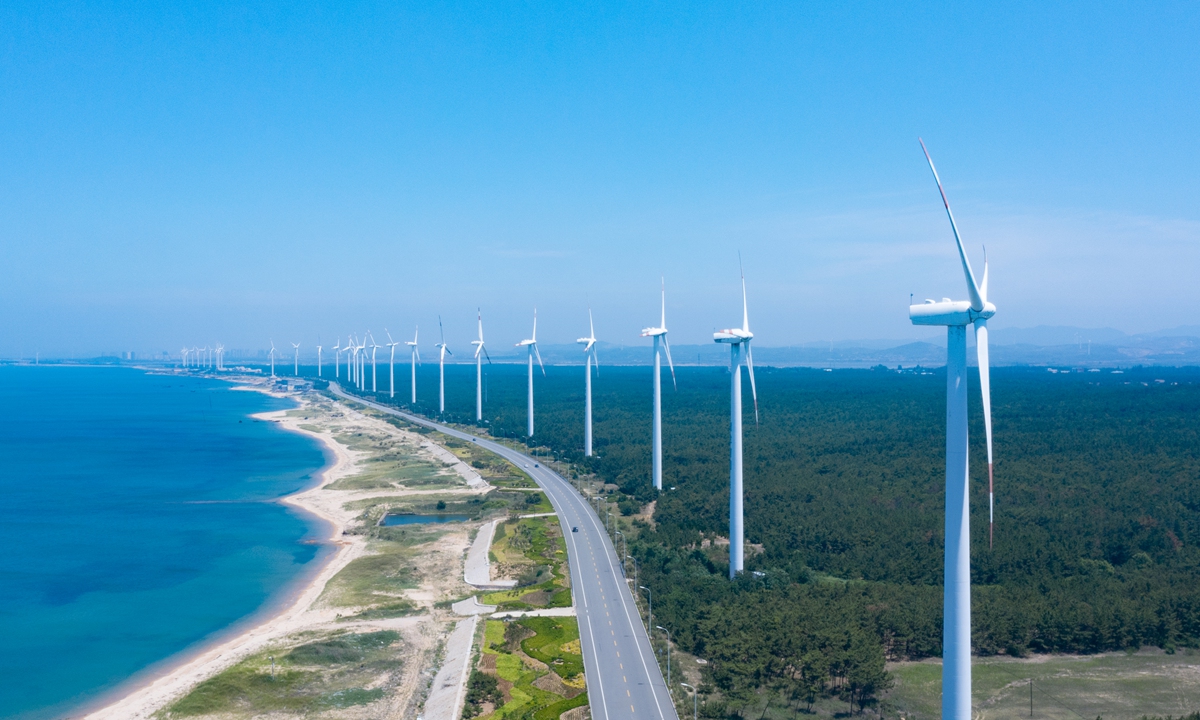
Wind turbines File photo: VCG
A Chinese Foreign Ministry spokesperson on Thursday urged the UK to provide a fair, just and non-discriminatory business and investment environment for companies from all countries, including Chinese companies.
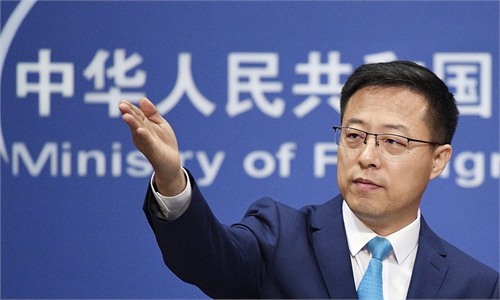
Spokesperson Lin Jian made the remarks in response to reports that the UK had blocked plans by Ming Yang Smart Energy to build a wind turbine factory in Scotland, based on national security grounds.
"China-UK economic, trade and green cooperation is in nature mutually beneficial. Such cooperation should not be viewed as political or security issues," Lin noted.
According to the Financial Times, the UK government claimed on Wednesday that Chinese turbine producer Ming Yang's products posed a national security risk, and said that it could not support their use in UK offshore wind projects.
Ming Yang announced in October 2025 that it planned to build the UK's first full industry chain integrated wind turbine manufacturing base in Scotland. The total investment for this project was expected to be 1.5 billion pounds ($1.99 billion), which would be used to construct manufacturing facilities for offshore and floating wind turbines, it said on its official website.
The Financial Times reported that the UK government said that after "careful consideration" it could not support the use of Ming Yang's turbines "in UK offshore wind projects." One person familiar with the matter claimed that the government had concluded there were "national security risks" associated with Ming Yang.
Regarding the case, Kate Forbes, Scotland's deputy first minister, said: "National security is obviously important and must be respected, but it is regrettable the UK government has failed to explain precisely what the problem is with Ming Yang," the Financial Times reported.
A spokesperson from the Chinese company told BBC Scotland News: "We are disappointed by the UK government's decision not to allow Ming Yang's world-leading technology to be used." The person said that the decision missed a "significant opportunity" to increase competition in the wind turbine market and the creation of up to 1,500 jobs.
The UK's move came after British Prime Minister Keir Starmer visited China in January, the first visit to China by a UK prime minister in eight years. During the visit, the two sides signed multiple cooperation documents covering areas such as the economy, trade, agriculture, food and education.
"Although no substantial security risks have been identified in Chinese wind power equipment to date, the UK government has still rejected the Chinese company's investment plan. This essentially reflects a typical manifestation of its tendency to securitize and politicize trade and economic issues," Jian Junbo, director of the Center for China-Europe Relations at Fudan University's Institute of International Studies, told the Global Times on Thursday.
Jian noted that the UK government's latest move was inconsistent with the positive atmosphere and cooperative intentions of China-UK economic and trade cooperation following Starmer's visit to China, and urged the UK to adopt a pragmatic attitude toward China.
Jian added that the latest restriction not only risks directly hindering Chinese companies from making normal investments and establishing factories in the UK, but will also impose practical constraints on the local green energy transition.
"While promoting the development of solar and wind power and other green initiatives, the country still requires substantial support from relevant equipment and production capacity. Overly restricting the participation of Chinese enterprises will undoubtedly increase the costs and difficulties of its own green transformation," the expert added.
The China Chamber of Commerce to the EU (CCCEU) said on Thursday that "We are highly concerned by reports that this investment project in the UK was restricted."
Chinese companies have long made positive contributions to local economic development, job creation, and the green transition in Europe, including the UK. Investment projects should be evaluated on objective criteria within a fair, transparent, and non-discriminatory market environment, the CCCEU said.
"While we respect legitimate national security concerns, the case in question suggests a clear political dimension in decision-making. A decision driven more by political considerations than solid evidence, and carried out with limited transparency or communication, increases uncertainty for investors and may undermine Chinese companies' long-term confidence in the European market," the CCCEU noted.
The CCCEU called on all relevant parties to uphold openness, fairness, transparency, and non-discrimination, and to provide a stable and predictable business environment for all market participants. "We will continue to follow developments closely and support companies in protecting their legitimate interests through appropriate channels," it said.
RELATED ARTICLES