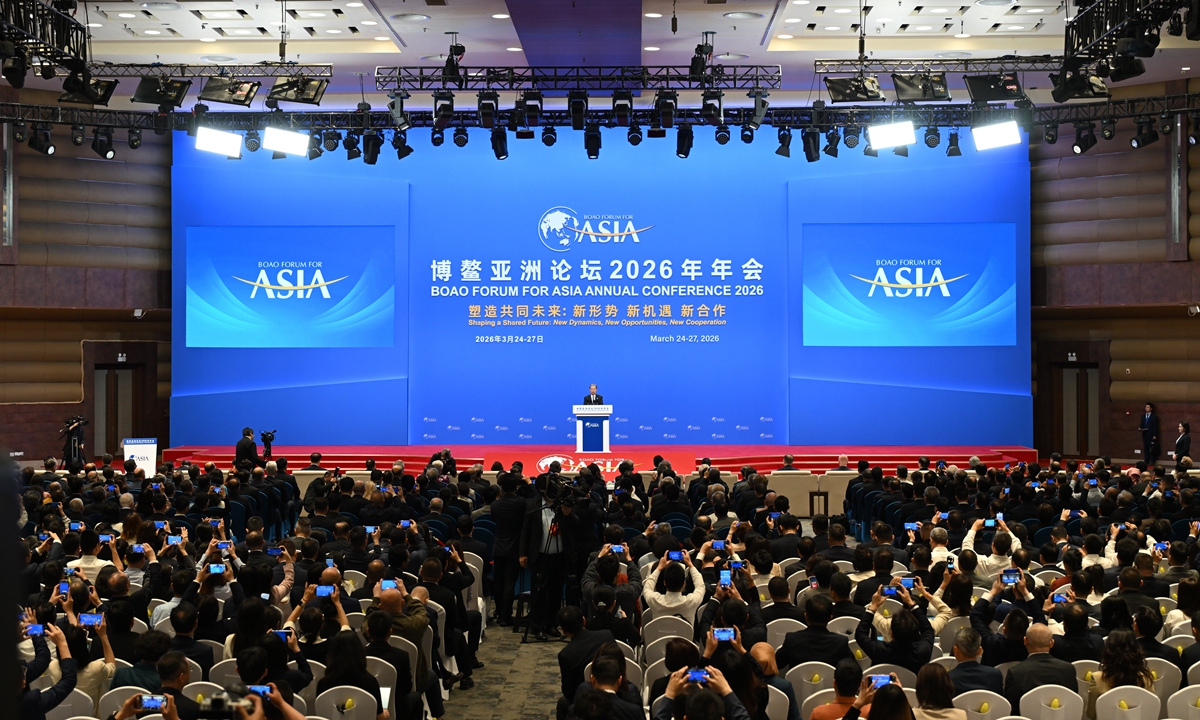
The Boao Forum for Asia Annual Conference 2026 holds a plenary session on March 26, 2026 in Boao, South China's Hainan Province. Photo: cnsphoto
As words like "war," "missiles," "airstrikes" and "turbulence" dominate global headlines, a strikingly different list of keywords is being read in South China's Hainan Province.
In the balmy, manicured resort town of Boao, delegates gathering for the Boao Forum for Asia (BFA) Annual Conference 2026 have traded the vocabulary of war for a synchronized chorus of "cooperation," "openness," and "innovation" - a carefully orchestrated attempt to project regional stability and pitch a shared economic future amid turbulence.
Themed "Shaping a Shared Future: New Dynamics, New Opportunities, New Cooperation," the BFA Annual Conference held a plenary session on Thursday, according to Xinhua News Agency.
Zhao Leji, chairman of the National People's Congress Standing Committee, attended the Thursday plenary and delivered a keynote speech. Noting that this year marks the 25th anniversary of the BFA, Zhao said the forum has become a prestigious platform for promoting exchanges, collaboration and common development among Asian nations and the wider world, Xinhua reported.
In today's world, geopolitical conflicts and regional wars keep emerging, unilateralism and protectionism become rampant, hegemonism and power politics are posing greater threats, and the outdated mindsets of civilizational estrangement and block-based confrontation are resurfacing, Zhao said.
In this context, people of all countries share a more urgent aspiration for peace and development, and a stronger call for fairness and justice. History has and will continue to show that, only solidarity can generate strength and only cooperation can bring win-win results. Only by forging ahead with concerted efforts can humanity address global risks and challenges to create a better future, he said, per Xinhua.
Zhao called for working together for a better Asian home and the building of a community with a shared future for humanity.
Leaders from major Asian economies echoed the call for stronger regional coordination and collective responses to shared challenges. South Korean Prime Minister Kim Min-seok, in a virtual keynote speech, stressed the need for not only South Korea and China, but all countries in Asia to come together in the face of uncertainty and challenges stemming from regional wars, as well as technological innovation, supply chain restructuring and demographic changes, Yonhap News Agency reported.
Singaporean Prime Minister Lawrence Wong also stressed during his speech the need to firmly support an open and rules-based trading system in an increasingly fragmented world, according to China News Service. He expressed confidence that China can play a greater role in promoting regional prosperity and stability.
"China will play a critical role - given its growing economic weight and increasing capacity to shape global outcomes," Wong said, as quoted by Bloomberg. He also emphasized that deeper ASEAN-China cooperation holds significant potential to further strengthen economic ties, and pledged to further enhance bilateral economic links.
Founded in 2001, the BFA is a non-governmental, non-profit international organization dedicated to promoting regional economic integration. This year's conference has attracted more than 1,600 representatives from over 60 countries and regions, including political leaders, business executives, scholars and media professionals, according to Xinhua.
As the first BFA annual conference held at the start of the 15th Five-Year Plan period (2026-30) and following the launch of special customs operations at the Hainan Free Trade Port, the convening of the forum itself sends a positive signal to a turbulent world, Su Jian, a professor at Peking University's School of Economics and director of its National Center for Economic Research.
The forum's emphasis on openness, cooperation, multilateralism and innovation-driven development aligns closely with global development needs, Su told the Global Times on Thursday.
Mohd Faiz Abdullah, executive chairman of Malaysia's Institute of Strategic and International Studies, said in an on-site interview with the Global Times on Thursday that sustained growth and shared prosperity depend on "as many as possible working together on a common platform," underscoring the need for stronger multilateral cooperation.
Abdullah added that in a global environment marked by fragmentation and risk, the key challenge is how prosperity can be "sustained, shared and anchored" at regional and global levels, with closer China-ASEAN integration seen as essential.
According to a flagship report released at the forum on Tuesday, Asia remains a key engine of global growth, with its share of global GDP expected to rise from 49.2 percent in 2025 to 49.7 percent in 2026 on a purchasing power parity basis.
Michele Geraci, former undersecretary of state at Italy's Ministry of Economic Development, told the Global Times at the forum that Asia's diversity of economies - ranging from large manufacturing hubs to smaller service-oriented states - makes cooperation not only necessary but mutually beneficial.
He said countries need to "find a way to balance the skills of each other," while China's industrial capacity and economic scale help create a "win for both" by linking regional production and enabling shared development opportunities.
Anchoring global stability
As a key driver of regional development, China is turning its commitment to openness and cooperation into concrete actions, analysts said. In recent weeks, the world's second-largest economy has hosted a series of major international events - including the Boao Forum for Asia, the China Development Forum and the Zhongguancun Forum - further reinforcing its role as a platform for global dialogue.
Earlier this month, China adopted the outline of the 15th Five-Year Plan for economic and social development, pledging to expand high-standard opening-up. Meanwhile, the Hainan Free Trade Port has entered a new stage following the launch of island-wide customs closure operations in December 2025, creating fresh opportunities for global investors.
South Korean PM Kim Min-seok also said that China is pursuing a high degree of opening up to the outside world and creating cooperation hubs in the form of industrial cooperation complexes in many places. He added, "South Korea aims to actively utilize such platforms where global companies combine with capital and technology to flesh out industrial, technological and investment cooperation with China, and produce tangible results," according to Yonhap.
Singapore PM Lawrence Wong highlighted China's growing role in emerging sectors, noting that the country has placed innovation at the core of its development strategy and is advancing rapidly in fields such as digital and green technologies. China will not only participate in the next wave of technological transformation, but also help drive it, he said, as quoted by China News Service.
China's sustained economic growth has also underpinned its global role. During the 14th Five-Year Plan period, China maintained an average annual growth rate of 5.4 percent and contributed around 30 percent to global economic growth, remaining a key engine of the world economy.
Su stressed that China's global initiatives and efforts such as upgrading the China-ASEAN Free Trade Area and deepening regional ties provide clearer frameworks for cooperation, offering much-needed stability and predictability in today's uncertain world.
Achim Steiner, former administrator of the United Nations Development Programme, told the Global Times that China's role is increasingly important amid global disruptions. He noted that many countries welcome China's "unequivocal commitment to multilateralism, to an international rule of law, and to norms and standards" that sustain global cooperation.
Steiner added that China's steady commitment to multilateralism and to sustaining the functioning of the international system offers a stabilizing force at a time of growing uncertainty — just as he put it, a "clarion call at a very disturbed moment."
RELATED ARTICLES