How strong is China’s macro policy? The facts speak for themselves!
Be alert to these misinterpretations of China’s economy
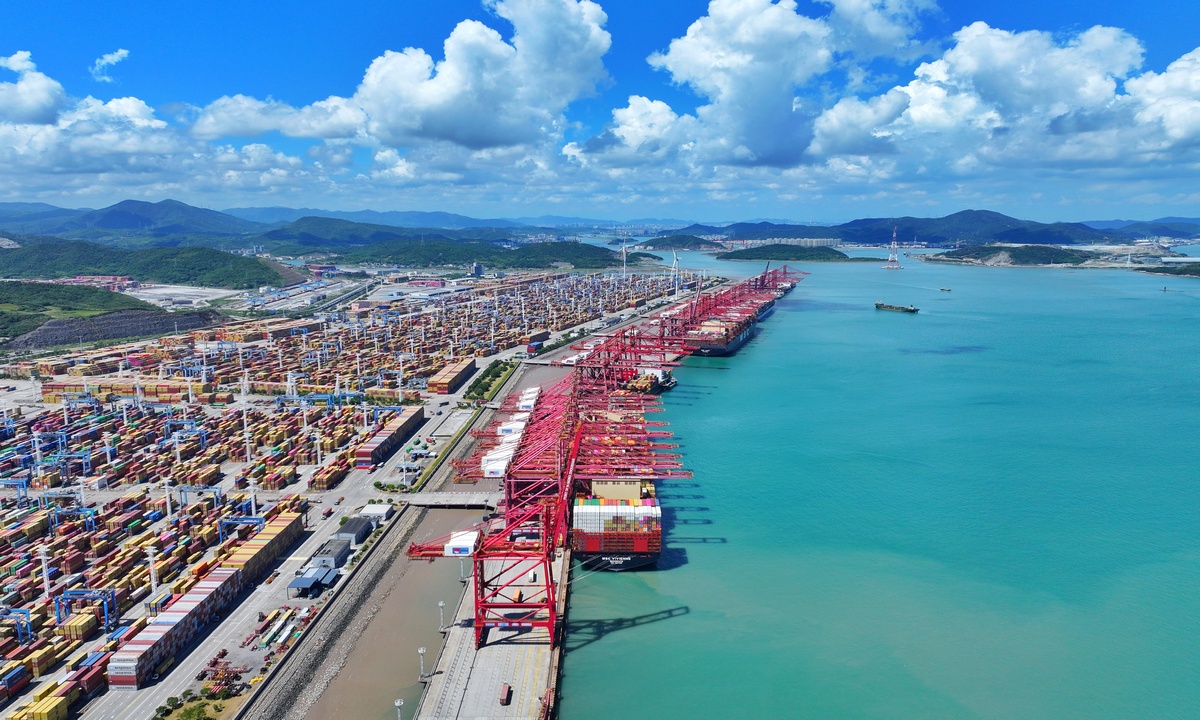
An aerial view of the Chuanshan port area of Ningbo-Zhoushan Port in East China's Zhejiang Province, on January 5, 2026. Photo: Courtesy of Ningbo-Zhoushan Port Group Co
This year's Government Work Report sends a clear signal: China will implement more proactive and effective macro policies. On the fiscal front, general public budget expenditure will reach 30 trillion yuan ($4.34 trillion) for the first time, an increase of about 1.27 trillion yuan from the previous year. On the monetary side, tools such as reserve requirement ratio cuts and interest rate reductions will be deployed in a flexible and efficient manner to maintain ample liquidity…
Despite such a clear policy orientation, some foreign media outlets have offered "contrarian" interpretations, arguing that the policy stance falls short of market expectations and even suggesting that China's macro regulation is turning more conservative.
Do these interpretations reflect a genuine misunderstanding of China's economy - or a deliberate distortion of it?
Compared with the broad-based stimulus measures - often described as "flood irrigation" stimulus - once favored by some countries, China in recent years has placed greater emphasis on combining counter-cyclical and cross-cyclical adjustments. This approach enhances macroeconomic governance by directing policy support to key areas, making it more targeted and sustainable. In this sense, using the scale of liquidity injection as the sole yardstick to measure China's policy strength is itself a flawed metric.
A closer look at the "blueprint" of China's macro policies reveals both their strength and precision in execution.
Addressing policy bottlenecks through institutional innovation
Effective macro regulation is not just about having funds to spend, but about ensuring they are spent efficiently. In recent years, a series of fiscal management reforms have been advanced to improve the efficiency of fund utilization through institutional innovation. For example, some localities have introduced performance-based elimination mechanisms, cutting nearly 1,000 projects over the past two years and saving tens of billions of yuan. Meanwhile, certain departments have implemented zero-based budgeting reforms, eliminating overlapping and redundant projects to address rigid spending patterns and inefficiencies at the source. These reforms will continue to deepen this year, allowing the same fiscal and financial resources to generate greater policy dividends.
Enhancing policy effectiveness through systemic coordination
The effectiveness of macro policies depends largely on the degree of coordination among different policy tools, rather than simply introducing more measures. In recent years, China has placed greater emphasis on synergy among fiscal, financial, industrial and employment policies. For instance, the central government has allocated 100 billion yuan this year to roll out a package of six coordinated fiscal-financial measures aimed at boosting domestic demand and addressing the imbalance of strong supply and weak demand. At the same time, coordinated fiscal and financial policies are guiding more social capital toward supporting enterprise upgrading and higher-quality development. When policies work in concert, their impact surpasses the sum of individual measures.
Improving policy precision through structural optimization
Policy measures should not only be forceful, but also well-targeted and focused. China's macro policies increasingly channel resources toward the most critical areas. Fiscal spending is tilted toward scientific and technological innovation and public well-being; financial tools focus on expanding domestic demand, supporting innovation, and aiding small and micro enterprises; and capital market reforms continue to enhance support for high-quality tech firms…Centered on building a modern industrial system, these coordinated policies both upgrade traditional industries and foster emerging ones, while also laying out forward-looking plans for future industries. Such targeted measures carry far greater long-term significance than indiscriminate stimulus.
Regardless of how complex and evolving the external environment may be, China's macro policy framework remains anchored in the principle of pursuing progress while maintaining stability and adhering to economic laws. While ensuring the continuity and stability of fiscal, monetary and other macroeconomic policies, adjustments will be made in a timely and appropriate manner to the intensity and direction of policies in light of evolving conditions. Such policy calibration reflects long-term and strategic considerations, rather than short-term or narrow interests.
By contrast, some Western countries show a clear tendency toward short-termism in macroeconomic policymaking. Policy continuity is often disrupted by electoral cycles, with new administrations frequently overturning the previous government's economic policies, resulting in repeated policy reversals. In comparison, China's macroeconomic policies are not swayed by any special interest groups, making them both credible and reliable, and providing the market with a strong sense of confidence.
China's economy is committed to pursuing progress while maintaining stability, improving quality and efficiency, and pushing forward with innovation-led and high-quality development. In 2025, China's GDP surpassed 140 trillion yuan, reaching a new level. Innovation achievements and major breakthroughs have drawn global attention, development momentum has strengthened, and public well-being has steadily improved. The country's "four major advantages" have been fully leveraged to effectively respond to risks and challenges from multiple fronts. China's strong coordination in the formulation and implementation of major policies enables different measures to quickly form a unified force, ensuring smooth transmission across all levels and effective execution, and thereby firmly stabilizing the economic fundamentals in a complex environment.
Last year's Central Economic Work Conference emphasized that it is necessary to continue to pursue both policy support and reform and innovation. Strengthened macro regulation is reflected not only in increased funding, but also in the deepening of reforms and continuous institutional innovation. The combination of increased investment, deepened reforms, and coordinated policy implementation generates a multiplier effect, reflecting the sophistication of macroeconomic regulation.
Looking back, the repeated claims by some foreign media that policy measures have fallen short of expectations or that more forceful stimulus is still needed may, to some extent, aim to disrupt market expectations and undermine confidence. However, China's economic achievements have never relied on short-term stimulus, nor will its future be driven by temporary policy boosts. For an economy exceeding 140 trillion yuan in scale, what truly matters is consistency, stability, and sustainability.
The greater the challenges, the more evident China's resilience and strategic resolve. With macro policies increasingly focused on quality and resilience, China's economy will continue to move forward steadily amid a complex and evolving global environment.
This was compiled based on an article published in the "Chisu Jinsheng" economic commentary column of People's Daily on March 26, 2026.
RELATED ARTICLES