Former Italian official says he has been urging Italian, EU leaders to be ‘more diplomatic, less aggressive’ toward China and recognize a multipolar world
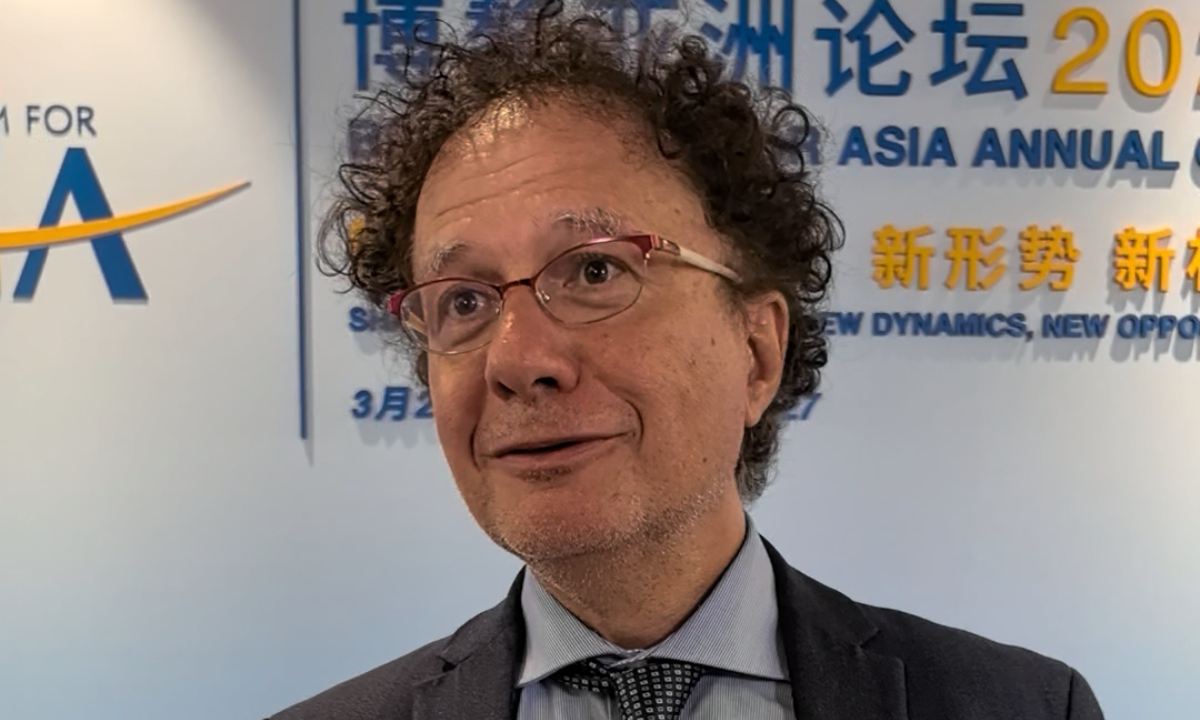
Michele Geraci, former Italian undersecretary of state and adjunct professor at NYU Shanghai, speaks in an interview with the Global Times on March 26, 2026, during the Boao Forum for Asia in South China’s Hainan Province. Photo: Zhang Yiyi/GT
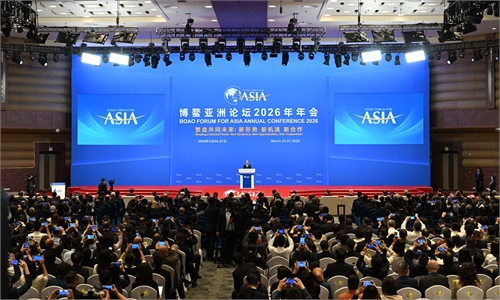
At the Boao Forum for Asia, an Italian economist and former undersecretary at Italy’s Ministry of Economic Development told the Global Times that he has been in frequent contact with Italian officials, urging both Italian and EU leaders to take a “more diplomatic, less aggressive” approach toward China and recognize that “the world is moving to this new multipolar world.”
Michele Geraci, former Italian undersecretary of state and NYU Shanghai adjunct professor, told the Global Times in an exclusive interview on Thursday during the Boao Forum for Asia Annual Conference 2026 in South China’s Hainan Province.
When asked by Global Times about his recent message to Italian Prime Minister Giorgia Meloni as media reported, in which according to reports, he urged her to open the eyes to better understand China.
Geraci said that, in fact, the message goes beyond a single text. “For the last several weeks and months, I’ve actually tried to make her and the Italian government understand a few things about China that they may not see from Rome,” he said.
“One is that the trade deficit does not matter.” He noted that Italian officials are overly focused on the trade imbalance with China, recalling that he had told them face to face: “do not worry about it. We need to buy things from China. It’s not that if you have a trade deficit, you lose; if you have a trade surplus, you win.”
Geraci said that the content of the text message he sent recently was consistent with this view. “The content was what I said—yes, that the trade deficit does not matter, and also an invitation to European Union leaders to look at China in a more diplomatic way, less aggressive with China, and to recognize that the world is moving to this new multipolar world. So we need to do this.”
“I also sent another text message to the vice prime minister of Italy, telling that we need to improve our foreign policy toward China, to make it more constructive, less aggressive, less anti-China.”
When Geraci emphasized “more constructive, less aggressive, less anti-China,” pausing on each word, he gestured firmly with his hands, his expression tightened, underscoring his determination and seriousness, the Global Times observed.
More broadly, Geraci argued that misunderstandings about China in Europe stem partly from political incentives. “Many European and Italian politicians have a short-term interest to create an ‘imaginary monster’ that they can fight against,” he said. “It doesn’t matter if it’s real or not… they need to have a ‘monster’, so they need to get votes.”
Geraci said such misunderstandings are also reflected in Europe’s unclear perception of China’s development. He also stressed that Europe continues to underestimate China’s industrial and technological capabilities.
“They don’t know that China is advancing in AI, in semiconductors, in artificial intelligence, in health, medicine, curing cancer, and many other things like that,” he said, noting that many in Europe still believe China is “more backward” and “copies.”
Looking ahead, Geraci highlighted the broader significance of China’s policy direction. He said the main contribution of China’s 15th Five-Year Plan lies in “clarity and stability,” emphasizing that “what matters is that China gives a direction” and that it “pretty much always meets their focus.”
He concluded that the role of China’s five-year plans extends beyond domestic development, serving as “clarity and taking away volatility” for the global economy at a time of rising uncertainty.
RELATED ARTICLES