Young Chinese visit graves of historical figures, finding emotional resonance
Tomb-sweeping manual
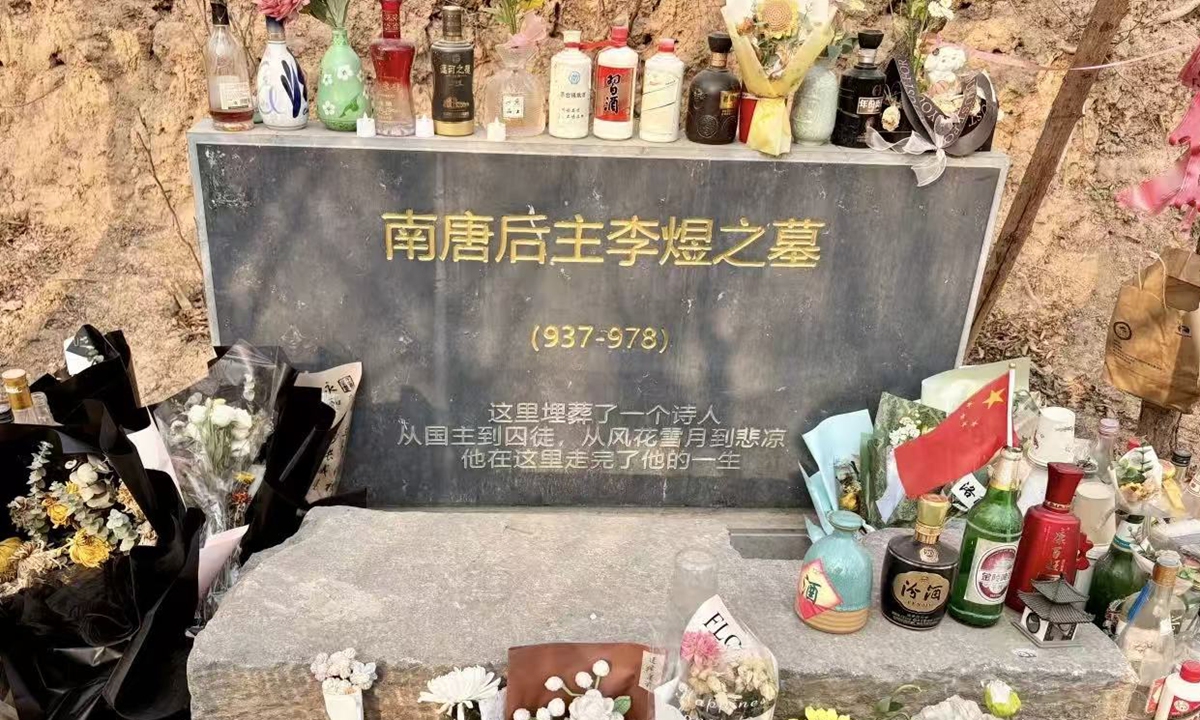
Various offerings in front of the tomb of Li Yu, the last lord of the Southern Tang kingdom (937-975) Photo: Courtesy of Ruizi
As Qingming Festival, a traditional Chinese holiday honoring the deceased and marking the "Pure Brightness" solar term, approaches, some young people are planning to put a modern spin on the tradition by visiting the graves of famous historical figures, many set in scenic locations.
From leaving ibuprofen capsules at the tomb of Cao Cao, a ruler of the Three Kingdoms period (220-280) known for his chronic headaches, to offering a variety of wines and spirits at the resting place of Li Bai, the Tang Dynasty (618-907) poet who is as well known for his obsession with alcohol as he is for his verses, these gestures reflect a playful yet reverent engagement with history.
The trend has turned Mangshan, a hill and ancient burial ground in Luoyang, Central China's Henan Province, into a latest must-visit spot for travelers, especially for history enthusiasts. Social media has even given rise to "tomb-sweeping manuals," telling visitors the locations of those famous tombs on Mangshan, with clear directions, and the rest places of other big names in history, which are scattered in the city.
What, then, draws people to the tombs of historical figures?
A practical manual
"This is my second time to visit Luoyang, and this time, I came specially for Mangshan," 22-year-old Ruizi (net name) told the Global Times, showing the reporter a "Mangshan tomb-sweeping guidebook" on Xiaohongshu, or RedNote.
The guidebook catalogs the tombs of historical figures in Mangshan, noting the condition of the tombs and offering a brief introduction of each tomb owner. Most importantly, it provides practical details for potential visitors, including the names of the destinations, with the preferred routes for taxi drivers, and which buses to take to get to the nearby villages.
Ruizi, a senior college student, came primarily for the grave of Li Yu, the last lord of the Southern Tang kingdom (937-975) who was born in today's Jiangsu Province in East China, but died hundreds of kilometers away in Henan Province in Central China.
"In my high school years, he was one of my favorite poets. His talent and tortuous fate impressed me at that time, which prompted me to come to pay tribute to him," Ruizi said, placing a bouquet of flowers in front of the tomb stone.
Flowers, bottles of Chinese baijiu, a traditional Chinese distilled liquor, along with water and soil brought from Jiangsu, and handwritten letters all speak to how Li Yu continues to be memorized more than one thousand years later, even though the gravestone itself was only recently erected, and the accurate location of Li Yu's tomb has not been confirmed, beyond its general placement in Mangshan.
According to a report from Luoyang cultural heritage administration in 2022, the Mangshan tomb cluster is the largest ancient tomb complex in China, where many emperors and ministers were buried, not to mention other literati.
At an intersection, an interesting road sign caught the visitors' eye: two handwritten signs, one pointing right to the tomb of Li Yu and the other pointing left to the tomb of another famous poet Wang Zhihuan, whose piece on the Yellow River was the first poem many Chinese people learned in kindergarten.
No words could describe the unique feeling of standing in front of the grave of a name in a textbook; it is like suddenly the power of Chinese language, of Chinese culture and civilization, beats intensely in my chest. Their verses, their life stories and virtues, became more real and tangible, said another visitor surnamed Lin, who came from Northwest China's Shaanxi Province.
Lin has always had an affection for history. In addition to Mangshan, Lin's itinerary also included the visits to the graves of emperors of the Eastern Zhou Dynasty (770BC-256BC), of Ban Chao (206BC-AD220), a Han Dynasty envoy who wrote his name in the creation of ancient silk road, of Bai Juyi, another famous Tang Dynasty poet of the realistic genre, and of Cheng brothers - Cheng Yi and Cheng Hao who were important Confucius philosophers in the Northern Song Dynasty (960-1127).
"I planned my trip chronologically, and the figures are stars shining through the veins of Chinese civilization," Lin said. "Visiting them is like visiting a distant ancestor of my own family."
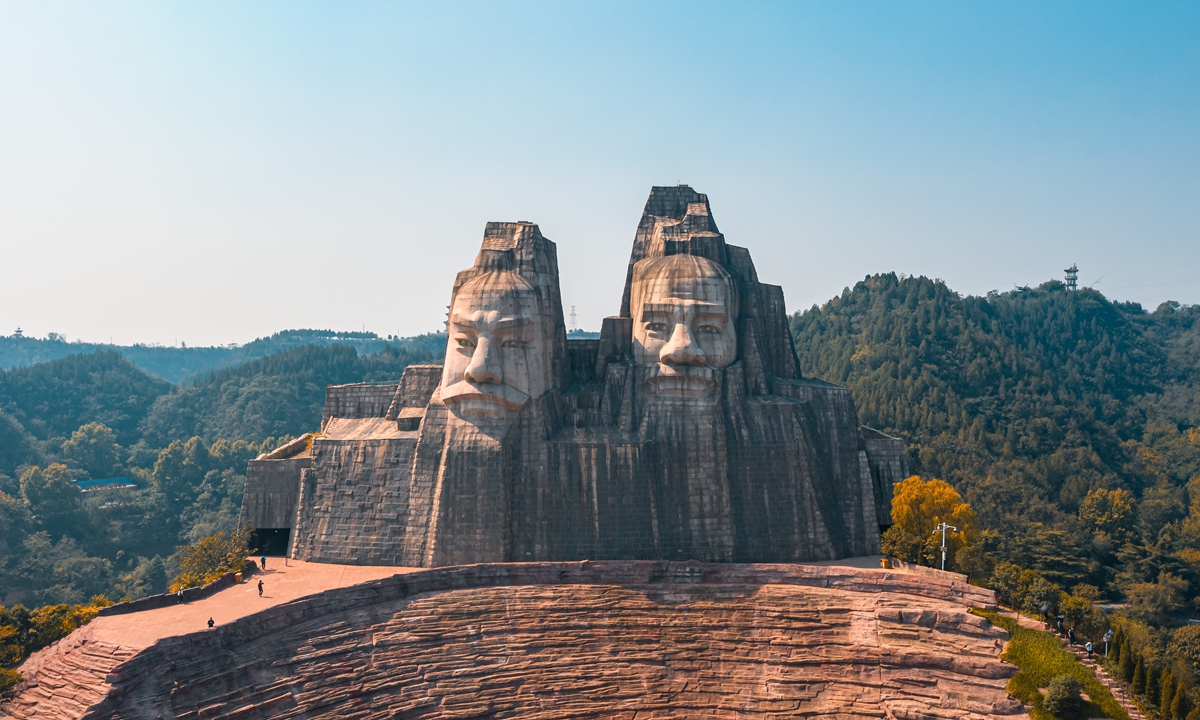
Aerial view of the sculptures of legendary Emperor Yandi and Emperor Huangdi in Mangshan, Central China's Henan Province. Photo: VCG
Emotional chorus
Compared with chasing a contemporary "star" who may suffer career setbacks, paying tribute to these timeless idols who remain forever in history is not only a personalized way of showing respect but also a journey to calm the mind. It has also become a way for young people to learn deeper about history, make like‑minded friends and relieve stress.
Local tour guide Wang Mian told Beijing Youth Daily that "tomb-seeping routes" have become increasingly popular recently among the post-2000 generation.
They usually immerse themselves into the environment, and feel like they are having conversations with the historical figures of the ancient times, Wang said.
Wang was amazed that those young people have deeply researched these ancient figures, knowing well of their life stories, their works and social circles, their ambitions.
"I don't want to go there and just have a glimpse. Doing the research is like making a friend from the ancient times," Lin said.
Sometimes the tomb-sweeping trips also bring about real friends.
Lin has a friend who usually sweeps tombs together with her. "We got to know each other on RedNote, when I posted an invitation for car-hailing near the tomb of Zhuge Liang," Lin said.
Zhuge Liang is a renowned military strategist in the Three Kingdom Period (220-280) who was buried in Hanzhong of Shaanxi Province.
Sharing an interest in history, Lin and her friend traveled together a lot, recommended history-themed books and film and television works to each other. Their friendship has gone deeper as now they start to share everyday happiness and troubles, offer advice and support.
Even when visiting the tombs of these historical figures alone, they feel a sense of mental comfort and a deep emotional resonance. They write their thoughts and emotions in length in letters to the ancient figures, carefully pick up offerings as gifts, and trying to understand what life was like for them, and draw strength to overcome difficulties in study and work from their wisdom and courage.
People of Lin's generation have recited the essay "The Notes on Yueyang Tower" by Song Dynasty poet and scholar Fan Zhongyan.
"But it was when I stood in the pine and cypress trees inside the quiet graveyard of Fan, during an escape trip, that I suddenly truly understood the composure and loyalty to true self behind his words: 'Not delighted by external gains, not saddened by personal losses'," Lin said.
RELATED ARTICLES