ARTS / CULTURE & LEISURE
As Hollywood depicts global teamwork, US policies reveal growing disconnect
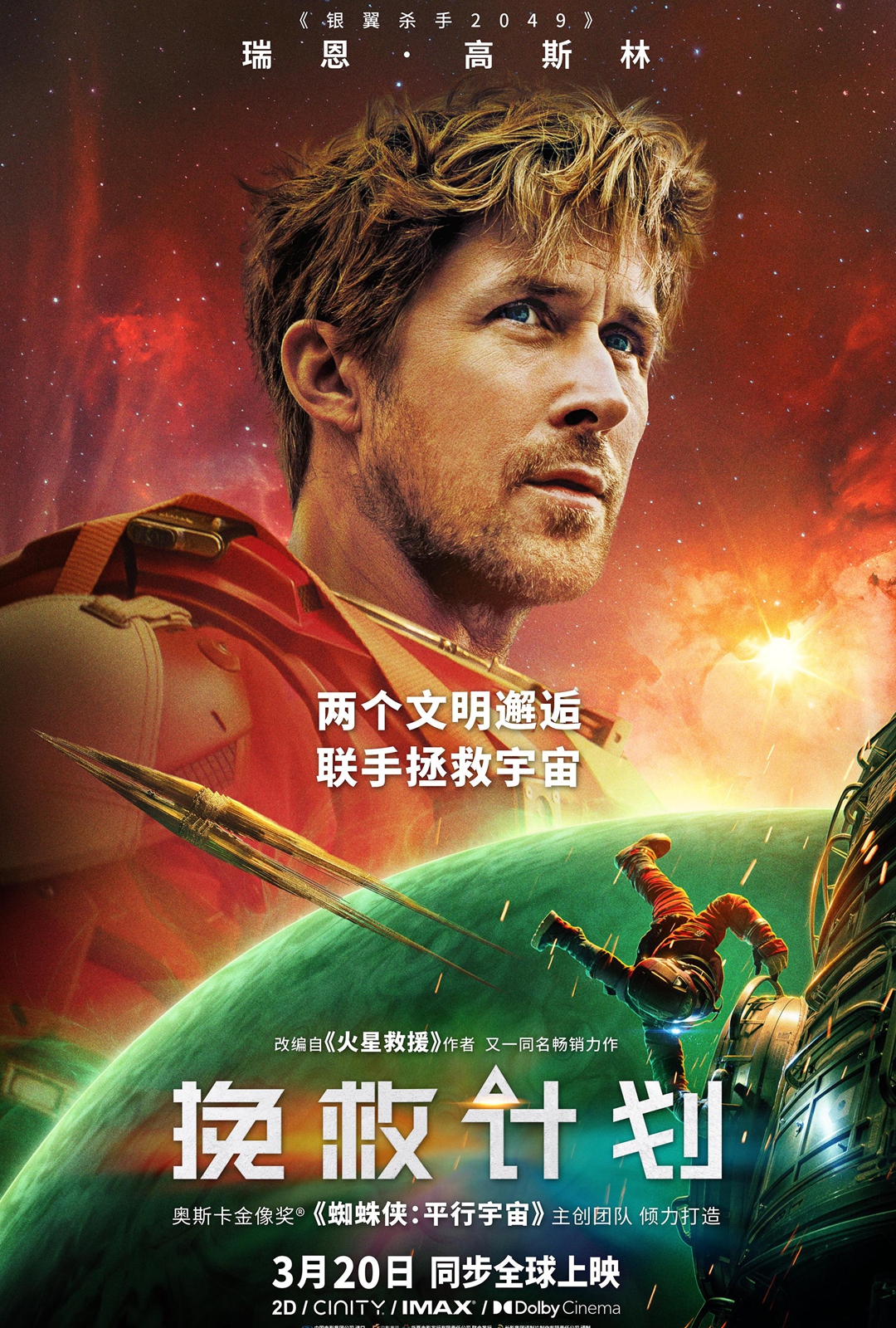
Promotional material for Project Hail Mary Photo: Courtesy of Douban
As Hollywood turns to narratives of "saving the Earth together," its depictions of global cooperation are offering a striking contrast to the fractures seen in contemporary US politics.Project Hail Mary is currently screening worldwide, telling what may seem like a familiar sci-fi story: A US astronaut, alone in deep space, overcomes immense challenges through intelligence and courage to complete a seemingly impossible mission and ultimately save humanity.
Yet unlike many of its predecessors, the film departs from the traditional "lone US savior" trope. Its protagonist, Ryland Grace, is not a self-chosen hero but is compelled into the mission. His success hinges not on individual heroism, but on collaboration - most notably with an extraterrestrial lifeform he encounters by chance. Even at the human level, the film underscores shared sacrifice: Grace's two fallen crewmates come from China and Russia, signaling that the burden of saving humanity is no longer borne by a single nation.
Hollywood has long positioned the US as both the leader and savior in global crises. However, this narrative has gradually evolved in recent years.
In The Martian, also adapted from Andy Weir's novel, China's space agency plays a crucial role in rescuing the stranded astronaut portrayed by Matt Damon. Although China's role is less prominent in Project Hail Mary, it remains part of the collective effort, reflecting a broader shift toward acknowledging multinational cooperation.
Details throughout the film further reinforce this theme. The mission patch of Project Hail Mary in the movie prominently features the flags of China, the US, Russia and India at the top, alongside those of Malaysia, Mexico, Canada, the European Union and others. In laboratory scenes, observers of Grace's experiments wear uniforms from different countries, while scientists worldwide jointly deliberate on how to execute the mission.
The film pushes cooperation to an even higher level through its central narrative. At its core, Project Hail Mary explores how Grace establishes communication and trust with Rocky, an intelligent from the 40 Eridani system. In the vast isolation of space, the two overcome barriers of language, biology and background to work together toward a shared goal.
Initially, Grace and Rocky share almost nothing in common - not even biological composition. One is carbon-based, the other silicon-based; and Rocky lacks vision entirely. Their similarities are arguably fewer than those between humans and any mammal on Earth. Yet through interaction, they build trust and leverage their respective technological strengths to solve critical problems.
Such cooperation - whether across species or across nations - may seem even more "science fiction" than the interstellar voyage itself, especially when viewed against the realities of today's geopolitical landscape, where collaboration often faces mounting obstacles and the US is increasingly seen as undermining, rather than advancing, global cooperation.
Charles Dunlap Jr, a professor at Duke University, highlighted this gap in one of his student's review of the original novel Project Hail Mary. Dunlap noted that the level of international coordination depicted is overly idealized, citing "the Wolf Amendment" as an example, which has barred bilateral collaboration between NASA and Chinese space agencies since 2011. It has contributed to the emergence of a bifurcated global space order, "driven less by incompatible visions of exploration than by mutual concerns over technological hegemony."
Indeed, in contrast to Hollywood's cooperative vision, the US has in practice erected barriers across technological, political and economic domains. In mid-March, NeurIPS - one of the leading US-based conferences in artificial intelligence - updated its annual submission guidelines with restrictions that "would have affected researchers at Chinese companies like Tencent and Huawei who regularly present work at NeurIPS," according to Wired. The move drew backlash from Chinese researchers.
More broadly, Washington has also turned away from established international frameworks. In January alone, the US formally withdrew from the World Health Organization and the Paris Agreement, and announced plans to exit 66 global organizations.
Science fiction, however, remains a powerful medium precisely because it transcends such narrow conceptions of nationality and calls for cooperation.
The author is a reporter with the Global Times. life@globaltimes.com.cn
RELATED ARTICLES