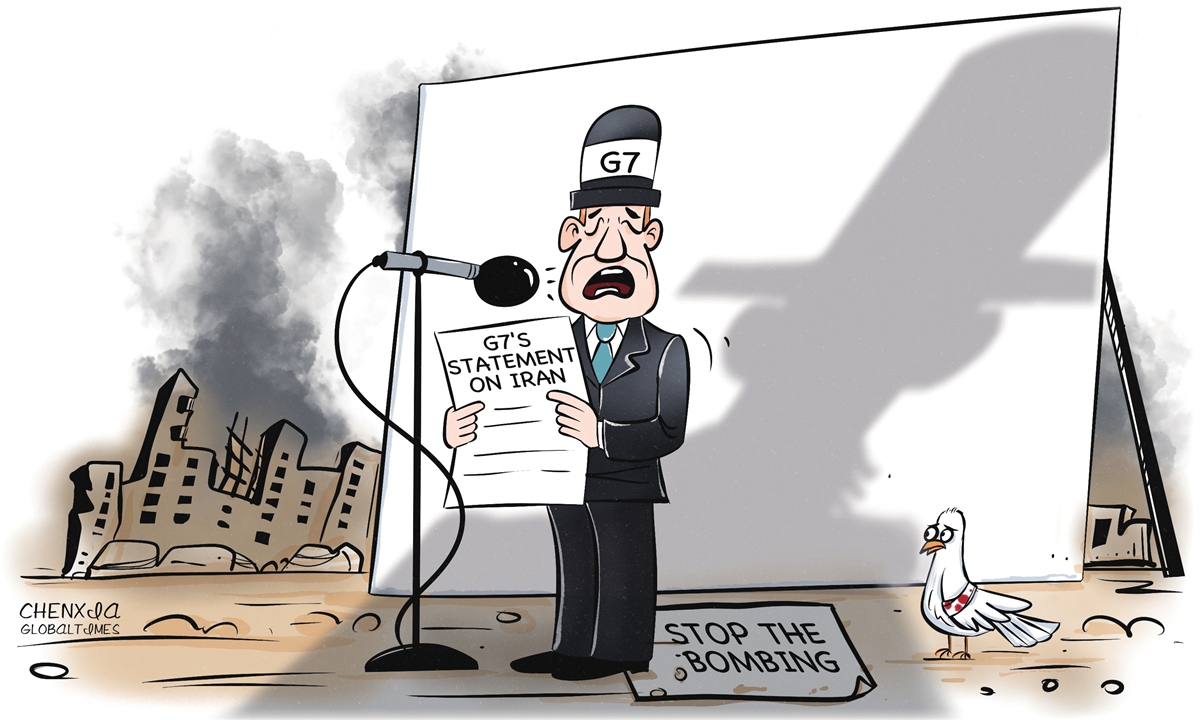
Illustration: Chen Xia/GT
When the foreign ministers of the Group of Seven concluded their meeting in France on March 27, they issued a carefully worded joint statement. It called for "an immediate cessation" of attacks against civilians and civilian infrastructure, and urged the permanent restoration of freedom of navigation through the Strait of Hormuz.
The statement named no party, raised no question of accountability, and proposed no binding mechanism for follow-up. It was a document of studied emptiness. The question worth asking is: Why could the G7 not bring itself to say "stop the bombing?"
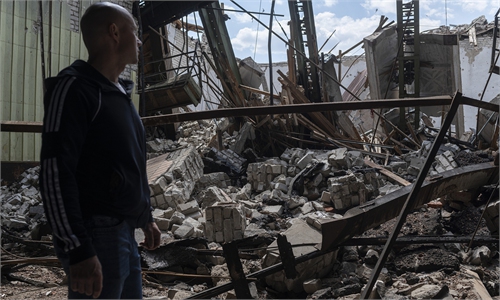
The answer is not complicated. The US-Israel strikes on Iran have, by the end of the conflict's first month, killed more than 1,500 civilians, according to Iran's state broadcaster. On the opening day of the war, a Tomahawk missile struck the Shajareh Tayyebeh girls' elementary school in Minab, killing at least 168 people - the majority of them children. The Iranian Red Crescent Society reported that more than 87,000 civilian sites across the country had been damaged, including approximately 289 medical facilities and roughly 600 schools. These figures come from independent organizations and humanitarian agencies. Against this backdrop, the G7 issued a declaration that mentioned neither the belligerents nor the bombing, nor anyone's responsibility - only "the conflict," as though the destruction were a natural phenomenon with no identifiable author.
That choice of language was not accidental; it was engineered. To call for reducing "the impact of the conflict on civilians" is to make "the conflict" itself the grammatical subject, not the party conducting the airstrikes. Decades of diplomacy obscure aggressors, framing war as a shared fault. Perpetrator and victim blur, dissolving responsibility. This complicit language isn't caution.
The answer lies in the G7's structural architecture. The US exerts strong political influence, while Britain, closely tied to Washington, avoids open criticism. France, although calling the war "not ours," remains constrained by NATO. Germany voiced discontent, but ultimately concurred. Japan, Canada and Italy have limited independent security options.
This is the G7's structural dilemma: It is a multilateral forum in which the initiator of the conflict occupies the central seat, and therefore one that is constitutionally incapable of holding that initiator accountable. This is not a failure specific to this declaration. It is a flaw built into the institution's design.
What the remaining six members obtained in exchange for their signatures was political cover. A suitably vague multilateral declaration allows each government to tell its domestic audience that it "made its position clear," while simultaneously avoiding any rupture with Washington. Every party received what it sought - except the civilians beneath the bombs.
The declaration is flawed. Such statements don't stop wars; history proves this. This one lacks funding, action, and aid. It ignores vital post-conflict issues like governance, reconstruction and security, offering no solutions. What the declaration serves is the G7's reputation management.
In the ruins of Iran, the foreign ministers of seven industrialized democracies met for two days and produced a document that could not include the words "stop the bombing," presenting the result as a "coordinated position." Herein lies the statement's most profound dishonesty: It exists not to advance peace, but to sustain the appearance of advancing peace. What the statement actually demonstrates is the G7's own historical predicament. The fissures among its members were exposed at this meeting more starkly than at any point in recent memory.
The G7 was once the coordinating core of the Western-led international order. Its collective voice could shape international norms, accelerate diplomatic processes and establish boundaries for armed conflict. Those functions are eroding at an alarming speed. A grouping that cannot say "stop the bombing" has forfeited its claim to moral authority in international affairs. What remains is a conference table and an increasingly threadbare illusion of relevance.
RELATED ARTICLES