US E-3 reportedly destroyed in Iranian strike; Chinese expert dissects Iran’s intelligence, precision targeting of time-sensitive assets
By Liang Rui and Published: Mar 30, 2026 03:57 PM

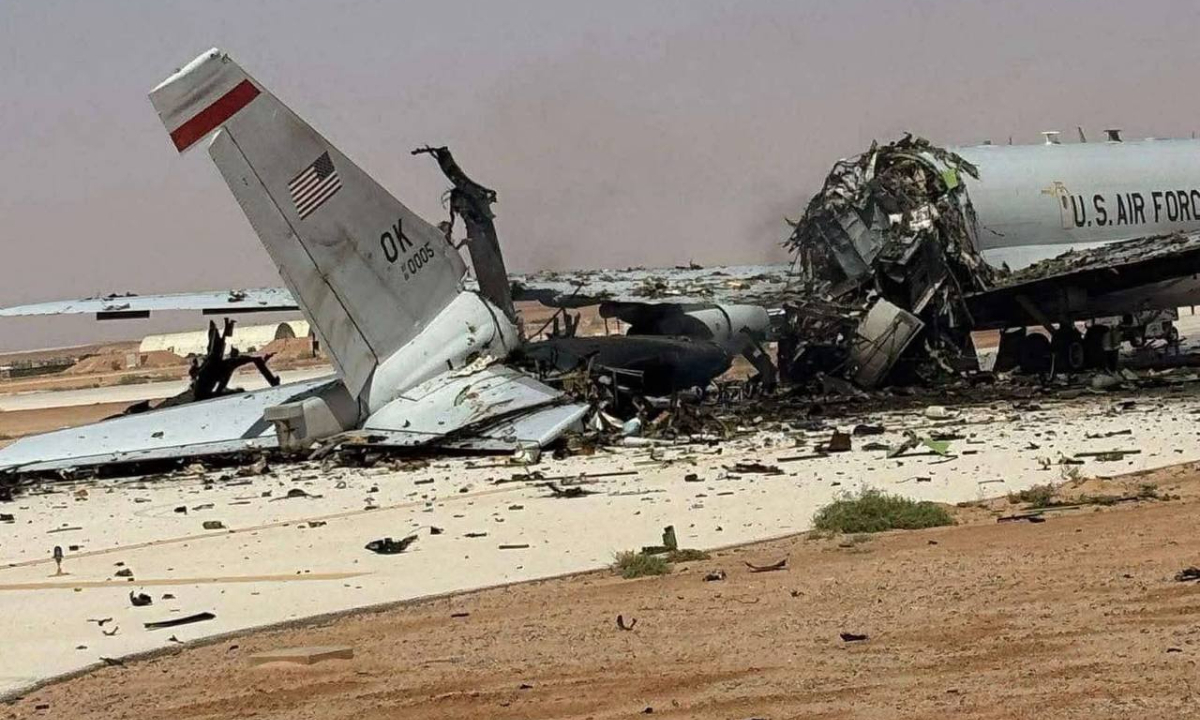
A US E-3 Sentry airborne warning and control system aircraft (AWAC) is reportedly destroyed in Iranian missile and drone strikes at the Prince Sultan air base in Saudi Arabia on March 27, 2026. Photo: Screenshot from the X account of the Fars News Agency
Iran has destroyed a US E-3 Sentry stationed at a Saudi air base, according to multiple media reports. So far, Washington has made no public claim on the incident. A Chinese expert told the Global Times on Monday that the strike reflects how Iran orchestrates its intelligence-to-strike chain, from real-time surveillance to the rapid engagement of time-sensitive assets. The expert noted that the precision and destructive effect suggest advances in weapon guidance, while the timing of the attack shows how Tehran has maintained operational tempo despite weeks of airstrikes.
On Sunday, Fars News Agency, which media said is close to Iran’s Islamic Revolutionary Guard Corps (IRGC), posted on social media platform X that IRGC destroys US Army's E-3 airborne warning and control system aircraft (AWAC).
An American E-3 Sentry was among the aircraft damaged at the Prince Sultan air base in Saudi Arabia on Friday, according to US and Arab officials, reported the Wall Street Journal (WSJ) on Saturday. The base was hit by an Iranian missile and drone attack, which injured 12 service members and also damaged several US refueling airplanes.
Al Jazeera reported that the airbase, about 96 kilometers (60 miles) southeast of the Saudi capital, Riyadh, is run by the Saudi air force but is also used by US forces.
According to the WSJ, the E-3 Sentry helps manage the battlespace and tracks drones, missiles and aircraft from hundreds of miles away. The aircraft provides commanders with a real-time picture of the war and allows them to direct assets to intercept threats, and also manage friendly aircraft, citing military analysts.
US Central Command has not yet publicly commented on the incident, BBC reported on Monday.
On Friday, the Saudi Ministry of Defence said it intercepted several drones and missiles launched from Iran towards Riyadh but has not yet commented on the attack on the airbase, said the Al Jazeera.
Unlike fixed facilities such as airbases or radar stations, aircraft parked on the ground are classic time-sensitive targets. Iran’s ability to precisely locate and strike such a target in a narrow time window shows the efficiency of its end-to-end kill chain - from detection and identification to decision-making and strike execution, Zhang Junshe, a military affairs expert, told the Global Times on Monday.
“Iran’s accurate timing and rapid response suggest it possesses relatively strong real-time surveillance, early warning, and target acquisition capabilities,” Zhang said.
As for how this was achieved, Zhang said that it was likely the result of layered intelligence collection. This may include satellite-based imaging and tracking, combined with airborne platforms such as drones or reconnaissance aircraft for persistent surveillance. At the same time, human intelligence (HUMINT) or internal infiltration cannot be ruled out. Given the long-standing intelligence competition among Iran, the US, and Israel, mutual penetration and covert networks are a persistent reality.
Images cited by many media reports including BBC and Fars News Agency showed a structural break in the mid-to-rear section of the E-3 Sentry, with the tail separated from the fuselage.
This level of damage indicates a catastrophic failure of the main load-bearing structure, rendering the aircraft beyond repair and amounting to a total loss. Such a kill effect suggests several technical characteristics, Zhang said.
First, it points to a relatively high degree of precision, with the missile striking a critical structural point. Second, it indicates advanced terminal guidance capabilities - potentially including in-flight trajectory correction or parameter adjustment in the final phase - to ensure both accuracy and maximum destructive effect, the expert said.
“The loss of this E-3 is incredibly problematic, given how crucial these battle managers are to everything from airspace deconfliction, aircraft deconfliction, targeting, and providing other lethal effects that the entire force needs for the battle space,” Heather Penney, a former F-16 pilot and director of studies and research at AFA’s Mitchell Institute for Aerospace Studies, was quoted by the Air & Space Forces Magazine as saying on Saturday.
Zhang commented that Iran’s ability to carry out such a strike after more than a month of sustained air attacks seems to point to considerable operational resilience. Now into its second month, the conflict has not unfolded as some in Washington and Tel Aviv may have anticipated. Rather than collapsing under sustained airstrikes, Iran appears to be maintaining, and in some respects strengthening, its capacity and will to resist. The US and Israel appear unable to simply overpower Iran by military force alone.
RELATED ARTICLES