GT Voice: Political hype about ‘economic security’ meets resistance from EU businesses
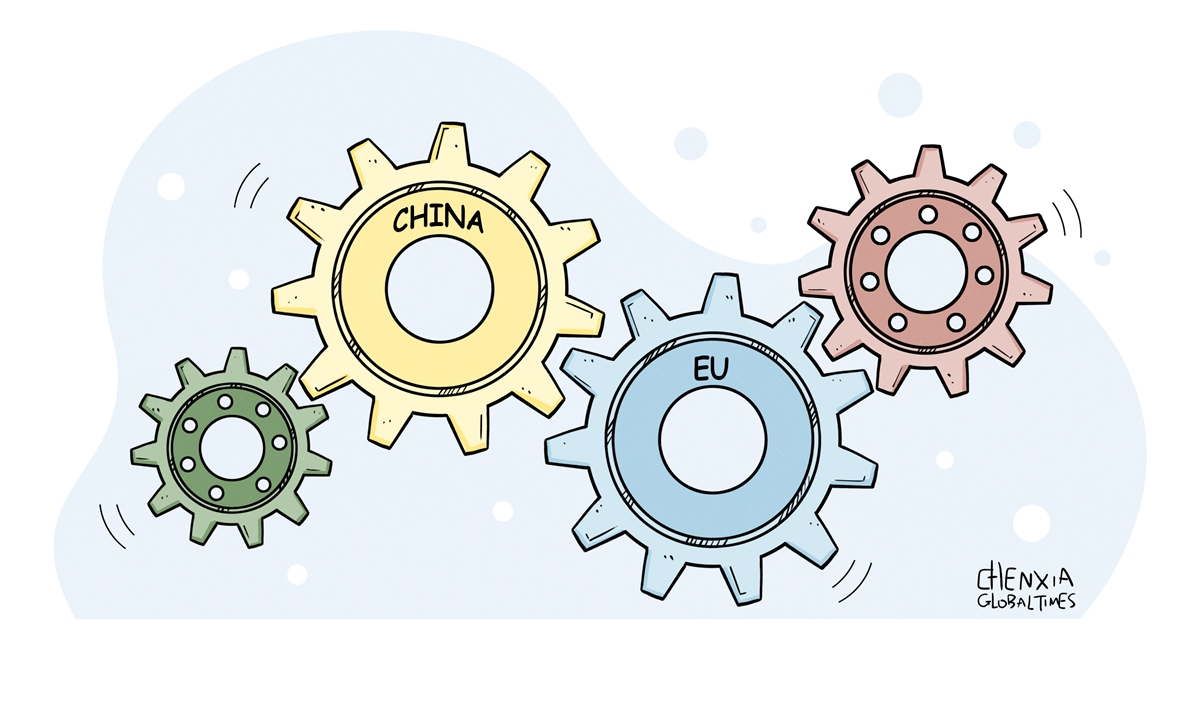
Illustration: Chen Xia/GT
While some in the EU have been enthusiastically promoting the idea of "economic security" and pushing for reduced reliance on certain trading partners, this rhetoric has met with considerable resistance in the business world. The latest case in point is a study, conducted by the University of Sussex and King's College London seen by Reuters on Monday, which showed that German companies are so deeply tied to both the US and China that they cannot decouple from either without severe economic costs.Automakers and machinery groups are most reliant on China as a market, while chemical and pharmaceutical firms depend more heavily on the US for research, development and production, the study said. The study's conclusions come as no surprise. That is because it merely presents, in an academic manner, the logic that has long guided German businesses' choices over the years.
These choices have never been driven by political considerations; rather, they are the results of rational calculations based on market forces, supply chain efficiency and cost-benefit analysis. It is precisely these choices that expose the emptiness of political slogans about "decoupling," "de-risking," or "industrial security."
Economic security cannot be achieved by fragmenting global markets. Forcibly severing supply chain links forged over decades in the name of "security" would ultimately weaken the competitiveness of the very businesses it claims to protect and undermine the foundations of the economy at home. Indeed, genuine "de-risking" should be about reducing unilateral sanctions, protectionism and geopolitical disruption, while safeguarding the stable functioning of global industrial chains. It should not be about politicizing normal economic cooperation and turning companies into pawns in geopolitical games.
Moreover, the situation of German companies is not an isolated case. From semiconductors to automobile manufacturing to electronic products, no country or company can stand alone in a fragmented global industrial chain. Decades of globalization have created a landscape in which economies are deeply interwoven.
Within this landscape, China - as the world's manufacturing hub and a vast market - and the US - as a center of technological innovation and a major consumer base - both occupy critical positions. Any attempt to dismantle either of these pillars would set off chain reactions, imposing costs on all participants across the supply chain.
It's revealing that at the very moment some politicians are hyping the rhetoric of "economic security," German companies are not pulling out of China. On the contrary, they have been expanding their presence in fields such as high-end manufacturing, green energy and the digital economy.
Data from the German Economic Institute shows that new German direct investment in China amounted to about 7 billion euros ($8.26 billion) in 2025, well above roughly 4.5 billion euros a year earlier. As noted by Juergen Matthes, an expert at the institute, German companies are not only expanding their presence in China but also accelerating the pace of investment, according to the Xinhua News Agency.
This apparent paradox reflects a recognition of market realities: China offers the world's most complete industrial system, its largest pool of engineers, a remarkably resilient supply chain and a steadily improving business environment. No company that respects commercial logic can afford to overlook these fundamentals.
The key question is what genuine "economic security" actually entails. If "economic security" is repackaged as an exclusionary geopolitical tool - using "security" as a cover for protectionism - that itself becomes a real risk to the global economy. German companies have made their choice clear: they trust markets over political slogans, and they value certainty and predictability over uncertainty.
Ultimately, German companies, through their global footprint, have embraced open markets. That choice deserves to be respected and supported by policy, not suppressed by ideological narratives. Europe's economic future depends on its ability to resist irrational political hype and continue playing the role of a connector in a complex world.
RELATED ARTICLES