IN-DEPTH / IN-DEPTH
A foreign patient's recovery story highlights rising global appeal of Chinese healthcare, blending tech and personalized service
A cure connection
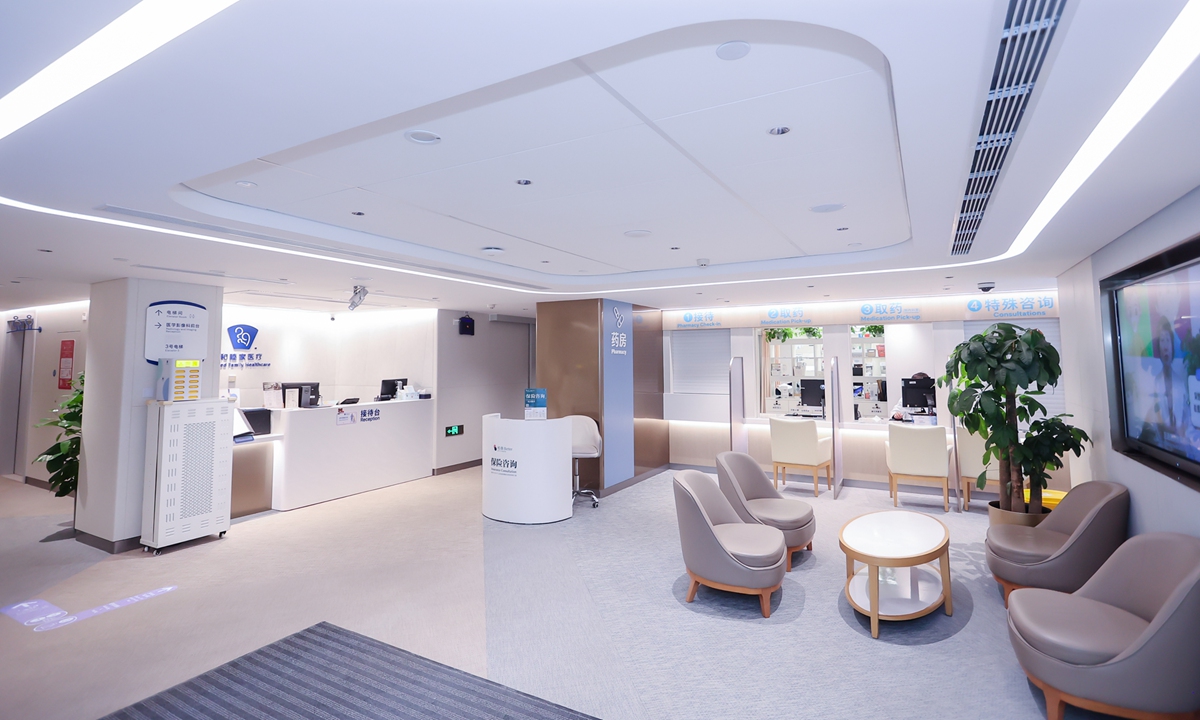
A view of the reception hall at Beijing United Family Hospital Photo: Courtesy of Beijing United Family Hospital
Bilingual signs in English and Chinese are visible everywhere when Global Times reporters visited Beijing United Family Hospital. In the hallways, foreign patients chat fluently with doctors in English, and nurses greet them warmly as they pass by with carts. The facility feels more like a small international community than the crowded, busy hospitals many people imagine.On the morning of March 25, 2026, the reporter met Alex (pseudonym) in his hospital room, days before he would be discharged and return home. The 45-year-old multiple myeloma patient held two pages filled with handwritten notes - everything he wanted to say.
"It's very good, very excellent high-quality care I received. I was very impressed," Alex told the Global Times.
Days later, on March 28, he concluded his more than three-month-long treatment and flew back to his home country. Before his departure, his medical team gave him several refrigerator magnets featuring the Temple of Heaven, an ancient Chinese phoenix crown and the artifact of famous Si Yang Fang Zun (Four-Goat Square Zun), a bronze vessel from the Shang Dynasty (C.1600BC-1046BC). Each magnet had an English label on the back explaining its cultural significance. Speaking in fluent English, Chinese doctors explained these were symbols of China, hoping Alex and his family would remember their medical experience in China whenever they saw them.
Alex's journey, from a desperate overseas plea for a lifeline, to gradually recovering back to good health, and culminating in these meaningful mementos, reflects the newly emerging allure of Chinese medical technology on the global stage. Against the backdrop of advancing the Healthy China Initiative during the 15th Five-Year Plan period (2026-2030), foreign-funded hospitals in China, leveraging their inherent "international DNA" and patient-centered philosophy, are becoming vital bridges connecting global patients with China's high-quality medical resources.
Building trust across borders
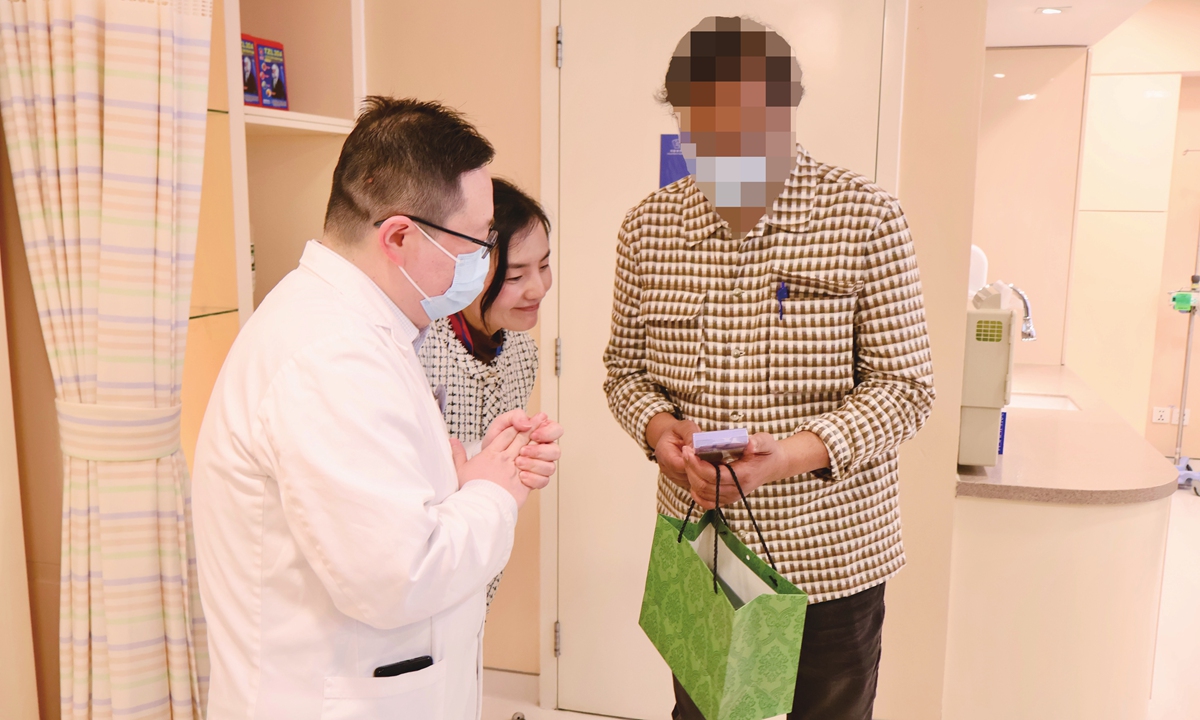
Alex (right) receives farewell gifts from staff members at Beijing United Family Hospital on March 25, 2026. Photo: Lin Xiaoyi/GT
Alex's path to China started with a desperate global search for hope.Diagnosed with multiple myeloma in April 2022 - a rare blood cancer that often relapses - he underwent multiple lines of chemotherapy and targeted therapy in his home country over the following three years. Although he achieved clinical remission twice, the cancer relapsed again in November 2025. His local doctors told him that they had no further effective treatment options.
Refusing to give up, Alex scoured the world for alternatives. He learned that chimeric antigen receptor (CAR) T-cell therapy is one of the most effective treatments for relapsed and refractory multiple myeloma. However, it was not yet commercially available in his country. While mature in the US, the treatment came with a long waiting list.
Then, a crucial referral changed his fate. Referred by his local doctor, Alex got in touch with the hematology team at United Family in Beijing.
"We learned that the development of CAR-T therapy in China has been very rapid. It has been in clinical application since 2017, with a large number of cases," Alex said. Yet he admitted his initial hope was clouded by worries: How would he communicate medical details without speaking Chinese? Could he adapt to the different food? Would his medical visa be approved? These concerns formed invisible barriers between him and medical care in China.
Those barriers were broken by the hospital's international team, who exchanged around 60 e-mails with Alex and his family over nearly three weeks.
"From remote multidisciplinary consultations and professional explanations of the treatment plan to practical arrangements for living in China and full assistance with the medical visa, those 60 e-mails built trust step by step," Liu Wei, general manager of United Family Healthcare Beijing-Tianjin Market, told the Global Times.
The international team outlined the treatment plan and potential risks while also providing Alex's family a virtual tour of the hospital. "Based on his complete medical history, we broke down the complex treatment plan step-by-step, using simple analogies and language he could understand," Ji Yu, Alex's attending physician, told the Global Times.
Alex and his family arrived in Beijing on December 26, 2025. The hospital's staff assisted with everything from getting a local SIM card and settling into nearby accommodation, to guiding them to purchase food and helping with cross-border money transfers - thoughtful services that put them at ease, and helped them navigate the challenges of living in a new country.
"Before coming to China, we knew almost nothing about Chinese hospitals. They don't do massive marketing like hospitals in Europe and America," Alex admitted, describing his initial choice as a leap of faith. But after experiencing the full treatment process, he was effusive: "The doctors and nurses here are not only highly professional but also exceptionally attentive and caring."
A blend of tech, efficiency and compassion
"Here, there is advanced treatment technology, an efficient process, considerate service and medical staff you can trust," Alex stated firmly, adding he would definitely recommend Chinese healthcare to fellow patients and friends.
Liu believes Alex's successful recovery reflects China's technological breakthroughs in CAR-T therapy, as well as the unique strengths of foreign-invested private hospitals that integrate advanced medicine with personalized service.
"China and the US conduct the most CAR-T clinical trials globally, and China now surpasses the US in the number of trials. More and more innovative treatments are becoming available here," she said.
Treatment efficiency is a key advantage attracting foreign patients. Alex experienced this firsthand: In other countries, you might wait one or two years for such treatment. But here, he received an immediate response after contacting the doctors, and treatment started very quickly.
"This technological appeal needs an efficient, agile diagnostic system to support it, and China has clear advantages in response speed and process flexibility," explained Ji, noting that when collecting cells from Alex, whose blood vessels were severely damaged by chemotherapy, the team actively explored solutions and placed a femoral venous catheter for the patient, with nurses closely monitoring him to prevent side effects such as low calcium. Single rooms and strict infection control also provided essential protection for his weakened immune system.
Meanwhile, the Global Times learned from Beijing United Family Hospital that CAR-T treatment in China costs much less than in Western countries - only about one half to one third of similar treatments in the US. This cost-effectiveness is a key reason many foreign patients choose China. Alex said he would strongly encourage other patients to come to China for treatment.
If technology, efficiency and affordability represent the "hard power" attracting international patients, then deeply integrated international and personalized services are the "soft power" that turns this appeal into trust and comfort, Liu said. She noted that in China, unlike public hospitals that mainly provide public welfare services, private hospitals focus on meeting the diverse, high-standard needs of international patients.
Founded in Beijing in 1997 as the healthcare services arm of Chindex International, United Family Healthcare (UFH) was China's first foreign-invested for-profit healthcare provider, committed to delivering systematic convenience and thoughtful, human-centered care. Liu cited an example: UFH has direct-billing agreements with dozens of insurance companies worldwide, sparing patients the burden of paying large deposits upfront.
Jenny, Alex's care case manager, told the Global Times that one of the magnets she gave him was intended for his daughter - she had learned during their conversations that the girl was interested in traditional Chinese culture.
On the back of the exquisite phoenix crown magnet, the doctor wrote in English: "The crown represents the wish for a girl to be cherished like a princess and to shine with elegance and wisdom."
From isolated cases to a growing trend
During the interview, Liu revealed a telling detail: the hospital responded to Alex's first few consultation emails almost around the clock. "We cherish such opportunities. If you don't reply immediately, the patient might seek other options."
Amid China's push for high-quality healthcare development under the Healthy China Initiative, UFH has continuously improved its international services, refined its medical capabilities and upgraded patient experiences to meet the diverse needs of global patients.
Liu noted that in recent years, the number of foreign patients at Beijing United Family Hospital has continued to rise, and their needs have expanded from basic emergency care to complex treatments for cancer, rare diseases and other serious conditions.
This trend, she believes, reflects continuous improvements in China's medical and policy environment. "The government has streamlined medical visa procedures for foreign patients, and accelerated the approval of drugs and medical devices, allowing more global innovative treatments to become available in China promptly."
These "policy dividends" create a synergistic effect with the inherent international service capabilities of foreign-funded institutions, jointly enhancing China's appeal as a medical destination, she said.
The 2026 Government Work Report pledged to expand market access in services, including further expanding opening-up trials for wholly foreign-owned hospitals. Guided by the outline of the 15th Five-Year Plan, which highlights "promoting high-standard opening up and creating new horizons for mutually beneficial cooperation," the medical sector is opening wider, drawing international medical resources and unlocking growth potential for foreign hospitals.
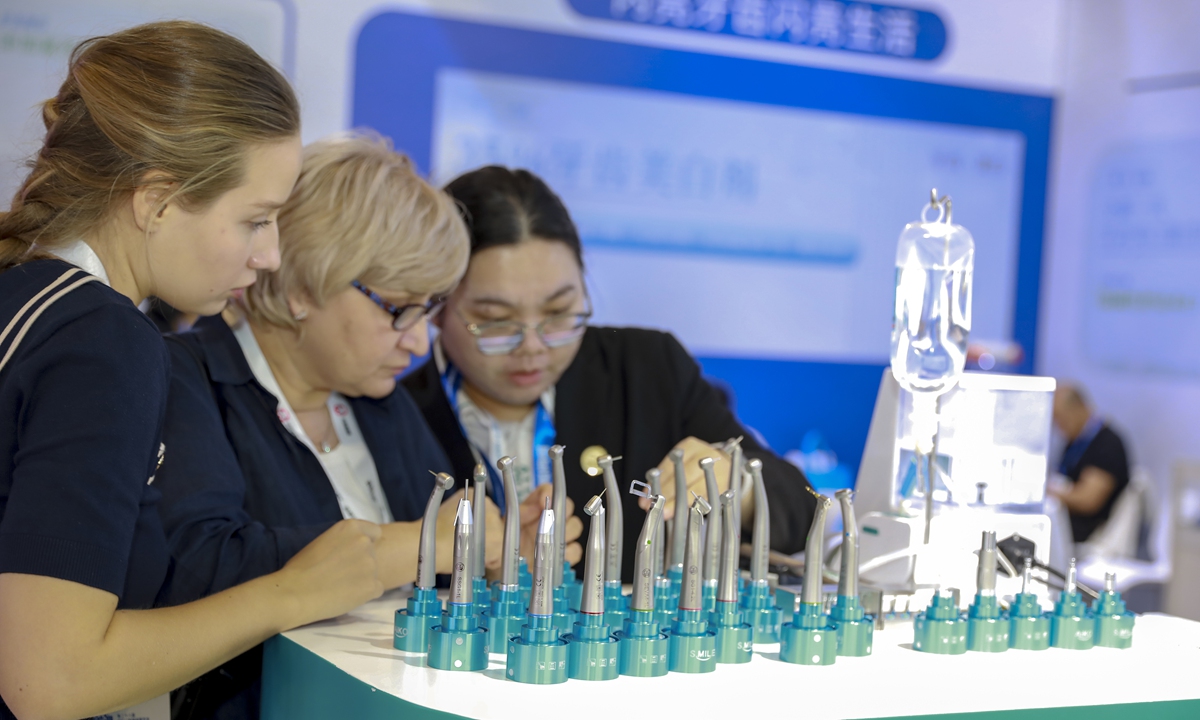
Overseas buyers inquire about dental medical devices at an international medical device exhibition in Shanghai on October 24, 2025. Photo: VCG
At the end of the interview, Alex posed for photos with his medical team, holding his new souvenir magnets. Before he returned home, the hospital had arranged a comprehensive remote follow-up plan, with his doctors providing regular guidance throughout his recovery. The care he received in China will continue to support him long after he left."I hope my next trip to China will be a vacation with my family," Alex told the Global Times with a smile. His eyes no longer showed anxiety, but hope for the future.
RELATED ARTICLES