Illustration: Chen Xia/GT
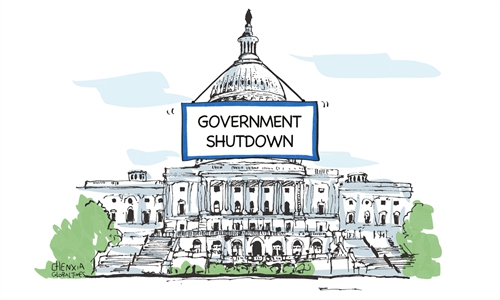
On Monday, the shutdown of the US Department of Homeland Security (DHS) entered its 45th day, surpassing the previous record of 43 days for a federal government shutdown set last October and November.
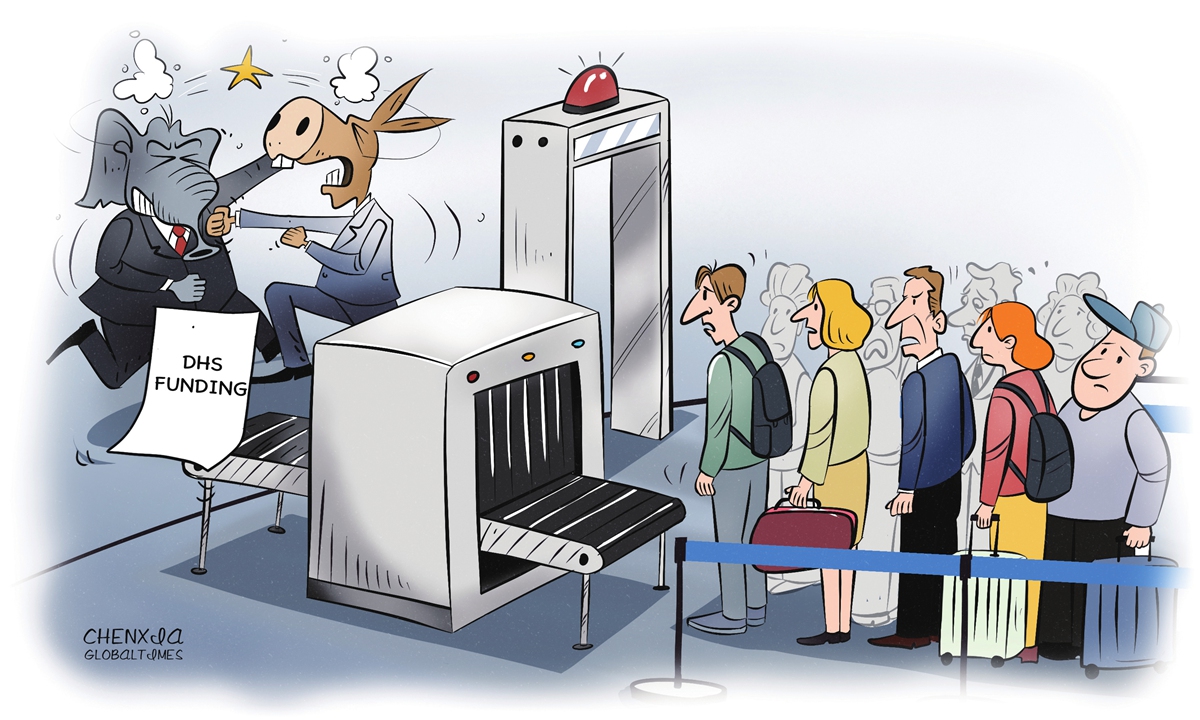
Passengers are reportedly waiting nine hours in airport security lines, 50,000 Transportation Security Administration (TSA) officers are being forced to work without pay, and more than 500 flights were canceled at a single airport in one day. These staggering figures highlight a troubling moment in US governance. On X, one user described this new "American record" as "a sad milestone."
However, the solution offered by the US government resembles little more than a stopgap measure. US President Donald Trump instructed relevant departments to utilize funds that have a "reasonable and logical nexus" to the TSA operations to provide back pay and benefits to TSA employees who have not been paid.
Nonetheless, some media outlets have pointed out that it remains unclear where this funding will come from and whether the president possesses the legal authority to enact such measures. This temporary fix addresses only the symptoms of the problem rather than its root causes, underscoring the inefficiency and dysfunction of the US governance system. When a country is unable to guarantee the basic operational funding of its own government departments, the purported rationality and superiority of its system collapse under their own weight.
For 45 days, the endlessly quarreling Democrats and Republicans have failed to reach even a basic consensus, leaving many Americans trapped in prolonged uncertainty and disorder, waiting for an outcome that seems nowhere in sight. This situation starkly reflects the US' inadequate governing capacity.
The DHS shutdown results from ongoing conflicts among lawmakers in Washington over funding. Its ripple effects are rapidly intensifying, with the aviation system taking the hardest hit. Lengthy security lines have become commonplace across the country. An NBC report stated that "the prospects of a quick end to the shutdown are unlikely."
Analysts increasingly describe US government shutdowns as "routine," which makes the situation more alarming. Following a 43-day federal government shutdown that ended in November 2025, the DHS shutdown has now extended to over 45 days within just a few months.
The increasing frequency and duration of these shutdowns are not coincidental but rather the result of structural flaws embedded in the US political system.
"These disputes reflect a deeply fragmented and unstable political landscape," Li Haidong, a professor at China Foreign Affairs University, told the Global Times.
"However, such divisions are unlikely to disappear," Li noted, stressing that partisan conflict will persist, leading to more frequent shutdowns. In other words, the current trend of governance failure in the US appears irreversible, with no clear prospect for a constructive solution.
Over time, prolonged shutdowns contribute to a growing sense of social frustration and instability. As these pressures build, social trust erodes, and political polarization deepens further.
"Breaking records" should be associated with development and progress. However, in the US, it has increasingly become synonymous with moments of institutional embarrassment: Partisan rivalry overrides national governance, public services stall, social trust declines, and systemic vulnerabilities continue to widen.
As one TSA officer told NBC, "This is the fourth week I'm working without pay and it's killing me." How can people trust the US when its political activity is characterized by "destruction" rather than "construction"?
RELATED ARTICLES