'The CPC's original aspiration and disciplinary requirements shape officials' inner political beliefs'

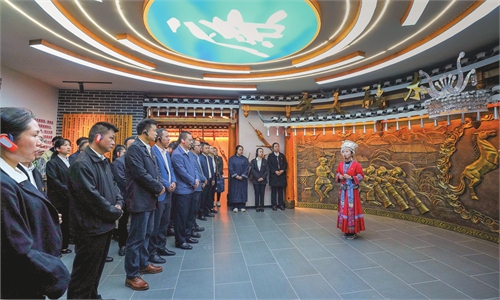
CPC members help growers harvest black fungus and supply it to the market on May 19, 2025 in Bozhou City, Anhui Province. Photo: VCG
Editor's Note:
What does it mean to govern well, and how should governance performance be gauged? The CPC' answer is that a correct view on governance performance should proceed from reality, respect objective laws, and, through sound decision-making and hard work, create achievements that withstand the test of practice and history, truly benefit the people, and earn public recognition. To examine the distinctive logic and global relevance of the CPC's correct understanding of governance performance, the Global Times (GT) launches a new series, "Understanding the correct view on governance performance," inviting leading international observers to share their thoughts.
In an interview with GT reporter Zhang Ao, Xulio Rios (Rios), founder and emeritus advisor of the China Policy Observatory in Spain, said that "the CPC's original aspiration and disciplinary requirements shape officials' inner political beliefs, serving as the ideological foundation for establishing a responsible perspective."
This is the first installment of the series.
GT: The CPC has emphasized the importance of establishing and practicing a correct view on governance performance. Why does China place such a strong emphasis on this?
Rios: The correct view on governance performance goes beyond a one-sided pursuit of single indicators. Instead, it prioritizes high-quality development, the well-being of the people and the laws of social development as the core criteria for assessing governance performance assessment.
It is especially fitting at this stage to pursue solid, people-centered development rather than superficial achievements. This approach is designed within the framework of Chinese governance to evaluate the quality of political management. It includes a responsibility system based on specific objectives, as well as disciplinary supervision, audits and other oversight tools.
The practice of this governance perspective is anchored in the leadership of the CPC. Competence and results serve as key benchmarks for assessing the effectiveness of policy implementation, and the core basis for the governance system's legitimacy.
GT: In your view, how does the CPC guide officials' governance performance and sense of responsibility?
Rios: The CPC's leadership is the guiding force of the state and society, and its practices are fundamental to maintaining political system stability and promoting social progress, laying the political foundation for the correct view on governance performance.
The CPC's original aspiration and disciplinary requirements shape officials' inner political beliefs, serving as the ideological foundation for establishing a responsible and long-term governance perspective.
Constant reflection underpins the structural self-evaluation of political power in China and is a core institutional element for practicing the correct view on governance performance.
GT: Chinese President Xi Jinping stressed the need to constantly ponder three questions: Why did I join the CPC? What do I aim to achieve as an official? What legacy do I want to leave behind? What do these three questions reveal about how a correct view of governance performance should be shaped?
Rios: The triad formulated by Xi constitutes a mechanism for political self-correction that aligns well with the logic of governance of the CPC, which emphasizes internal discipline, legitimacy through performance and historical continuity.
The first question refers to the individual's founding intention. It forces a distinction between political vocation, personal ambition and mere institutional inertia. Recalling the reason for joining the Party acts as an antidote to bureaucratization and opportunism. It also serves to align individual identity with the collective mission, preventing a dissociation between formal membership and real commitment.
The second question concerns present performance. It is not enough to have had "good reasons" for joining; these must be translated into tangible results. This question introduces a criterion for constant evaluation: Does my action contribute to the public interest as defined by the Party and the state? In Chinese governance, this dimension connects directly with mechanisms for evaluating officials, promotion and accountability.
The third question introduces a dimension of political significance by suggesting that what matters is not only what can be done now, but also how it will be interpreted and what lasting effects it will have. This is especially relevant as it discourages short-sighted decisions and favors policies with a structural focus.
The three questions do not operate in isolation; they form a closed circuit of coherence that encompasses both the sense of belonging and the activities undertaken, fostering a sense of purpose in public service and ensuring consistency. All of this operates by establishing a logical sequence between identity, performance and historical responsibility, thus creating a high level of doctrinal coherence and operational homogenization.
GT: In global context, what new insights can China's governance discourse on the "correct view on governance performance" offer for the evolution of world politics?
Rios: The CPC's political tradition exemplifies a blend of continuity and innovation, encompassing both doctrinal and practical dimensions. Beyond institutional frameworks and practical measures that support a modern understanding of governance performance, the inheritance and innovation of traditional Chinese political culture have further enriched its cultural connotations. This defining feature of China's political system is emerging as a modern innovation that warrants thorough global analysis and serious consideration.
GT: The CPC's view on governance performance is guided by Party spirit and long-term governance. Compared to the Western political context, what advantages do you think China's governance logic has?
Rios: The logic of Chinese governance offers the distinct advantage of aligning political power, administrative apparatus, and time horizon around long-term objectives.
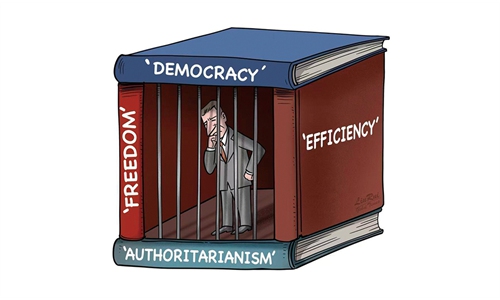
I would argue that the main advantage is the ability to maintain priorities over extended periods without depending on electoral cycles. This facilitates cumulative policies - such as advanced industrialization, infrastructure, and technological transition - that require decades of coherence. Where competitive systems may experience shifts between governments, sustained strategic planning preserves a relatively stable course.
Secondly, the system allows for faster alignment across administrative levels. This reduces implementation friction and facilitates the execution of large-scale, complex projects. It doesn't eliminate conflicts, but it tends to resolve them internally rather than externalizing them in the public arena.
Finally, governance is legitimized not only by immediate results but also by its integration into a long-term project. This narrative provides cohesion and continuity, reducing the fragmentation and dispersion of political debate.
RELATED ARTICLES