Are Hainan’s special customs operations taking someone else’s slice of the pie?: Global Times editorial
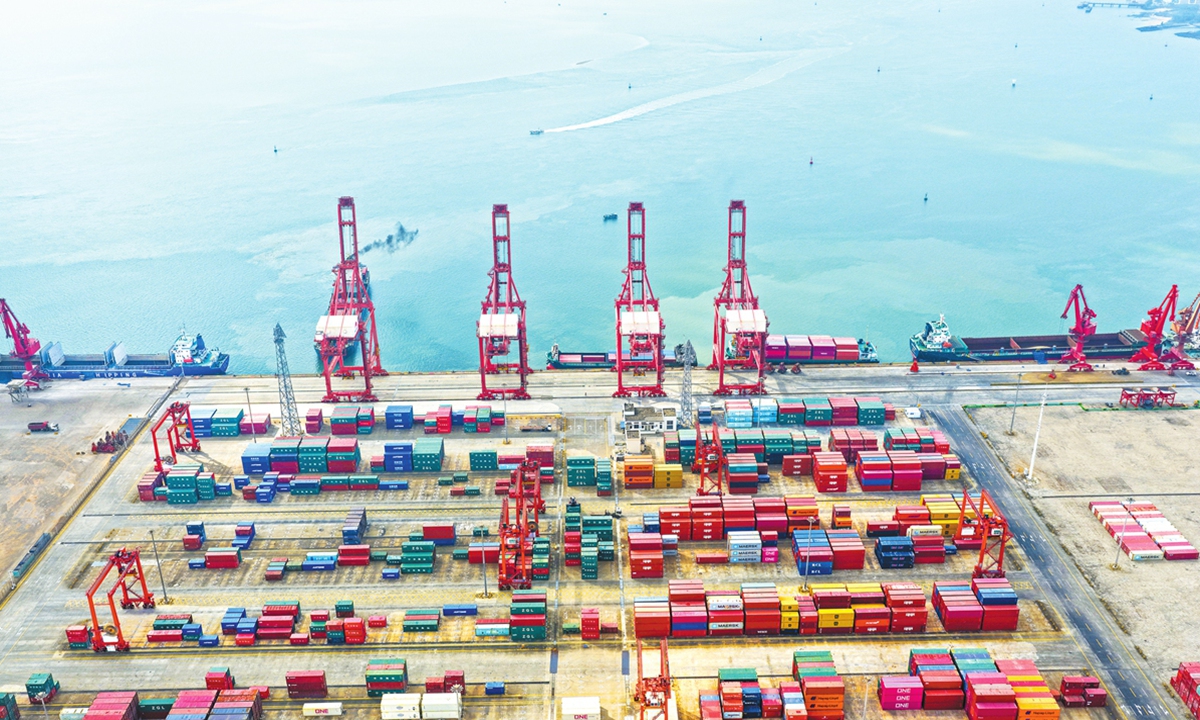
An aerial view of the busy and orderly scene at Yangpu Port in Danzhou, South China's Hainan Province, on December 20, 2025 Photo: VCG
Editor's Note:
Currently, China's economy is steadily advancing along the path of high-quality development, even as domestic and international circumstances become increasingly complex. Some Western media, due to misunderstanding or bias, have repeatedly questioned or even distorted China's economic development. Accordingly, the Global Times launches the "Q&A on China's Economy" column to publish opinion pieces to present facts and clarify perceptions.
It has been over 100 days since the island-wide special customs operations of the Hainan Free Trade Port were launched. Its institutional design and innovative framework have drawn widespread attention from both domestic and international media. At the same time, questions such as "will Hainan replace Hong Kong?" and "will Singapore be affected?" occasionally surface, reflecting concerns that Hainan's special customs operations may impact other regional competitors, particularly by squeezing the development space of some mature free trade ports in the Asia-Pacific. Such views remain trapped in an outdated narrative of zero-sum competition. They fail to understand the new practice of China's opening-up and cooperation strategy as embodied in the Hainan Free Trade Port.
So, are Hainan's special customs operations really taking someone else's slice of the pie? As a key pilot region in China's reform and opening-up process, Hainan has consistently adhered to the principles of openness, cooperation and mutual benefit. Its special customs operations are not aimed at any specific country or port. The data speaks for itself. During the 100 days of special customs operations, the "win-win" effect has begun to emerge: visa-free arrivals increased by 54.2 percent year-on-year, foreign trade grew by 32.9 percent and the number of newly established foreign-invested enterprises rose by over 30 percent. Meanwhile, Singapore recorded a record high in marine fuel sales this January, underscoring its solid position as the world's largest bunkering port; China's Hong Kong also saw double-digit growth in import and export value in the first two months of the year. These facts show that Hainan's special customs operations are not taking anyone's share, but rather creating incremental growth for the regional economy and expanding the size of the "pie".
Any discussion of "competition" among ports must be grounded in the basic economic principle of comparative advantage. Take Singapore as an example: As a globally renowned transshipment hub, it leverages its natural geographic advantage at the chokepoint of the Strait of Malacca to focus on cross-regional and global supply chain transit, occupying a key position in the global logistics network. By contrast, the Hainan Free Trade Port serves as a gateway hub oriented toward the Chinese mainland market, with its core function being to facilitate flows into and out of the Chinese market. Singapore's strengths lie in its highly skilled population, mature financial system, advanced high-tech industries and well-established ecosystem of international cooperation. Hainan's advantages, on the other hand, include backing from the world's largest manufacturing economy, vast land development potential, a favorable climate and ecological resources, and sustained policy and financial support from the central government. The two differ clearly in target markets, value chain roles, and competitive strengths, representing distinct development quadrants rather than direct, homogeneous competition.
What "potential impact" might the Hainan Free Trade Port have on Singapore? This question was raised by a Singaporean member of parliament in February this year. In response, Singapore's Deputy Prime Minister Gan Kim Yong noted that the impact is likely to be limited. Last week, at the Boao Forum for Asia Annual Conference 2026, Singapore's Prime Minister Lawrence Wong praised the Hainan Free Trade Port as a vivid example of China's commitment to openness. In fact, multilateral frameworks such as the China-Singapore Free Trade Agreement and the Regional Comprehensive Economic Partnership have already created low-tariff channels for Singapore's exports to China. As China continues to expand opening-up, overall global trade flows will increase, and Hainan's facilitation of direct access for ASEAN goods to the Chinese market will, in turn, help expand the "pie" of trade for all countries in the region.
At present, as the US-Israel-Iran conflict escalates, global investors are closely watching a new geopolitical landscape and shifts in international capital flows. Against this backdrop, the development blueprint for the Hainan Free Trade Port is clear and well-defined. Leveraging policy dividends, it will build a high-end trade services cluster that integrates logistics, warehousing, finance, legal and other services. For rational global investors, the development potential and investment opportunities arising from Hainan's full special customs operations are the issues that deserve the most attention.
The 21st century is widely regarded as the century of Asia, with an estimated substantial increase in the number of middle-income consumers requiring massive infrastructure development. Asia's economic growth is projected to reach 4.5 percent in 2026, remaining a key engine of global economic growth. In other words, Asia's real economy alone may require 10 or even 20 more world-class ports on the scale of Singapore to support expanding shipping operations and cross-border investment. The construction of the Hainan Free Trade Port is both a response to regional development needs and a shared commitment to Asia-Pacific prosperity.
Hainan has been actively learning from internationally recognized free trade ports such as Hong Kong, Singapore and Dubai, while pursuing complementary strengths and deeper cooperation with them. The notion of "competing for the same slice of the pie" ignores the potential for achieving win-win outcomes and common success. Today, China needs Hainan as a "testing ground" to deepen opening-up and explore institutional innovation, while other international free trade ports can leverage China's continued opening-up to optimize their own development models and engage with Hainan in higher-level competition and collaboration. This kind of positive interaction will ultimately enhance supply chain efficiency and trade growth across the Asia-Pacific, benefiting all countries and regions involved.
RELATED ARTICLES