China firmly opposes Philippines ‘renaming’ Nansha Qundao island features, vows to defend sovereignty
Manila urged to refrain from opportunism and duplicitous tricks in China ties
Chinese Foreign Ministry
China on Wednesday expressed firm opposition to the Philippines' infringement upon China's sovereignty and rights and interests and vowed to do what is necessary to firmly defend its territorial sovereignty and maritime rights and interests in the South China Sea after reports that the Philippines will rename more than 100 island features in a bid to reinforce its "sovereignty" in the South China Sea.
Chinese Foreign Ministry spokesperson Mao Ning made the remarks at a regular press conference in response to a question regarding the Philippines' plan to rename more than 100 island features belonging to the Nansha Qundao in the South China Sea.
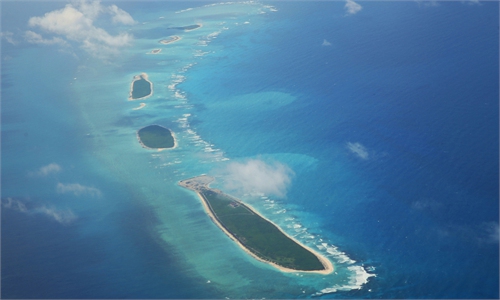
China has indisputable sovereignty over Nansha Qundao and its adjacent waters, Mao said.
The Philippines illegally delineated the so-called "Kalayaan Island Group" (KIG) beyond its territorial scope, and carried out so-called "naming" of relevant islands and reefs in China's Nansha Qundao, which violates China's territorial sovereignty and goes against the UN Charter and relevant international laws, the spokesperson said.
The Philippines' illegal claims over self-claimed "KIG" area have long been denounced by China. The white paper titled China Adheres to the Position of Settling Through Negotiation the Relevant Disputes Between China and the Philippines in the South China Sea, issued by China's State Council Information Office in 2016, refuted the Philippines' "KIG" claims.
It said that the Philippines claims its nationals "discovered" the islands in 1956, and uses this as an excuse to single out some islands and reefs of China's Nansha Qundao and name them "KIG" - an attempt to create confusion over geographical names and concepts and dismember China's Nansha Qundao.
As a matter of fact, the geographical scope of Nansha Qundao is clear, and the so-called "KIG" is part of China's Nansha Qundao, according to the white paper.
Nothing but a stunt
Following an order issued by Philippine President Ferdinand Marcos Jr, the Philippines will adopt local names for more than 100 features in the so-called "KIG." This move will also extend from maps to the education sector, Philippine media claimed.
The move is based on Executive Order (EO) 111 issued on March 26 and released Tuesday night, upon the recommendation of the National Maritime Council (NMC), Philippine News Agency (PNA) reported on Wednesday.
The Philippines' National Maritime Council claimed standardizing the names is essential to ensure "effective administration and governance," as well as to strengthen the Philippines' "sovereign rights" over the area, according to Philippine News Agency (PNA).
In the face of facts and legal principles, the Philippines' unilateral naming is merely a rhetorical ploy aimed at reinforcing its claims over the so-called "KIG," Chen Xiangmiao, a research fellow at the National Institute for South China Sea Studies, told the Global Times on Wednesday.
Chen said that such acts and claims neither alter the sovereignty over the features in the South China Sea nor hold any substantive significance in the eyes of the international community.
The Philippines-based news outlet Rappler has also indicated that "the EO's scope is limited, after all, since it only covers the executive branch." Citing the example of the Philippines' naming of the waters west of the country as the "West Philippine Sea," the report noted that no other country, not even its treaty-ally the US, uses this term.
Under the latest order, the Philippine National Mapping and Resource Information Authority has been directed to update and publish official maps and charts reflecting the new names, which have yet to be released, per the report.
The EO also instructed national government agencies and instrumentalities to use the names in all their official communications, messages and documents, Philstar reported.
According to Philippine media, certain educational authorities and institutions are expected to use the names in educational and training institutions as well as in research, textbook publishing, and instructional materials.
Chen said the aim is to inculcate nationalist ideology in young Filipinos in their formative years through education and embed its so-called South China Sea claims in the national consciousness.
Such sentiments are likely to deepen the rift between China and the Philippines and undermine future bilateral consultations between the two countries, Chen added.
Tricks of duplicity
Just last week, Marcos expressed willingness to resume discussions with China on a joint oil and gas project in the South China Sea, a move which Philippine media said was a "reset" in China-Philippine relations. Marcos also mentioned talks with China on fuel and fertilizer, claiming that China has been very "helpful" with fertilizers, per Bloomberg.
On March 28, Chinese Vice Foreign Minister Sun Weidong co-chaired the 24th China-Philippines Foreign Ministry Consultations (FMC) with Undersecretary for Policy of the Department of Foreign Affairs of the Philippines Leo M. Herrera-Lim in Quanzhou, East China's Fujian Province, which marks the first such consultation in three years, following the 23rd round held in Manila in March 2023.
Yet, even as signs would seem to suggest a thaw in China-Philippines relations, the Philippines did not cease its underhand moves throughout March, extending from maritime actions to this latest act of renaming some areas, observers said.
The Southern Theater Command of the Chinese People's Liberation Army (PLA) and Chinese Coast Guard issued four statements in response to the Philippines' relevant provocative acts in March alone.
Ding Duo, director of the Research Center for International and Regional Studies at the National Institute for South China Sea Studies, told the Global Times on Wednesday that while there have been some signals of de-escalation in tensions between the two countries, the Philippines' provocative move to rename relevant maritime features once again exposes the opportunism and inconsistency of its policy toward China - a tendency that is inextricably linked to the fragmentation of interest groups within the country.
Echoing Ding, Chen also said the Philippine police and fisheries authorities seek to assert their so-called rights through provocative actions in the South China Sea, in an effort to secure the backing of both chambers of Congress, while economic authorities aim to maintain stability.
For China-Philippines relations, the Marcos administration now stands at a crossroads of choice: it must understand the true meaning of "self-restraint," Ding said.
If the Philippines is truly committed to easing relations with China, it should foster a sound atmosphere and earn China's trust, instead of putting on such an act of duplicity as provoking China one moment and seeking cooperation the next, said Ding.
RELATED ARTICLES