IN-DEPTH / IN-DEPTH
China’s grass-roots ‘CPC officials face setbacks openly and adjust promptly when problems emerge’: village Party chief’s ‘foreign assistant’ from Luxembourg
Planting with passion
By Lin Xiaoyi and Published: Apr 01, 2026 08:20 PM

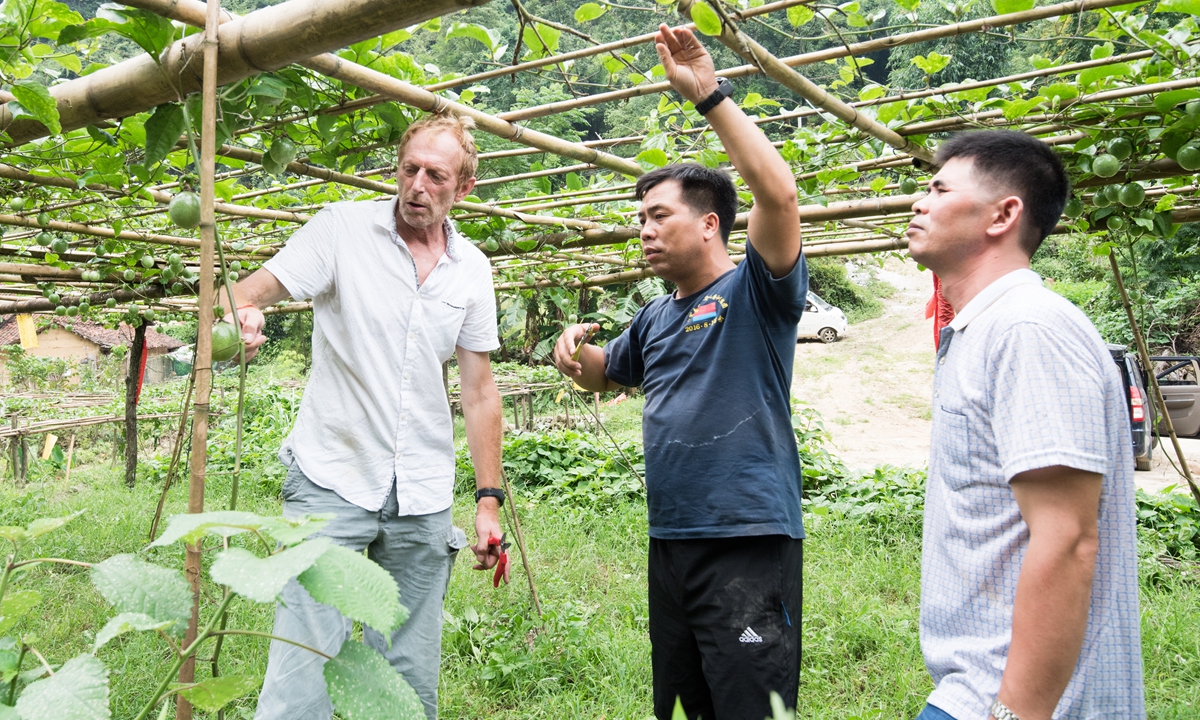
Hansen Nico Rene (left) and Xie Wanju (center) check the growth of passion fruit in the fields of Zhadong village in Hechi. Photo: Courtesy of Xie Wanju
Editor's Note:Chinese President Xi Jinping has pointed out, "to understand China today, one must learn to understand the Communist Party of China (CPC)." With the rapid development of China's economy and society, and the steady advancement of the Chinese path to modernization, the notable achievements of the CPC have drawn extensive international attention and scholarly interest. Against this backdrop, the Global Times has launched the "CPC in Global Eyes" column, focusing on the feelings, perspectives and insights of international friends from various fields regarding the CPC's historical path and achievements.
They include those who have visited or toured China, those who study the CPC deeply in academic fields, those who work, live, study or do business in China across various sectors, and those who closely follow the CPC's policies and developments. Through their vivid personal experiences, we aim to present a multifaceted overseas view of the CPC.
In the ninth installment of this series, we follow Hansen Nico Rene, a retired police officer from Luxembourg who became a "foreign assistant" to a village Party secretary in South China's Guangxi Zhuang Autonomous Region, as his eight-year journey of growing passion fruit opens a unique window into CPC's correct understanding of what it means to perform well - to maintain a people-centered approach and take concrete action to meet public needs.
Hansen Nico Rene and his partner Xie Wanju, the first secretary of Lianhua village's Party committee in Hechi, South China's Guangxi Zhuang Autonomous Region, walk steadily along the damp field ridges. Neat rows of young passion fruit seedlings line both sides. White plastic mulch, laid around the roots of each sapling to retain soil moisture and suppress weeds, glows softly in the spring sunlight.
It was just another day, much like many others since their paths first crossed in 2018.
A retired police officer from Luxembourg, Nico originally came to the mountains of Guangxi just as a traveler. But he soon grew deeply attached to the land and its people. In the spring of 2018, he became a "foreign assistant" to Xie.
Over the past eight years, he has followed Xie from Zhadong village in Hechi's Yizhou district to Lianhua village in Nandan County. He witnessed the trials, setbacks and adjustments of the local passion fruit industry in Zhadong, and later watched the crop take root, grow and thrive in Lianhua village through tailored, local planting plans.
He has walked through the fields, recorded daily life with his camera and taken part in village work wholeheartedly, seeing firsthand the most subtle and real details of grass-roots governance in rural China.
"What stays with me are the smiles and daily lives of the villagers. Xie Wanju always told me: people come first, and then people again," Nico told the Global Times.
Bond forged in fields
Nico's bond with Xie began with a single post on WeChat recruiting volunteers.
At the time, Xie served as the first Party secretary of Zhadong village. The village's passion fruit project was low on manpower, so he posted a call on WeChat's Moment, asking for volunteers to help drive stakes and build trellises for passion fruit trees. Responses came quickly, and among them emerged a tall, blond figure - Nico, who was then traveling through Guangxi after retiring.
"At that time, I saw poverty and a man, Xie Wanju, fighting to give a better life to these people. Golden passion fruit should be a solution. When I was asked to become a volunteer, I couldn't refuse," Nico said.
He joined the volunteer team right away. "I agreed to let Nico help out first because he truly wanted to, and second, I wanted foreign friends to see with their own eyes that we have the confidence and ability to build our countryside better," Xie recalled.
The two couldn't speak each other's language, but Nico headed straight for the fields the very next day. Standing over 1.9 meters tall, Nico handled the trellises and guy lines with ease; more than that, he worked with a kind of meticulousness that stood out. "The lines he pulled were perfectly straight," Xie remembered. "We usually chase speed, but Nico wanted it not only fast, but neat and proper - even beautiful."
Nico's first impression of Zhadong was one of stark contrast. "First we planted passion fruit in Zhadong. I didn't imagine such poverty in rural China," he said.
Yet amid the hardship, he also saw Xie's determination. The first year, the passion fruit harvest was promising. When buyers came, tasted the fruit and paid farmers in cash on the spot, "I will never forget the happiness when the trader tasted the fruits and gave cash to the farmers," Nico said.
But the complexity of rural work soon surfaced. Zhadong's bowl-like terrain became a "trap" in July 2019, when relentless rain flooded the low-lying fields, and an underground river submerged the nearly-ripe passion fruit vines within 12 hours. The next year, pest infestations struck. Two years of natural disasters washed away much of their early effort.
Faced with failure, the choice was stark: push ahead just to say the plan was being followed, or face facts and change course.
"We did not gamble, we did not practice speculative agriculture," Nico told the Global Times.
Leading the village committee, Xie invited agricultural experts. After a scientific assessment, the team decided to abandon passion fruit cultivation in the water-prone lowlands. Instead, they switched to fast-growing, flood-resistant forage grass, alongside supporting cattle and pig farming. The pivot was timely; the forage grass business turned a profit that same year.
"When we spot a problem, we fix it promptly, based on scientific research and decision-making. We own our mistakes, and we never stubbornly stick to a wrong path," Xie told the Global Times. He said that on the grass-roots front, decisions have to respect objective laws and deliver real results. No matter how well-devised the deployment, or how beautiful the blueprint, if not planted in suitable soil, they will ultimately remain nothing but castles in the air.
This "pain of transformation" gave Nico a new understanding of the sound performance mindset of China's grass-roots officials.
"China's grass-roots CPC officials face setbacks openly and adjust promptly when problems emerge. It's not about treating a plan as its own accomplishment - it's about genuinely considering what's best for the villagers in the long run," Nico observed.
Expansion of trust
In 2023, Xie was sent to Lianhua village, another village in Hechi's Nandan County, to help launch a new phase of rural revitalization work. Nico, without hesitation, followed Xie to the new front.
A fresh challenge awaited. Lianhua has wide day-to-night temperature swings, and no one there had ever managed to grow passion fruit successfully. Learning the hard lessons from Zhadong village, Xie didn't rush villagers into large-scale planting. Instead, he decided to test the local crop himself.
In 2024, Xie borrowed 10,000 yuan ($1,448) from a friend and cleared 0.067 hectares of land as an experimental plot, and planted passion fruit. When the fruit ripened, he took some villagers to the market and sold the fruit at a good price - 30 yuan per kilogram. Sweet fruit and tangible income proved the most persuasive argument, as local villagers felt the potential benefit in their pockets, their confidence in building a new industry was instantly boosted, Xie said.
In 2025, local villagers began planting passion fruit on their own initiative, with no urging from Xie and other village officials, pushing the cultivated area to 2.67 hectares. This year, it has expanded to 5.33 hectares, becoming a bright new source of income for the whole village.
Nico witnessed this "expansion of trust" every step of the way. He saw how grass-roots officials replaced empty slogans with down-to-earth action: "Show you how it's done, work alongside you, and help you earn money." Bit by bit, they bridged the "implementation gap" between policies and villagers' confidence.
"Problems are no secrets, and problems need solutions," Nico reflected. "Of course, there are checklists and paperwork, but I remember, when we started with passion fruit, we travelled a lot - visiting everyone planting passion fruit within a 100-kilometer radius. Not out of simple curiosity, but to share experiences, good and bad. When a decision is taken and approved by the local committee, it has been analyzed for a long time beforehand. We just want to stress: people's future is never gambled with," he told the Global Times.
From observation to belief
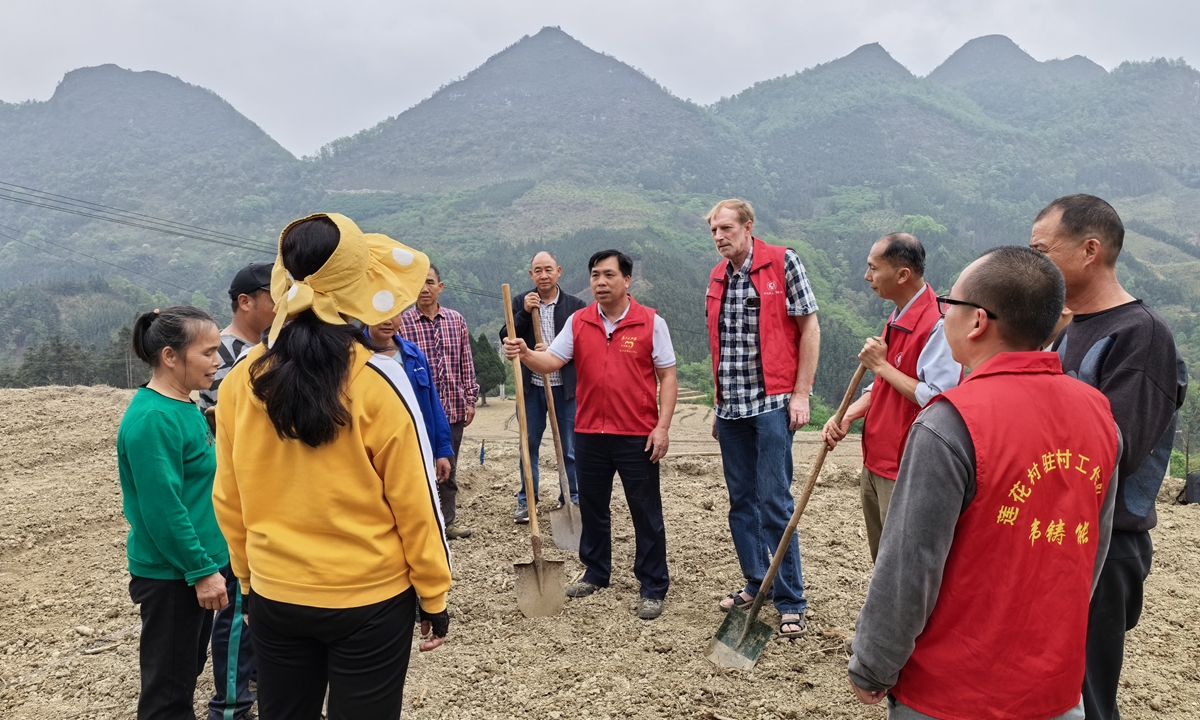
Members of the village-based work team, wearing red vests, explain key points regarding passion fruit cultivation to the villagers in Lianhua village, Hechi, in April 2024. Photo: Courtesy of Xie Wanju
Throughout the day, working in the passion fruit field, both Nico and Xie wore red vests emblazoned with the words "Serve the People."The Global Times also found that Nico's WeChat profile picture shows him in front of the Zhadong village committee building, wearing a backpack with the same slogan, giving a thumbs-up.
Years of living, eating and working alongside villagers have given Nico a distinct understanding of how China's grass-roots organization operates.
He believes grass-roots officials are one of the main reasons why China succeeds in so many things: They are effective precisely because they are so close to the people; they know everyone by name; they greet newborns, honor outstanding students and remember those who pass away.
"Any administration in other countries that I know cannot do this, because officials sit in their offices and wait for residents to come with their problems," he commented.
He contrasts this with systems in the West. "Europe has social workers, but they generally only go where they are called. Chinese grass-roots officials are part of the society. They see and hear things people might not otherwise tell them." His greatest respect, he says, is for officials like Xie, who connect deeply with the community, take responsibility and do not abuse their power.
Although Nico describes himself as living a retired life - "I will never get a busy schedule" - his plans for the next chapter of his life in Guangxi are clear and concrete:
"There are more passion fruit fields this year." He hopes the village's infrastructure will be further improved. "If this year's harvest is successful, more people will follow. More people, means new ideas."
On this land full of opportunities and new changes, he has witnessed countless "new things": young people returning to start businesses, the elderly moving into new homes, children walking out of the mountains on newly paved roads.
Whenever asked how he views China, Nico's response remains simple and consistent: "Come and see. Talk to the local people."
In his view, those with genuine, on-the-ground experience are the most credible voices to share that story with others: With dedication and perseverance, the Chinese people are fully capable of creating a brighter future for themselves.
RELATED ARTICLES