China-Pakistan ‘five-point initiative’ threads needle for peace with rationality: Global Times editorial
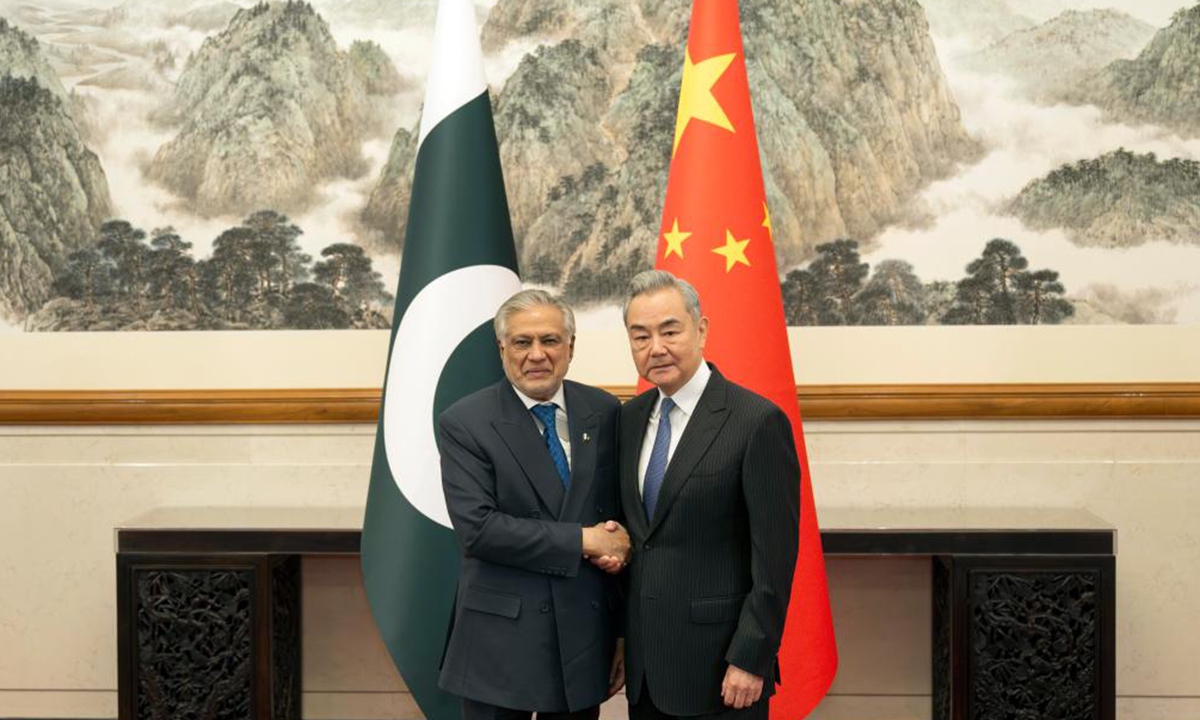
Chinese Foreign Minister Wang Yi, also a member of the Political Bureau of the Communist Party of China Central Committee, holds talks with Pakistani Deputy Prime Minister and Foreign Minister Mohammad Ishaq Dar in Beijing, capital of China on March 31, 2026. Photo: Xinhua
The five-point initiative for restoring peace and stability in the Gulf and Middle East region, put forward by China and Pakistan, has drawn significant international attention since its proposal on March 31. Proposed at a critical juncture when the conflict is at a crucial crossroads of "war or ceasefire" - amid the Strait of Hormuz crisis and global supply chain disruptions - the initiative is timely, pragmatic and highly constructive. It fully demonstrates China's sense of responsibility as a major country, highlights the unique value of the China-Pakistan all-weather strategic cooperative partnership, and injects vital momentum into efforts for the cessation of hostilities.
The initiative can be summed up in three words: cease, talk and ensure, namely immediate cessation of hostilities; start of peace talks as soon as possible; security of nonmilitary targets; security of shipping lanes; and primacy of the United Nations Charter.
The initiative addresses both urgent humanitarian and security concerns while laying the groundwork for a long-term political solution. Each point precisely targets key pain points and bottlenecks of the current crisis, offering a comprehensive and well-calibrated remedy that tackles both symptoms and root causes. It represents not only the common stance of China and Pakistan but also the shared aspirations of the international community, particularly the Global South countries that rely heavily on Middle Eastern energy and shipping lanes.
At present, both the US and Iran have shown a willingness to engage in negotiations, making the initiative particularly well-timed. One key reason it has received such attention since its release is the widespread belief that it is more than a mere statement of intent - it holds genuine potential to provide more momentum for facilitating US-Iran talks. This is due in part to Pakistan's unique role as a key intermediary, as well as China's considerable influence.
Pakistan's Deputy Prime minister and Foreign Minister Ishaq Dar stated before his visit to China that China had extended full support to Islamabad's initiative to host representatives from Iran and the US, which would go a long way to end the month-long conflict. Iran's ambassador to Pakistan welcomed Pakistan's mediation, appreciating the "proactive diplomatic initiatives based on good-will," underscoring the constructive role of the five-point initiative.
This also marks the first time that China has issued a joint initiative with another country on the US-Israel-Iran conflict. The China-Pakistan joint effort signals that momentum for promoting peace talks has evolved into a combined force of regional countries and major powers, and it is open to all peace-loving nations. Such an open and inclusive framework for peace helps rally the just voices of the international community, making mediation efforts broader in scope and stronger in impact.
Of course, launching peace talks is no easy task, but only by getting the parties to the table can further casualties and losses be avoided. The value of the five-point initiative proposed by China and Pakistan lies precisely in the fact that it sets rational "guardrails" and lays out a path toward peace. In future negotiations and strategic interactions, any party seeking to breach the ceasefire baseline, target civilians, or block sea lanes will face the pressure of international consensus, moral expectations and the rules embodied in this initiative. The more countries that participate, the greater the pressure on those who undermine peace.
We have also noted that some voices in the international community speculate whether China intends to "intervene in the conflict" or "provide security guarantees." Such claims misunderstand China's role and principles. China is not a party to the conflict and has consistently adhered to the principle of non-interference in others' internal affairs, while upholding a vision of common, comprehensive, cooperative, and sustainable security. Narratives of "intervention" or "security guarantees" are, at their core, products of bloc confrontation thinking. They will not bring lasting peace and may instead further complicate tensions. Achieving the cessation of hostilities ultimately requires the parties to the conflict, particularly the US and Israel, to cease military actions as soon as possible and return to the right track of complying with international law and the basic norms of international relations. The five-point initiative is not about "intervening" in the conflict; rather, it responds to the expectations of regional countries and their peoples, offering a constructive plan to advance peace and serving as a bridge for dialogue and communication among all parties.
The five-point initiative once again demonstrates that beyond the law of the jungle and military adventurism, there is a rational choice grounded in rules and dialogue, as well as a viable path to peace. China's recent measures in the Middle East - from facilitating the Saudi-Iran rapprochement to promoting intra-Palestinian reconciliation, and now to proposing this joint initiative - have clearly outlined a practical pathway for implementing the Global Security Initiative. Instead of relying on military deterrence or bloc confrontation, the approach is to patiently and impartially bring conflicting parties back to the negotiating table, and encourage them to sit down and talk. The more sincere efforts there are to de-escalate tensions, pave the way for a ceasefire, and build bridges for dialogue, the sooner the flames of conflict may subside.
RELATED ARTICLES