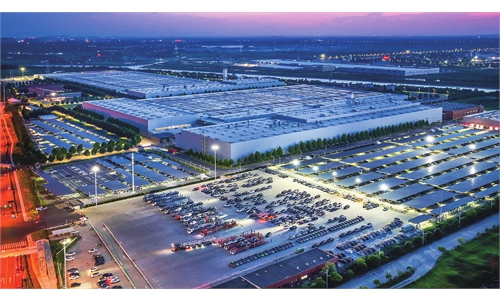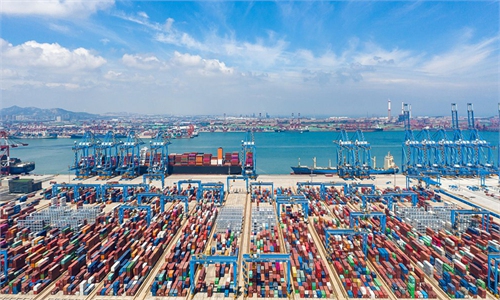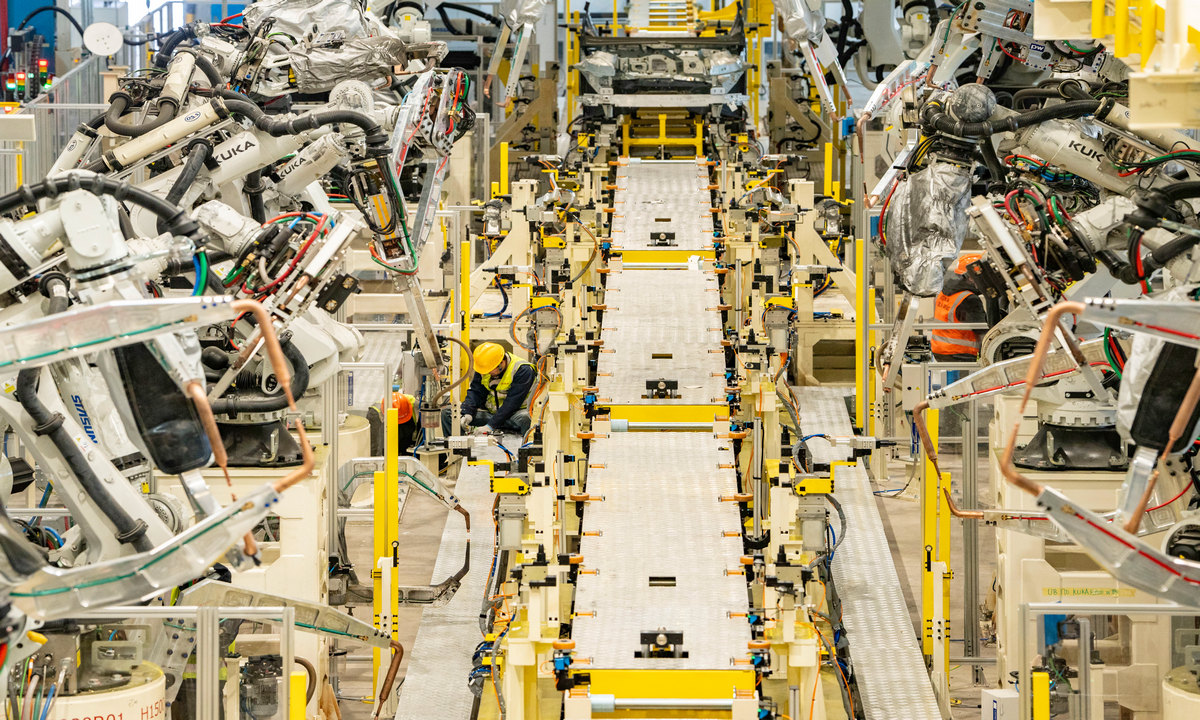
Technicians debug robots installed on the new production line at a welding workshop in Yiwu, East China's Zhejiang Province, on February 25, 2026. Photo: VCG
Recently, some foreign media outlets have claimed that, despite the enormous success of China's high-tech industries, traditional sectors, which account for the largest share of the economy, are under pressure. They argue that this economic divergence could intensify during the 15th Five-Year Plan period (2026-30). The rhetoric about China's economy falling into a "hot and cold divide," if not intentionally misleading in an attempt to slow the development of high-tech industries, reflects a failure to understand the internal logic of China's technological progress and ignores the deep connections among traditional, emerging, and future industries.
Judging from actual economic data and development trends, China's economy has not fallen into the so-called "hot and cold divide." Instead, it is undergoing an unprecedented and profound transformation. The deep integration of high-tech and traditional industries, the mutual empowerment of the digital and real economies, and the dynamic interplay among traditional, emerging, and future industries will continue to drive sustained economic growth.
Will the development of emerging and future industries divert resources away from traditional industries?
A buzzword has recently emerged - ciyuan (token). A token is essentially the smallest unit of information processed by large AI models. The more tokens are used, the more instances of AI computation are at work.
According to official data, as of March this year, daily token usage in China exceeded 140 trillion. This is more than 1,000 times the level seen at the beginning of 2024, when it stood at 100 billion, and more than 40 percent higher than the 100 trillion tokens recorded at the end of 2025.
This pace of growth indicates that AI is gradually transitioning from a high-end technology to digital infrastructure. Some economists compare this to the spread of electricity.
When electricity first emerged, it was a high-tech product, and ordinary factories could not afford to use it. However, with the expansion of the power grid and the decline in electricity prices, electricity became essential infrastructure for production and daily life, widely applied in cotton mills, steel plants, and eventually reaching every home. AI is following a similar trajectory. Moreover, compared with many other economies, China is advancing quickly on this path.
In China, the cost of using each token is expected to decline further - a trend that is almost certain. This could further spur the rapid development of high-frequency, large scale, and sustainably profitable business applications across both traditional and emerging sectors such as finance, cross-border e-commerce, and manufacturing.
The boundaries between high-tech and traditional industries are becoming increasingly blurred. In the interface between them, dynamic interplay takes place continuously, with effects flowing in both directions.
On one hand, high-tech industries are empowering traditional industries, such as AI driving the upgrade of the textile and steel industries; on the other hand, the demands of traditional industries are accelerating the deployment and commercialization of AI technology, such as the widespread application of AI in the toy industry, turning AI-powered toys into a new tool for young parents to bring technology into parenting.
High-tech and traditional industries do not exist in a "zero-sum" relationship; they are neither competing for development resources nor simply substituting one another. Rather, they empower and promote each other. The so-called "hot-cold divide" of China's economy is essentially an inertia-driven projection of outdated industry-classification thinking, a cognitive lag that interprets dynamic technological change through a static lens. Behind the 140 trillion daily average token usage, lies the rapid redefinition of old and new industries in China's economy, where tech revolution and industrial transformation are deeply intertwined, producing a distinctive "Chinese warmth."
How does the 15th Five-Year Plan (2026-30) scientifically plan for emerging and future industries?
When industrial integration breaks the narrative of "hot and cold divide," the layout of the 15th Five-Year Plan (2026-30), at the level of top-level design, clearly defines three directions for constructing a modern industrial system: intelligence, green development, and integration.
Developing new-quality productive forces is not about neglecting or abandoning traditional industries. In the second section, "Building a modern industrial system and consolidating and strengthening the foundation of the real economy," of the outline of the 15th Five-Year Plan (2026-30) for national economic and social development, the section on "optimizing and upgrading traditional industries" appears at the beginning. This chapter proposes strengthening the empowerment of digital, intelligent, and green technologies… to enhance China's position and competitiveness in the global division of labor.
The development of China's traditional industries has continued. With a wide range of sectors, large scale, and solid foundations, traditional industries form the bedrock of high-quality development of China's manufacturing sector. According to media reports, China's manufacturing value added accounts for nearly 30 percent of the global total, and its overall scale has ranked first in the world for 15 consecutive years - achievements closely linked to the steady development and ongoing optimization of traditional industries.
Building on the solid foundation of manufacturing development, while optimizing and upgrading traditional industries, China also needs to cultivate and grow emerging and future industries. The 15th Five-Year Plan (2026-30) calls for strengthening the supply of source technologies, accelerating the creation of application scenarios and ecosystems, cultivating more pillar and leading industries, and constructing new advantages in industrial development.
Future, emerging, and traditional industries are relative concepts, not fixed categories. Today's future industries may soon become emerging industries, or even traditional industries. The key driving force behind this industrial transformation is technological progress and widespread application. China's emphasis on strengthening source technology supply captures the essence of developing future industries, which is not about diverting resources from traditional industries and exacerbating so-called economic "hot and cold divide," but rather about driving industrial upgrading and transformation by strengthening the supply of source technologies.
Why are some foreign media so keen on promoting the "hot and cold divide" narrative?
Are China's traditional industries really facing difficulties? The toy industry, a traditionally labor-intensive sector, may help illustrate some points.
According to the 2026 China Toy and Juvenile Products Industry Report released by the China Toy and Juvenile Products Association, in 2025, the domestic retail sales of toys (excluding trendy toys) reached 103.53 billion yuan ($15.05 billion), marking a 5.8-percent year-on-year increase, while the retail sales of trendy and collectible toys reached 67.69 billion yuan, growing 45.4 percent.
Placed side by side, the 5.8 percent and 45.4 percent figures provide a true snapshot of China's economy: While the foundation of traditional industries remains solid, numerous new growth opportunities are emerging. This phenomenon reflects the complex and evolving interplay between China's economy and its consumer market.
Expanding the perspective from the toy industry to the macro level, China's industrial growth is generally steady. In 2025, the total value added of industrial enterprises above designated size rose by 5.9 percent year-on-year. Broken down by industry: Mining grew by 5.6 percent, manufacturing grew by 6.4 percent, and the production and supply of electricity, heat, gas, and water grew by 2.3 percent. However, some foreign media outlets selectively ignore these facts and instead amplify isolated economic issues, talking down the state of traditional industries. This judgment clearly diverges from the facts and is not only limited by cognitive biases but may also be influenced by strategic considerations.
Clearly, some Western nations are reluctant to see the rapid development of China's high-tech sector. On the one hand, they hype the "expansion risks" of China's AI and robotics industries, fueling "China threat" rhetoric; on the other hand, they attempt to undermine Chinese economy, creating a false narrative of "internal imbalance," and pushing a false narrative that China must choose between maintaining economic balance and developing high-tech industries. This two-pronged smear is simply an attempt to slow the progress of China's emerging and future industries.
They've clearly miscalculated. The key step in China's cultivation and expansion of emerging and future industries is strengthening the supply of source technologies. The goal of technological development is not to compete with others, but to fulfill the people's aspirations for a better life and to contribute to global technological progress. The 140 trillion daily average token usage is not only injecting vitality into China's economy but also providing a Chinese solution for the development of the global digital economy.
History has repeatedly proven that while the voices of those attempting to discredit China never cease, China's growth has continued steadily. When AI technology guides farmers in scientific planting, when intelligent robots collaborate with workers in factories, and when smart digital technology allows local specialties from remote areas to reach the global market, these changes show that the dynamic interplay within China's economy is gradually being unleashed, and the balance, vitality, and resilience of economic development are being enhanced.
RELATED ARTICLES