Holiday consumption gains momentum as Chinese people embrace Qingming Festival, spring breaks
Targeted policy support backs nation’s economic goals
By Chen Qingrui and Published: Apr 02, 2026 11:47 PM

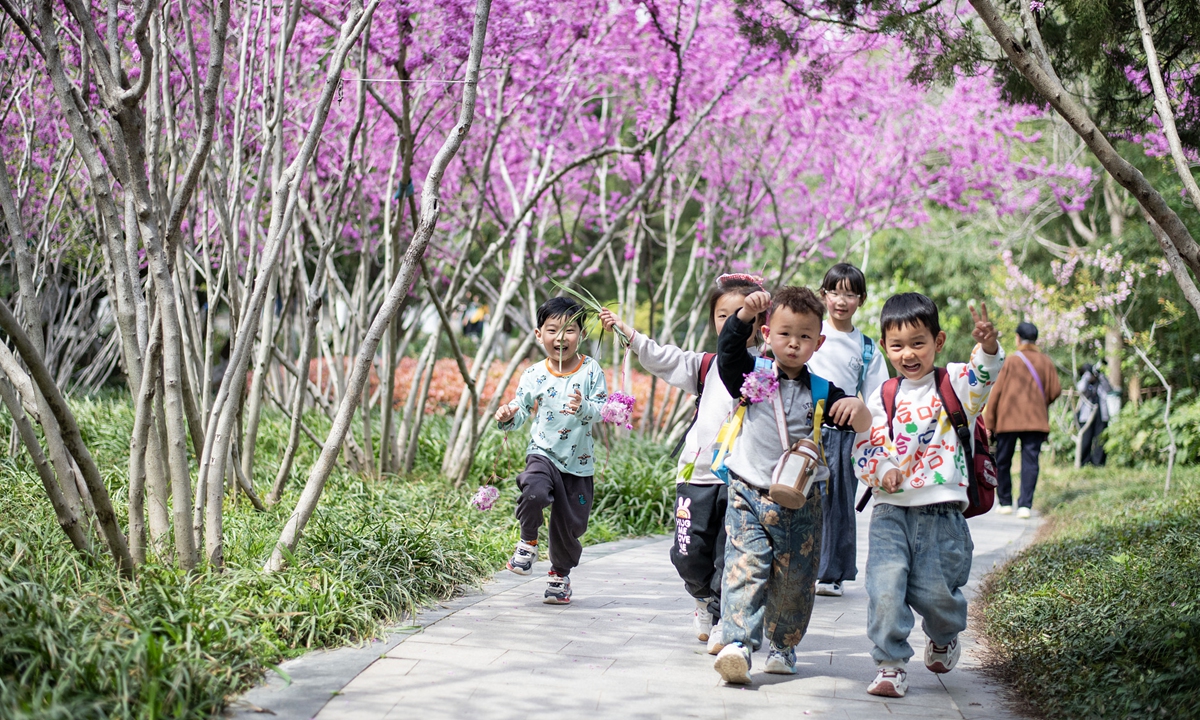
A group of children, led by their teachers, take a spring outing in Xiangshan National Forest Park, Huaibei, Anhui Province, on April 2, 2026. Photo: VCG
"We wanted the trip to feel unhurried," Lin, a tourist from Central China's Hunan Province traveling with his wife and primary school-aged child.
"What we need most is time — and the government is giving us that time. We finally had the time to slow down and go a bit farther."
Lin's family arrived a few days ahead of the traditional holiday rush for the Qingming Festival holiday [from April 4 to 6], he said. His child's school had already begun her spring break on Wednesday.
As the Chinese government highlighted the role of boosting consumption in the national economy, vowing the in-depth implementation of a dedicated initiative to boost consumption and unlocking the potential of services consumption, the nation's 2026 Government Work Report called for supporting eligible regions in promoting spring and autumn breaks for primary and secondary schools, and for implementing a paid leave system that enables staggered vacations, according to the Xinhua News Agency.
The Central Economic Work Conference held last year stressed the need to advance a targeted campaign to boost consumption and roll out plans to raise incomes for both urban and rural residents. It also called for expanding the supply of high-quality goods and services, while removing unreasonable restrictions in the consumption sector to unlock the potential of service consumption.
The policy direction has already been implemented in multiple provinces. Lin's choice reflects a broader shift in travel behavior this year, as the overlap between spring breaks and the Qingming Festival holiday has effectively lengthened the vacation window, reshaping how Chinese travelers plan and spend, a Chinese expert noted.
"Driving gives us more flexibility, but we need more time," Lin said. "Spring is the best season to be outdoors, and we didn't want to be confined to just one place."
Rising consumption demand
Travel platform Qunar told the Global Times in a statement on Thursday that as early as Tuesday, some families had already set off, forming the first wave of peak departures. By April 1, most spring break travelers had checked into hotels, driving occupancy in popular cities to nearly double that of a year earlier, the statement said.
Meanwhile, another Chinese online travel agency, Tongcheng Travel, said the number of trips and travel demand on April 1, the first day of spring break, is expected to match that of April 4, the first day of the Qingming holiday.
Some families are also opting to return earlier to avoid peak congestion, making the traditionally quieter mid-holiday period more active. Flight bookings for April 5 have risen by about 40 percent year-on-year, according to platform data.
Meanwhile, car rental services are seeing a surge in demand as more people opt to travel on wheels. According to a statement from domestic car rental service provider, CAR Inc, bookings for trips lasting more than four days have increased by over 120 percent, with the average rental period extending to around five days.
The company's data also suggests that travelers are no longer limiting themselves to short suburban outings, but are instead expanding their travel radius through self-driving trips.
Li Yong, an executive council member of the China Society for WTO Studies, told the Global Times on Thursday that a slew of government policies, designed to expand service consumption, has been rolled out this year. Service is a key channel to strengthen consumption's contribution to economic growth.
"Recent spring break travel trends suggest it is already proving effective, boosting both service spending and related goods consumption. As service activities often generate demand for associated products, the policy is creating a combined stimulus effect across multiple consumption sectors," Li said.
According to Wednesday's incomplete statistics from The Paper, more than seven provinces, including East China's Zhejiang Province, East China's Jiangsu Province, Southwest China's Sichuan Province, and Hunan, have so far explicitly announced the implementation of spring and autumn break systems.
Tourists that have already hit the road serve to add growing momentum for travel during the Qingming Festival holidays. Data from China's National Immigration Administration showed that during the Qingming holiday, average daily cross-border trips through ports nationwide are expected to exceed 2.3 million, up 11.1 percent from a year earlier, according to a Xinhua News Agency report on Wednesday.
To better serve tourists, a number of museums across the country, including the National Museum of China in Beijing, the Gansu Provincial Museum in Northwest China's Gansu Province, and the Shandong Museum in East China's Shandong Province, have announced that they will operate all days during the Qingming Festival holidays, with some extending operation hours, according to CCTV News on Thursday.
Targeted policy support
The current wave of spring break consumption is extending beyond tourism itself. Growth in travel, transportation and accommodation spending is beginning to spill over into broader sectors, echoing a solid start to the economy this year and highlighting the impact of targeted policy measures, industry observers said.
The Central Economic Work Conference held last year emphasized the need to implement more proactive and effective macro policies, enhance their forward-looking, targeted and coordinated nature, and continue expanding domestic demand while optimizing supply, according to the Xinhua News Agency.
The conference also placed particular emphasis on boosting consumption as a key priority in the economic agenda for 2026.
Meanwhile, China's Outline of the 15th Five-Year Plan (2026-30) for national economic and social development proposes an ambitious roadmap to build a strong domestic market and accelerate the formation of a new development pattern, with a particular focus on boosting consumption.
The nation's consumption demand is undergoing a rapid structural upgrade, with a notable shift toward higher-quality and experience-driven spending, Cong Yi, a professor at the Tianjin School of Administration, told the Global Times on Thursday. "Demand for cultural, tourism, entertainment, and sports-related services is rising as a share of overall consumption."
At this stage, the key is to align supply with these evolving preferences by accelerating supply-side structural reforms, improving the quality and efficiency of offerings, and better meeting diversified, higher-end consumer needs, Cong said, adding that each round of effective supply typically triggers a new consumption wave.
"Demand for experience- and culture-driven consumption will be a key growth area going forward," Cong said, noting that recent policy measures since the Central Economic Work Conference and the two sessions have increasingly focused on unlocking such demand. Cong added that coordinated policies on holiday arrangements represent a recent and direct response to evolving household demand, while paid leave is helping better align consumption with available time, smoothing demand across periods and delivering clear results.
Li said institutionalized policy measures would encourage households to better plan their spending, while also providing clearer signals for businesses to make more structured investment decisions. He noted that as such policies recently expanded holiday time and become more embedded, the flow of services consumption within the economy is likely to increase, driving investment in related sectors and providing important support for this year's economic targets.
Analysts said as millions of Chinese hit the road over spring break and the Qingming Festival holidays, the country's consumption growth is set to develop, contributing to China's overall economic development, which has got off to a good start in 2026.
Earlier this week, the latest data released by the National Bureau of Statistics (NBS) showed that China's March manufacturing purchasing managers' index rose to 50.4, up 1.4 points from the previous month, returning to expansionary territory for the first time after January and February.
Along with growth in the non-manufacturing business activity index and the composite PMI output index, which both returned to expansion territory, the data set indicated an overall improvement in economic activity, said Huo Lihui, a chief statistician with the NBS, on Tuesday.
RELATED ARTICLES