Illustration: Liu Xiangya/GT
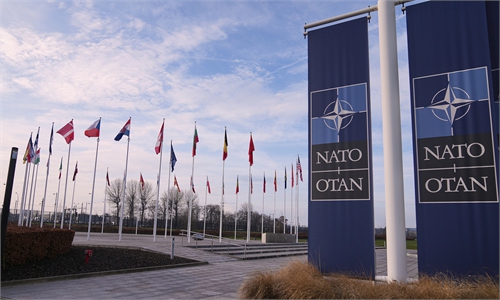
When Donald Trump threatened to withdraw the US from NATO, Western capitals seemed not to show particular surprise; it was clear they had anticipated it.
But the more important question is why, at this particular moment, such a statement could be made at all.
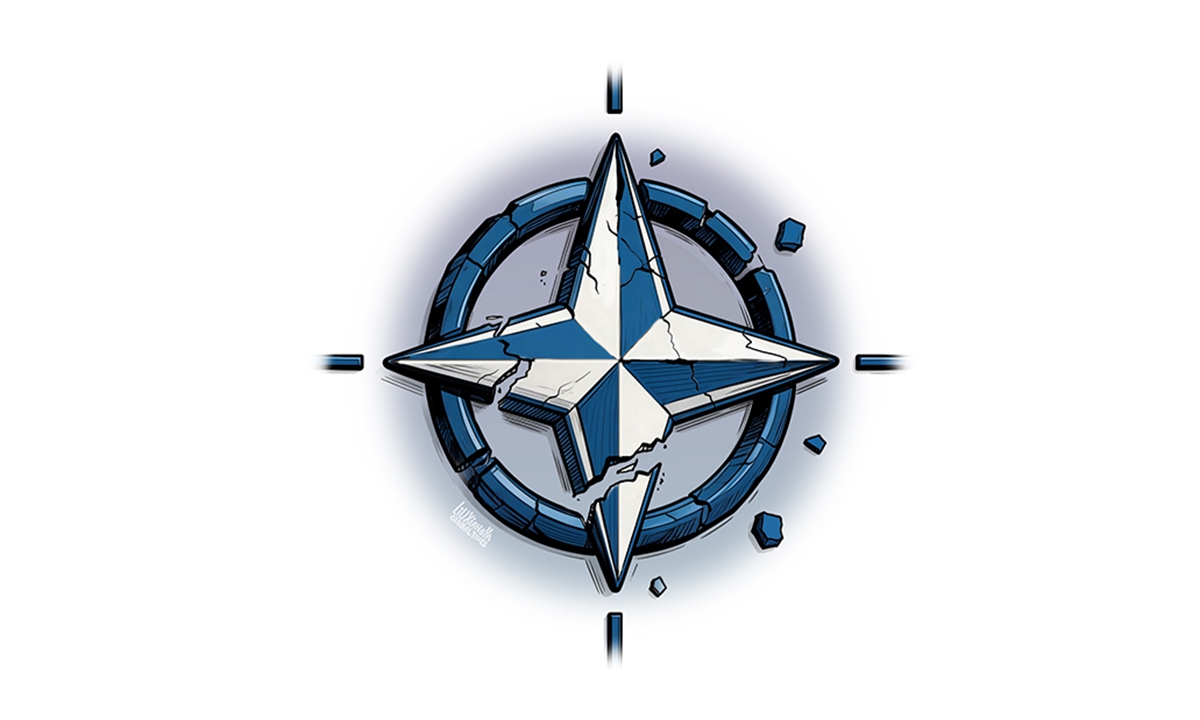
NATO's current crisis is the consequence of a slow, structural erosion that has been underway for decades. It is also due to its inability to keep pace with the rapidly developing multipolar world.
The alliance's original logic was straightforward. The Soviet Union posed a clear and present danger. Western Europe needed American protection. Washington needed strategic depth on the European continent. The threat was real, shared, and sufficient to hold divergent interests together.
That threat disappeared in 1991. NATO did not. Instead of dissolving, the alliance tried to consolidate its coherence. Therefore, it had to find a new target.
It began expanding eastward, then globally. Some voices have called for extending its reach into the Indo-Pacific, even to form an "economic NATO" against China, raising questions about NATO's strategic focus and relevance in a changing world.
An alliance that must continually invent new enemies to justify its existence is already in structural trouble.
In an increasingly multipolar world, NATO's attempt to wield military power, primarily through American power, to manage global affairs is no longer possible. However, some within NATO have not recognized this change.
The deeper problem is that Western interests have quietly but fundamentally diverged. When the Russia-Ukraine conflict erupted, Europe absorbed the consequences, including soaring energy prices, industrial outflow, and waves of refugees. Today, Europe's economic outlook is sluggish, and trade friction with the US persists.
Europe has begun asking an uncomfortable question: Are we defending shared values that unite us, or merely subsidizing others' strategic ambitions? This distinction has raised doubts about the alliance's purpose.
The war in Iran has sharpened that question considerably.
European governments refused to participate. Even Britain, Washington's most reliable partner, declined. This was not betrayal but a calculation rooted in domestic political shifts and strategic priorities, illustrating how internal political changes in key NATO members influence alliance cohesion and decision-making.
Trump's rise is itself a symptom of deeper forces. America's middle class has hollowed out. The US failures in Afghanistan and Iraq destroyed the domestic legitimacy of overseas intervention. Younger Americans show little attachment to the idea of their country as the world's indispensable guarantor.
The fiscal arithmetic is unforgiving. The US federal debt has exceeded $36 trillion. Interest payments now surpass the defense budget. The cost of maintaining a global military presence is real, recurring, and increasingly unsustainable. This is not ideology. It is arithmetic.
As for an economic NATO directed at China, the very ambition reveals the depth of Western strategic anxiety. But if the military alliance is already fracturing, what would hold together a coalition that would ask its members to prepare for a long economic war with China, the world's second-largest economy? Such a move would be fatal for NATO member states.
The idea of using NATO to expand Western ideology globally is either out of touch with the times or simply foolish. NATO no longer possesses that kind of power.
History offers no example of a great power that maintained its global commitments indefinitely after internal contradictions, economic decline, and domestic fractures. The US will not be the exception, highlighting the need for strategic adaptation.
NATO's story is not yet finished. But the forces pulling it apart are not the invention of any single administration. They are the accumulated weight of unresolved contradictions, contradictions that have been building since the wall came down.
Trump did not create that weight. He simply brought forward the moment it hit the ground.
The war in Iran has provided the world with a window into what awaits hegemonic powers if they fail to keep pace with global progress. The fate of NATO is no exception.
RELATED ARTICLES