Trump says he is strongly considering pulling US out of NATO; Remarks seen as pressure tactic as Iran war tests mutual trust: Chinese expert
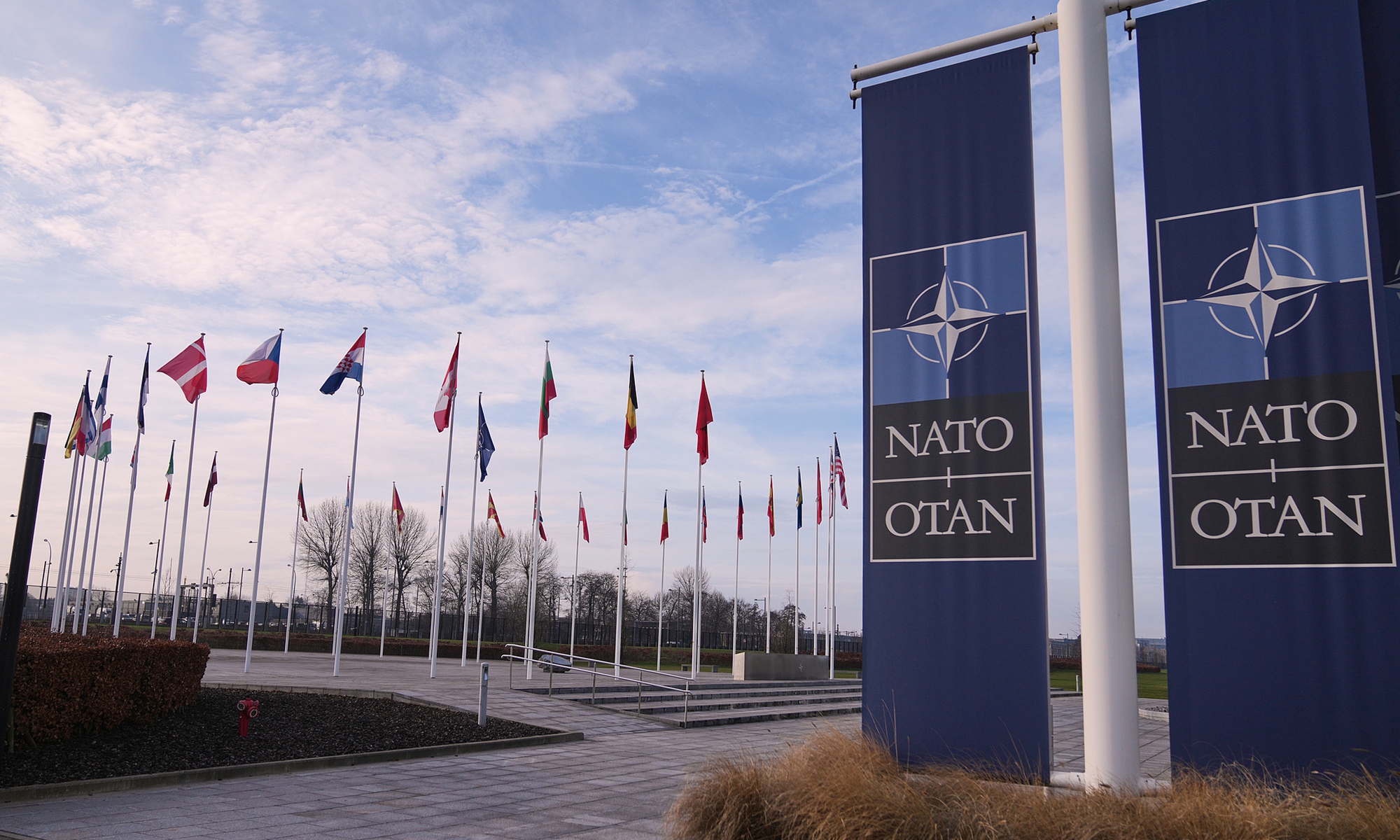
Flags flap in the wind outside NATO headquarters in Brussels, on January 19, 2026. Photo: VCG
Transatlantic alliance is facing further test as US President Donald Trump has reportedly claimed that he is strongly considering withdrawing the US from NATO over its failure to join the war against Iran. A Chinese expert said the latest remarks might be an attempt of the US to ramp up pressure on European allies, who have sought to avoid direct entanglement in the Middle East conflict while still hoping to keep the US engaged in the Ukraine crisis.
US President Donald Trump told The Telegraph he is strongly considering pulling the US out of NATO after it failed to join his war on Iran, the newspaper reported in an exclusive interview on Wednesday. The report described it as the strongest sign yet that the White House no longer regards Europe as a reliable defense partner following the rejection of Trump's demand that allies send warships to reopen the Strait of Hormuz.
The US president labelled the alliance a "paper tiger" and said removing America from the defense treaty was now "beyond reconsideration," according to The Telegraph.
Besides US President himself, some other top members of his administration had already raised the possibility of reevaluating the alliance. Speaking on Fox News in the hours before the interview with Trump, US Secretary of State Marco Rubio said America would have to "re-examine" its NATO membership when the war in Iran came to an end, the report noted.
"We are going to reexamine whether or not this alliance, that has served this country well for a while, is still serving that purpose or has it now become a one-way street, where America is simply in a position to defend Europe. But when we need the help of our allies, they're going to deny us basing rights," he told Fox News.
These remarks come after the US has asked European allies for a lot lately, CNN reported, including the use of military bases, the potential relocation of missile defense systems and generally stronger support for US military action against Iran. Many responses have been lukewarm, with allies offering limited defensive support but also repeatedly calling for de-escalation, according to CNN.
Rather than focusing on a genuine US withdrawal from NATO, the statement is more intended to step up pressure on Europe over dissatisfaction regarding the war with Iran, said Cui Hongjian, a professor at the Academy of Regional and Global Governance at Beijing Foreign Studies University.
Italy, a key US ally, denied a US request for aircraft to land at a military base in Sicily, according to its state broadcaster RAI on Tuesday.
Along with the UK, France and Germany, Italy has joined efforts to send air defense assistance to Gulf allies. But with regard to the offensive campaign, Prime Minister Giorgia Meloni has "joined the chorus of European leaders calling the war in Iran illegal, or as she put it, 'outside the scope of international law,'" CNN reported.
Other examples of European hesitation and refusals are mounting. The report by CNN said Spain's Prime Minister Pedro Sánchez has perhaps been the most outspoken - doubling down on his condemnation of US strikes and his position of not authorizing the use of Spanish military bases or airspace for any activity relating to the war in Iran.
For European allies, their primary goal is to avoid direct entanglement in the US-Iran conflict while keeping the US in NATO, so as to maintain US engagement with the Ukraine crisis, Cui said.
Earlier on Tuesday, Trump lashed out again on social media, according to The Washington Post. Countries including the UK, which refused to get involved in the war, should "build up some delayed courage, go to the Strait [of Hormuz], and just TAKE IT," Trump wrote on Truth Social. "You'll have to start learning how to fight for yourself, the U.S.A. won't be there to help you anymore, just like you weren't there for us."
British Prime Minister Keir Starmer, when responding to a question about the recent threat from Trump that the US would no longer come to the aid of the UK, said during a news conference that there's been "a good deal of pressure on me to change my position in relation to joining the [Iran] war, and I'm not going to change my position on the war," the BBC reported on Wednesday.
However, asked whether he's forging closer ties to Europe as his relationship with Trump deteriorates, Starmer said he's not choosing between the continent and the US.
The US president also accused France of refusing to allow Israel-bound military planes to fly over French territory. Paris, he said, has "been VERY UNHELPFUL," per the report. The French presidency then confirmed on Tuesday that France has not changed its policy regarding US military aircraft flying over its territory, expressing surprise at Trump's remarks, Xinhua reported citing local media.
Politico reported on Tuesday that European allies, meanwhile, have been left "befuddled" by the president's messaging. The Trump administration previously pressed them to take care of their own backyard - particularly regarding the Ukraine conflict - but is now seeking their help in a war thousands of miles away.
The conflict between the US and Iran has become a test of mutual trust for European allies, and has clearly dealt a severe blow to European trust in the US, Cui noted. Within the NATO framework, the two sides have long maintained military coordination as allies. However, European leaders have stressed that this is not their war, Cui said.
Even so, Europe still needs to address its key regional challenge, the situation in Ukraine, which requires US support, the expert continued.
RELATED ARTICLES