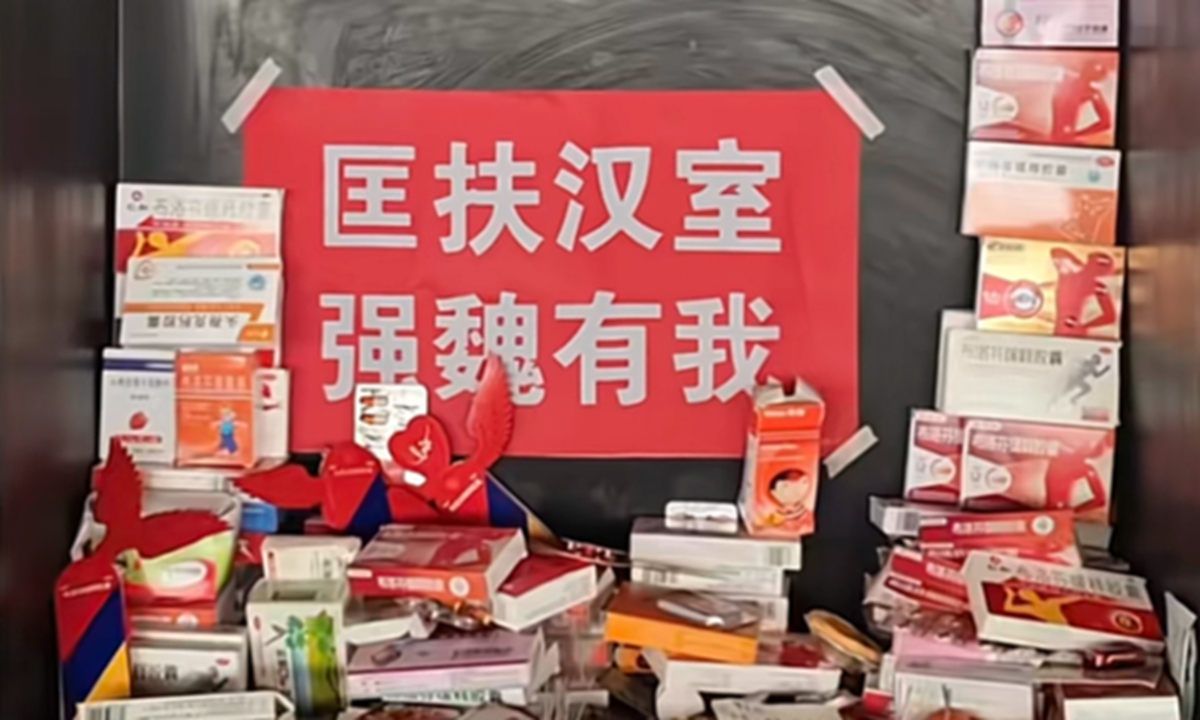
The cabinet at Cao Cao's resting place at the Cao Cao Gaoling Relics Museum in Anyang is lined with neatly stacked boxes of ibuprofen offered by visitors coming afar. Photo: screenshot
Unlike traditional tomb-sweeping rituals featuring flowers and incense candles, Chinese young people have come up with novel ways to honor the deceased during the Qingming Festival holidays which runs from April 4 to 6. As historical records note that Cao Cao, a ruler of the Three Kingdoms period (220-280) known for his chronic headaches, suffered from severe migraines during his lifetime, his tomb in Anyang, Central China's Henan Province, is now filled with various types of ibuprofen, accompanied by thoughtful "medical notes", the Global Times found on Chinese social media platforms including Red Note and Sina Weibo.
The scene was seen from the Cao Cao Gaoling Relics Museum in Anyang. The cabinet at Cao Cao's resting place is lined with neatly stacked boxes of ibuprofen offered by visitors coming afar, according to Chutian Metropolis Daily, the local newspaper of Wuhan, Central China's Hubei Province.
Staff at the Cao Cao Gaoling Relics Museum responded to the Global Times on Monday that the scenic spot has drawn large crowds of visitors during the Qingming Festival, with people bringing offerings every day. Workers will not dispose of these gifts at will, but arrange them neatly.
On Chinese social media platforms such as Sina Weibo and Red Note, some netizens have shared photos and videos of the ibuprofen-covered tomb, with captions such as "The grand chancellor Cao... if only you had ibuprofen back then, your headaches would have been gone". In the comment sections, netizens added that ibuprofen is offered for Cao Cao's migraines, and there are even cards from the game Legends of the Three Kingdoms and banners honoring the Wei Kingdom (220-265).
Such quirky offerings have also appeared at other ancient tombs. According to China Newsweek, the most distinctive "offering" at the tomb of Zhang Juzheng, a prominent statesman of the Ming Dynasty (1368-1644), is Ma Yinglong hemorrhoid ointment, as unofficial historical records claimed Zhang's health declined drastically after hemorrhoid surgery and led to his death.
Potato chips and spicy strips are commonly seen at Huo Qubing's tomb - since the young general of the Han Dynasty (206BC-AD220) died at 23, as college students realized he was their contemporary and at an age fond of snacks.
The 2026 China cultural tourism new style of playing report recently released by China's travel platform Mafengwo showed that the diverse tomb-sweeping activities have been included as one of the new cultural tourism plays across the country, according to China News Service.
Nowadays, many young people carry carefully prepared offerings to communicate with ancients thousands of years ago across time and space. In their eyes, this is not disrespectful. Instead, it is a way to understand history and commemorate ancestors from a youthful perspective, breathing new life into long-buried history, some netizens shared on Weibo.
Global Times
RELATED ARTICLES