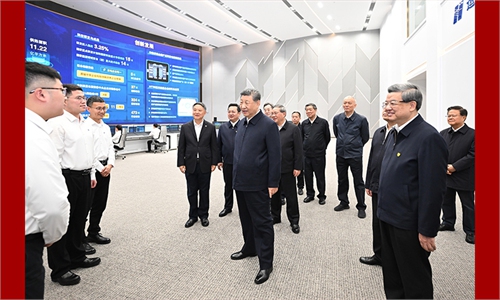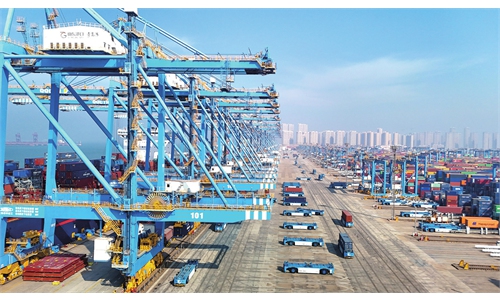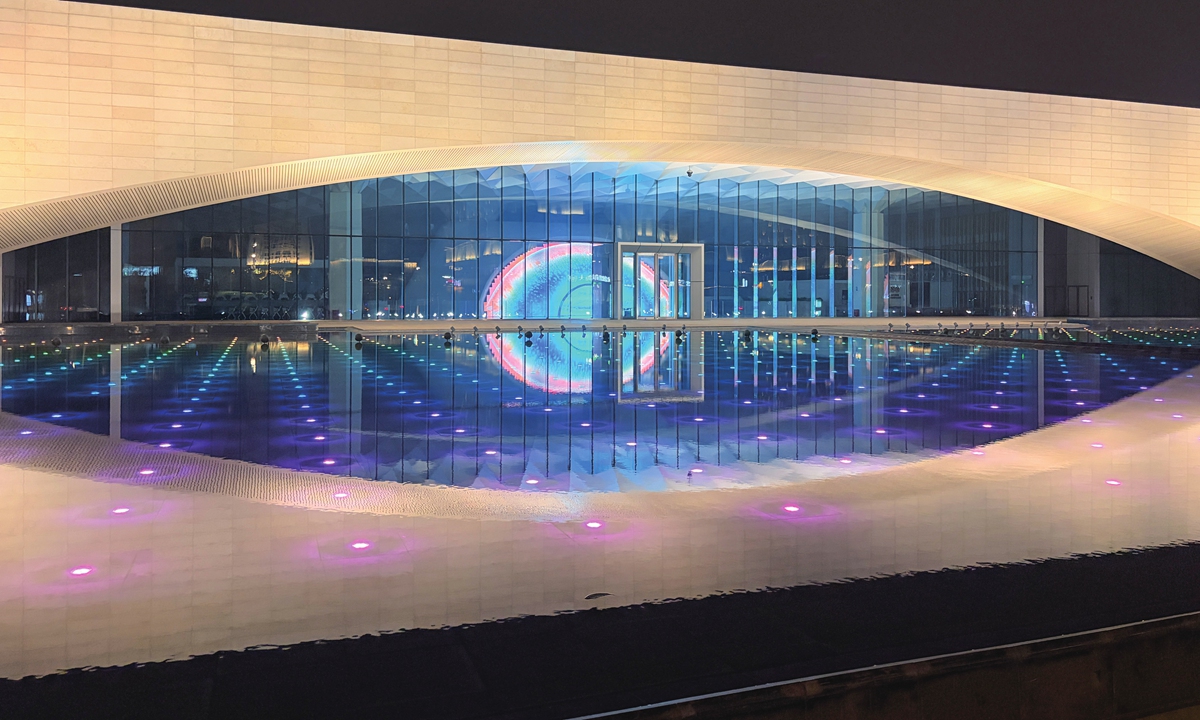
A view of the Xiong'an Urban Computing Center on April 2, 2026 Photo: Tao Mingyang/GT
At first glance, the streets of the Xiong'an New Area in North China's Hebei Province look clean and new, yet not particularly remarkable. It is only when driving through them that one senses the pulse of what has been widely referred to in China as "the city of the future." Here, drivers no longer "obey" green lights; the lights "obey" the traffic.
This is no illusion. Behind the so-called "green-wave traffic system" lie more than 20,000 roadside sensors that monitor traffic flow, queue lengths and vehicle types in real time. The data feed into an artificial intelligence (AI)-powered "city brain" that recalibrates signals in milliseconds. As a result, the average number of stops per vehicle has fallen by half, according to official figures.
This is just one example of the technological innovation that is being born — and coming alive — in the Xiong'an New Area. Established in 2017 under a grand national blueprint, the city has, in just nine years, made striking progress in smart-city construction and sci-tech innovation. More efforts have been urged to build the new area into an innovation hub in the new era and a model of promoting high-quality development.
Smart city
During the Global Times' recent trip to the new area, "new Xiong'an residents," including sci-tech workers, speak eagerly of the smart features of their new home and express quiet pride in contributing to its development. On a national level, development of this city of the future holds great significance for China's broader push toward high-quality development, an expert told the Global Times.
"Driving in Xiong'an, it's no longer about cars watching the traffic lights — it's the traffic lights that watch the cars," Zhang Yan, who moved to Xiong'an about four years ago, told the Global Times, with a smile that suggested she's seen more than a few jaws drop.
Zhang is not just any driver enjoying the smart traffic system in Xiong'an, she actually led a small but mighty team of about ten workers at Xiong'an-based China Telecom Digital City Technology Co that helped roll out the "green-wave traffic system" across the Rongdong district of Xiong'an.
The system doesn't just collect real-time traffic flow and road conditions — it also automatically spots equipment failures, sends alerts, and generates maintenance orders before most drivers even notice a glitch, Bai Jiaxue, a representative also from China Telecom Digital City Technology Co, developer of the drone system, told the Global Times.
Meanwhile, with a single remote command, a square box mounted on a traffic signal pole along Jinhu Street in the Rongdong district slowly opens, releasing a drone that begins a fixed 1.27-kilometer patrol route. The entire mission takes around five minutes, during which the drone conducts traffic monitoring, illegal parking detection, and landscaping inspections.
Drones have become a common sight across the Xiong'an New Area. They patrol the city's parks, monitoring water levels and issuing flood alerts. In certain work zones, they also ferry packages weighing up to five kilograms between buildings, according to Bai.
The Xiong'an New Area's embrace of smart-city technologies — including AI and drones — aligns with China's broader push to not only develop cutting-edge technologies but also to apply them at scale, experts noted.
Unlike mature megacities such as Beijing, Shanghai, Guangzhou, and Shenzhen, Xiong'an started with high standards from the very beginning, Hu Qimu, deputy secretary-general of the Forum 50 for Digital-Real Economies Integration, told the Global Times on Tuesday, adding that with strong policy, financial, and resource support, Xiong'an is best positioned to become a model for smart city development.
"As a massive living laboratory, Xiong'an can be divided into key application scenarios such as smart transportation and public services. The solutions and models developed here are highly replicable and scalable, making them suitable for adoption across other cities," Hu said.
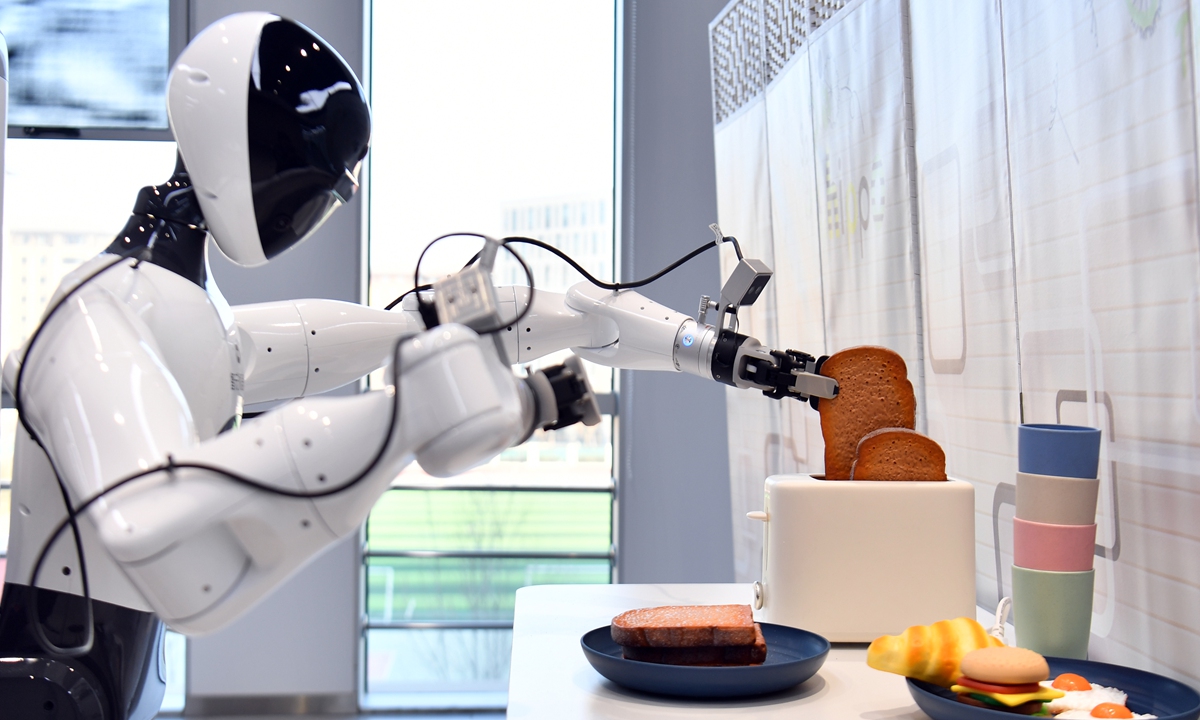
A robot undergoes training for home living application scenarios at a company in Xiong'an on January 8, 2026. Photo: VCG
Innovation hub
Behind Xiong'an's smart development lies a rapidly emerging innovation ecosystem comprising universities, state-owned enterprises, global tech giants, and fast-growing private startups.
Over the past nine years, more than 400 branches of state-owned enterprises have set up operations in Xiong'an, alongside over 200 companies in fields such as aerospace information, AI, and digital technology, Xinhua News Agency reported.
Inside a factory at the pilot testing base of the Xiong'an Science and Innovation Center, the "Xiong'an-1" satellite is undergoing testing and calibration. Under the operation of technicians, its 20-meter-long flexible solar arrays can fully deploy in just three minutes.
As the first satellite produced in the Xiong'an New Area, "Xiong'an-1" represents a landmark project in the city's aerospace information industry. After completing the pilot satellite factory and automated satellite mass-production line, the satellite's R&D, design, production, and testing were all finished in 2025, and "Xiong'an-1" successfully rolled off the production line on October 22 of that year.
It is currently undergoing fault simulation and flight condition testing, with a planned launch and in-orbit verification expected in the second quarter of 2026, Xiong'an-based Hong Qing Technology Co, the satellite's manufacturer, told the Global Times.
The aerospace information sector is one of Xiong'an's pillar industries. As one of the first key enterprises to settle in the area, Hong Qing Technology achieved the remarkable feat of "registration, construction, manufacturing, and product completion all within the same year" in 2025, showcasing the synchronized momentum of "Xiong'an speed" and corporate efficiency, according to the company.
Such rapid development is underpinned by strong government support and a robust innovation ecosystem. In February, the State Council approved the upgrade of the Xiong'an high-tech industrial development zone to a national-level zone, calling for deeper integration of sci-tech and industrial innovation while attracting high-end innovation resources from home and abroad, the Xinhua News Agency reported.
As one of multiple major sci-tech platforms, the Zhongguancun Science Park in Xiong'an, with a managed area of 207,000 square meters, focuses on cutting-edge sectors including AI, digital technology, biotechnology, and the low-altitude economy.
Its nine themed buildings follow a "one building, one industry, one ecosystem" model, housing 269 technology enterprises, including national high-tech firms, specialized SMEs, and "gazelle" companies. Also crucially, the park has attracted over 2,700 innovation talents from China and abroad, forming two prominent industrial clusters centered on AI and robotics, according to the science park.
One floor above the exhibition hall of the science park is the global headquarters of Mech-Mind Robotics, a global company with subsidiaries in Japan, South Korea, the US, and Germany, and business operations spanning more than 40 countries and regions. The company focuses on the three core modules of industrial robotics — "eyes, brain, and hands" — covering recognition, decision-making, and manipulation.
Xiong'an provides targeted policy support, facilitates upstream and downstream resource integration, and promotes industrial synergy through the science park where "upstairs neighbors are also supply chain partners," Ma Xiaoqian, an employee from the company, told the Global Times.
With its positioning as a "city of the future," Xiong'an aligns closely with the development needs of AI and robotics enterprises, while offering an efficient, business-friendly environment that ensures strong support for growth, Ma said.
RELATED ARTICLES