Illustration: Liu Xidan/GT
Amid rising global economic uncertainty and protectionism, the resilience and vitality of regional cooperation in Asia are drawing increasing attention.A report released on Monday by the ASEAN+3 Macroeconomic Research Office (AMRO) pointed out that over the past two decades, China became the primary hub of supply chains within the region, the Xinhua News Agency reported. According to the AMRO report, ASEAN+3's economic linkages have undergone a fundamental transformation compared with two decades ago, and regional production networks have evolved from a Japan-centered hub into a denser, more interconnected architecture anchored by China.
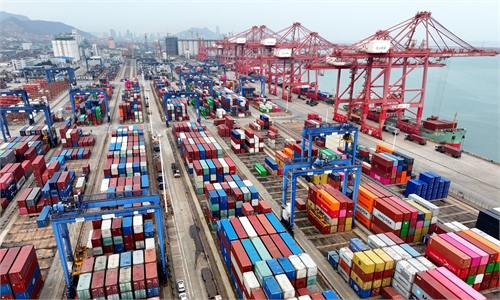
Why has China become this primary hub? The answer lies in the combined effect of its growing manufacturing strength and deepening regional cooperation. The AMRO report explicitly attributed China's hub status to its "expanding manufacturing capacity, logistics infrastructure, and central position in intermediate goods trade."
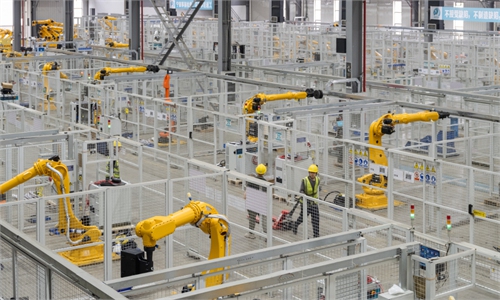
More importantly, China's manufacturing sector is transitioning toward technological sophistication. Through initiatives to promote the high-quality development of key industrial chains and rebuild the industrial base, China has achieved breakthroughs in core technologies such as integrated circuits, industrial machine tools and new-energy vehicles. The reliability of its industrial chains has steadily improved, providing stable supplies for the regional production network.
The AMRO report described the region's supply linkages as "interdependence rather than unidirectional dependence on China." For a long time, some Western media outlets and politicians have played up the narrative of so-called "over-reliance on China," as if deep economic engagement with China meant risk. But the facts tell a very different story.
Supply-chain links have always been two-way. China is not only a provider of intermediate goods but also a huge source of demand for end consumer goods. Agricultural products and electronics from ASEAN countries, as well as core components and high-end materials from South Korea, are exported to China in large volumes. At the same time, Chinese consumer demand for imported automobiles, cosmetics and chips creates significant market space for regional partners.
This pattern reflects rational choices made by all sides based on their comparative advantages. It is precisely this multidirectional flow that makes the entire regional production network more efficient and resilient.
China's hub status has provided neighboring countries with unprecedented development opportunities. The past 20 years witnessed the rise of Vietnam's electronic assembly industry, Thailand's emergence as a major automotive manufacturing center, and the growth of Malaysia's semiconductor packaging and testing industry. These countries have gradually moved up the value chain. China provides large-scale manufacturing capacity and a complete supporting ecosystem, while neighboring countries use their own advantages to undertake specific links, forming a complementary relationship.
This hub-and-node dynamic has been further reinforced by regional institutional arrangements. Mechanisms such as the Regional Comprehensive Economic Partnership (RCEP) and the China‑ASEAN free trade area have significantly lowered transaction costs and facilitated industrial chain integration. In 2025, total trade between China and ASEAN exceeded $1 trillion for the first time, up 7.4 percent year‑on‑year. In the four years since the RCEP took effect, the region's share of global foreign direct investment has surpassed 30 percent, placing it at the forefront of global regional cooperation mechanisms.
Beyond trade agreements, Asia's vast market provides another layer of resilience. The region is home to more than 4 billion people, with a relatively high proportion of young people. Coupled with the digital and green transitions, this vast domestic market not only provides a stable outlet for regional production capacity but also guides industrial chains toward higher value‑added segments through consumption upgrading.
The global green energy transition and the development of the digital economy are gaining momentum. China has already built up leading advantages in emerging fields such as photovoltaics, lithium batteries, new-energy vehicles, 5G communications, and artificial intelligence. The cooperative relationship between China and its neighbors within Asia's production network will continue to extend into higher value-added areas. As the main hub, China's continued commitment to openness and innovation will remain a key source of stability and shared prosperity for the entire region.
RELATED ARTICLES