China's green experience in scale and economic integration particularly important
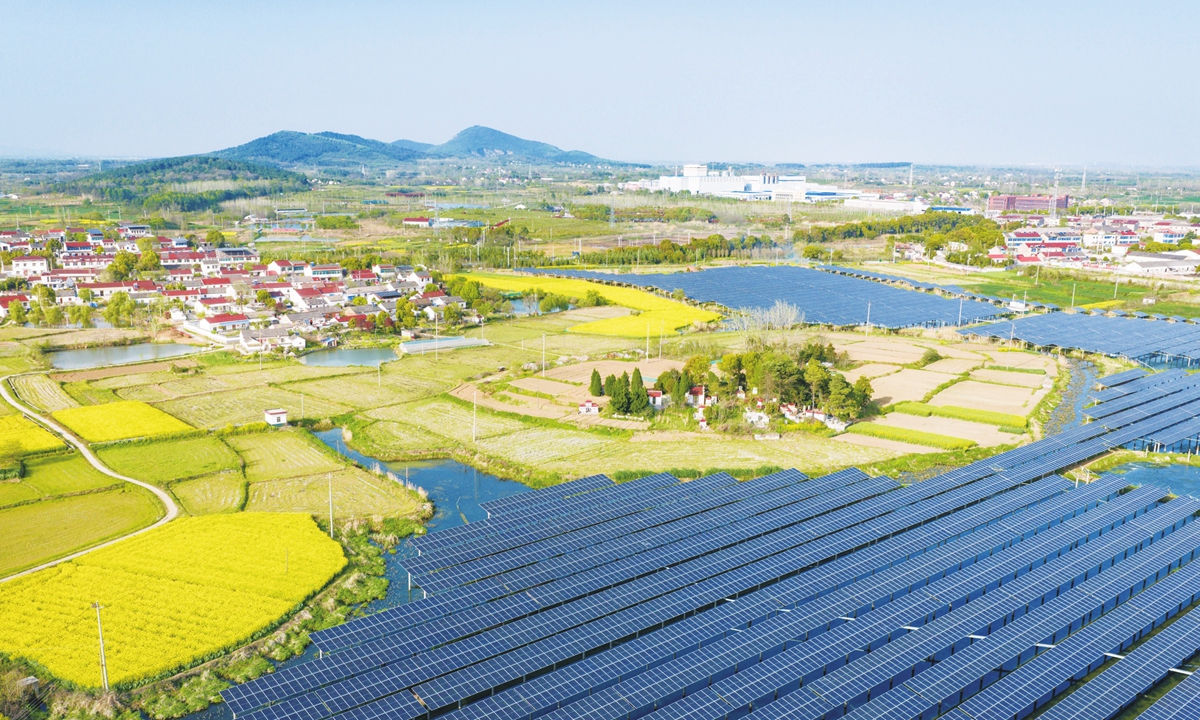
Photovoltaic panels are neatly arranged among the surrounding green scenarios in He county of Ma'anshan city, East China's Anhui Province on April 5, 2026. Photo: VCG
Editor's Note:In an era marked by ecological challenges, development dilemmas and geopolitical dynamics are increasingly intertwined. Through a series of innovative practices, Chinese modernization offers a "green solution" to some of humanity's pressing questions of survival and development. Rooted in the wisdom of Chinese civilization and refined through Xi Jinping Thought on Ecological Civilization, this approach presents both a philosophical vision and a practical pathway toward sustainable development.
In this context, the Global Times (GT) launches the "China through a 'green' lens" series. It invites leading scholars and observers worldwide to decode the underlying logic behind China's green development and to better understand the global implications of China's green development philosophy.
In the second installment of the series, Amir Lebdioui (Lebdioui), director of Technology and Industrialization for Development Centre, University of Oxford, told GT reporter Zhang Ao that "one of the distinctive strengths of China's successful green industrial policy lies in its ability to combine long-term strategic direction with policy experimentation at the local level, which is not an easy exercise and requires a strong capacity to adapt."
GT: Xi Jinping Thought on Ecological Civilization has provided a new pathway to modernization in the new era, contributed a new solution to global environmental governance, and created a new form of human civilization. In your view, what significant implications does China's transformation from domestic ecological governance to global cooperation hold?
Lebdioui: I think that Xi Jinping Thought on Ecological Civilization is very welcome, and China has already been a valuable partner for climate governance. But it can and has to go far beyond the current model, with a new form of green tech transfer from China to the Global South and the rest of the world, especially as China now holds green technological dominance. A recent OxValue white paper on clean tech even reveals that China concentrates the most valued cleantech unicorns in the world.
Addressing climate change must align with the pursuit of green industrial strategies and development goals, making international cooperation on technology, innovation and industrial development increasingly vital - all the more so as more countries look to follow China's approach. Cooperation on green technological innovation and diffusion, supply chains, and innovation can help ensure that the benefits of the transition are shared more broadly.
China's growing engagement in global ecological cooperation could play an important role in strengthening collaboration across regions, particularly between developing countries.
GT: President Xi once emphasized that we must accelerate the formation of green production modes and lifestyles, and lay a green foundation for high-quality development. From your observations on China's green production modes, what practical and science-based experiences has China developed in implementing ecological civilization?
Lebdioui: China's experience around green development is particularly important in two areas: scale and economic integration.
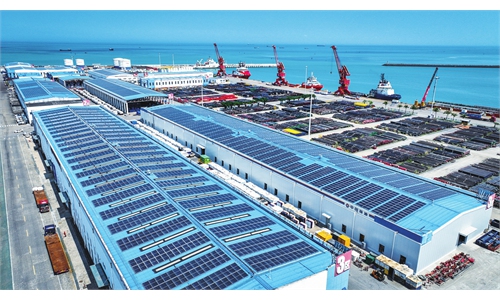
First, China has demonstrated how the large-scale deployment of green technologies can dramatically reduce costs. The rapid expansion of solar power, electric vehicles and battery technologies in China has helped accelerate the global diffusion of these technologies in a way the world has not seen before. And the world owes a lot to China because it has enabled all of us to benefit from much cheaper low-carbon technologies. It is estimated that as a result of China's scale-up of solar manufacturing capacity, costs reduced by over 90 percent since 2010, changing the economics of the energy transition globally. Without that, it would be so much more difficult to roll out green technologies at scale and fight climate change, which is already challenging as it is.
Second, China has been very successful at integrating environmental goals into its broader industrial and technological strategies. Rather than treating environmental protection as separate from economic development, green transformation has become part of industrial upgrading and innovation, and by extension, to reduce poverty.
Of course, each country has different economic structures and institutional capacities, so policies cannot simply be copied. But many countries can learn from key principles behind China's approach, namely seeing the ecological agenda as a developmental opportunity, and continuous learning through experimentation.
GT: In your book Survival of the Greenest, you noted that China's approach to green industrial policy offers valuable insights into balancing centralized long-term vision with localized short-term implementation. Could you elaborate on the unique strengths of this model?
Lebdioui: There is a common misconception that China's industrial success lies in a top-down approach, but one of the distinctive strengths of China's approach is its ability to combine long-term strategic direction with policy experimentation at the local level, which is not an easy exercise and requires a strong capacity to adapt. For instance, solar PV manufacturing scaled through provincial competition (Jiangsu, Shandong), and EV subsidies were piloted in specific cities before national rollout.
China's central government has provided clear strategic priorities in areas such as renewable energy, electric mobility and green manufacturing, notably thanks to its subsequent five-year plans. At the same time, provinces and cities have been encouraged to experiment with different policy approaches, allowing policymakers to learn quickly from both successes and failures, which ends up giving responsibility and flexibility to a whole range of actors.
China's experience also aligns with how I think about industrial policy. In my research on green industrial policy, I emphasize that economic transformation is not only about choosing the right policy instruments, but also about building institutions that can learn and adapt over time. In other words, the cook matters more than the recipe. China's experience shows how strong coordination can help combine strategic vision, experimentation and learning, which, I think, is a crucial lesson for other countries trying to replicate it.
GT: China stands ready to work with all parties to build a clean and beautiful world. How do you see China's determination and its role in reaching this goal?
Lebdioui: China is already a major player in the global green transition, thanks to its robust strengths in renewable energy, electric vehicles and low-carbon manufacturing - advances that have driven down the cost of green technologies for the world at large.
Looking ahead, China can make an even greater contribution by expanding global access to such technologies, moving beyond technological leadership to embrace a vision of technological stewardship. In practice, this means helping ensure that the benefits of green innovation reach more countries and support sustainable development globally.
For the global green transition to succeed, it must serve as a development opportunity for more countries. China can play a critical role in making that possible, and may well be the only country capable of doing so in the current global context. This would bring mutual benefits to both China and other developing nations.
RELATED ARTICLES