Xi Jinping Thought on Ecological Civilization ‘provides an invaluable reference for developing countries’: American scholar
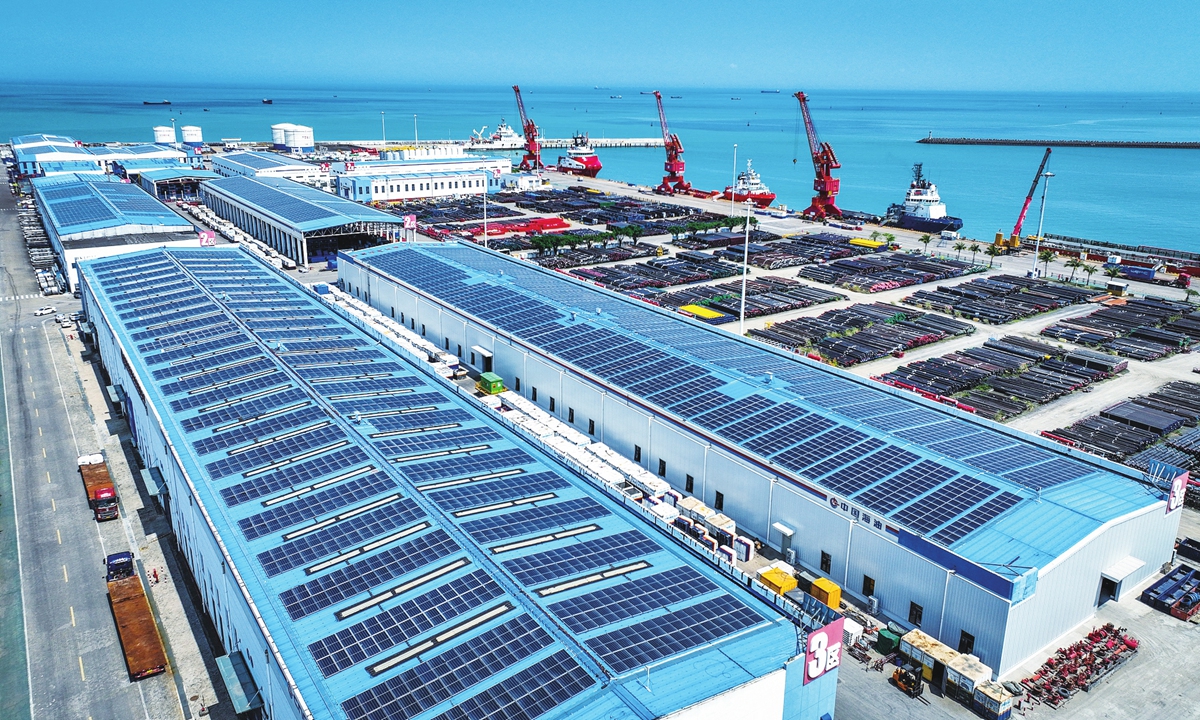
The photovoltaic project in South China's Hainan Province is officially connected to the grid for power generation on March 19, 2026. Photo: VCG
Editor's Note:In an era marked by ecological challenges, development dilemmas and geopolitical dynamics are increasingly intertwined. Through a series of innovative practices, Chinese modernization offers a "green solution" to some of humanity's pressing questions of survival and development. Rooted in the wisdom of Chinese civilization and refined through Xi Jinping Thought on Ecological Civilization, this approach presents both a philosophical vision and a practical pathway toward sustainable development.
In this context, the Global Times (GT) launches the "China through a 'green' lens" series. It invites leading scholars and observers worldwide to decode the underlying logic behind China's green development and to better understand the global implications of China's green development philosophy.
Josef Gregory Mahoney (Mahoney), a professor of politics and international relations and director of the Center for Ecological Civilization at East China Normal University in Shanghai, told GT reporter Li Aixin that China's efforts on ecodevelopment "injects predictability into global environmental governance." This is the first installment of the series.
GT: Chinese lawmakers voted to adopt the Ecological and Environmental Code at the closing meeting of the fourth session of the 14th National People's Congress. It is guided by Xi Jinping Thought on Ecological Civilization. How do you interpret the significance of this code?
Mahoney: The new Ecological and Environmental Code signifies a breakthrough as China moves to consolidate its green revolution. This revolution accelerated in the new era under the guidance of Xi Jinping Thought on Ecological Civilization, with China becoming the global leader in green innovation, green development and green transformations, while also scoring major victories ensuring dramatically cleaner air, water and land around the country.
This is not merely a compilation of laws but a groundbreaking restructuring of the legal system. It demonstrates China's green revolution has moved from the fragmented, single-dimensional policy-driven phase of the past into a new stage underpinned by a systematic and binding rule-of-law framework.
No less importantly, amid the growing uncertainties in the current international landscape, the code injects predictability into global environmental governance. It provides an invaluable reference for developing countries seeking to balance economic development with environmental protection. It also explicitly encourages international cooperation in green and low-carbon technologies and products, helping Chinese industries enhance their voice in the global value chain.
GT: "Man and nature form a community of life" serves as the important point of Xi Jinping Thought on Ecological Civilization. How do you understand the philosophical essence of this concept?
Mahoney: Since President Xi illustrated with the "two-integrations" concept, Chinese wisdom has always been present in China's creative practice of Marxism, and Chinese Marxism has often returned to Chinese wisdom to address new challenges. For example, yinyang thought and the privileging of "and" over "or" was always the distinctive feature of Chinese Marxist understanding of the "unity of opposites."
GT: Reflecting on the environmental conditions you first observed in China and today's achievements in ecological civilization, what do you think are the most representative changes you've noticed?
Mahoney: In 1998, when I first came to China, I lived in Shenyang for a year. Ecologically and economically, that was a hard time in that city. While the old factories had reached their life cycles and were shutting down, others were still pumping out pollution. Furthermore, people still depended on coal to keep their homes warm, and some of the very poor were burning old tires. Upper-respiratory problems were the norm.
However, Shenyang recorded 328 excellent air days in 2025, while good water quality reached 73.3 percent. The city uses AI and drones for 24/7 ecological monitoring and has established a comprehensive "zero-waste city" program. Meanwhile, total emissions due to coal burning in districts like Huanggu have dropped by approximately 30 percent over the past five years.
GT: "Lucid waters and lush mountains are invaluable assets" has become the guiding principle for China's ecological civilization construction. This principle elucidates the relationship between economic development and ecological protection. Based on your observations, what specific and compelling practices has China adopted to strike a balance between ecological conservation and economic growth?
Mahoney: In addition to substantial systemic improvements, which include formally coupling the new Ecological and Environmental Code with the green development focus of the 15th Five-Year Plan (2026-30), we've seen many major efforts to ensure a healthy balance between ecological conservation and economic growth.
In technology innovation, China is well known for being the world leader in green technologies associated with EVs as well as renewable energy production. China is also leading the way with innovations related to precision pollution controls. For example, Zhejiang's "Blue Cycle" program uses IoT and blockchain to manage marine plastic waste with digital traceability.
GT: Western industrial civilization created vast material wealth but worsened global climate crises and ecological imbalances. By contrast, Chinese modernization prioritizes "man and nature forming a community of life," defining itself as "a modernization characterized by harmonious coexistence between humanity and nature." What global significance does this contrast hold?
Mahoney: The US has officially abandoned its leadership on the energy transition, with officials denying climate change and curtailing green development and transformations in the US itself, while becoming the world's top oil producer and shamefully worsening what is already the world's worst per capita emissions.
While the US destroys, China constructs, and does so at home and abroad consistent with green development. Chinese modernization is based on a very different worldview and seeks a very different outcome.
While the US seeks hegemony and the privilege of zero-sum unilateralism, China seeks a win-win, principles-based multilateralism consistent with creating a shared future for humanity.
In short, the US believes it can only be great at others' expense, while China realizes that real security and development is a shared human project.
Destructive powers like the US are inherently self-limiting. They present existential risks for everyone, but they can also be countered via greater global solidarity emphasizing green values while ensuring development justice for countries lacking the same.
I believe China's commitment to a multipolar world, its efforts to reinforce and improve multilateralism, its commitment to green innovation and development, can altogether be understood as advancing, step-by-step, as a new internationalism. Furthermore, it can reach a point where it can save the world and hundreds of millions of its peoples from the dark consequences of climate change, injustices and insecurity associated with chronic underdevelopment and brown paradigms.
RELATED ARTICLES