Joint study on ‘time capsule’ lunar soil from Chang’e-5, -6 missions reveals evolutionary processes of organics in solar system
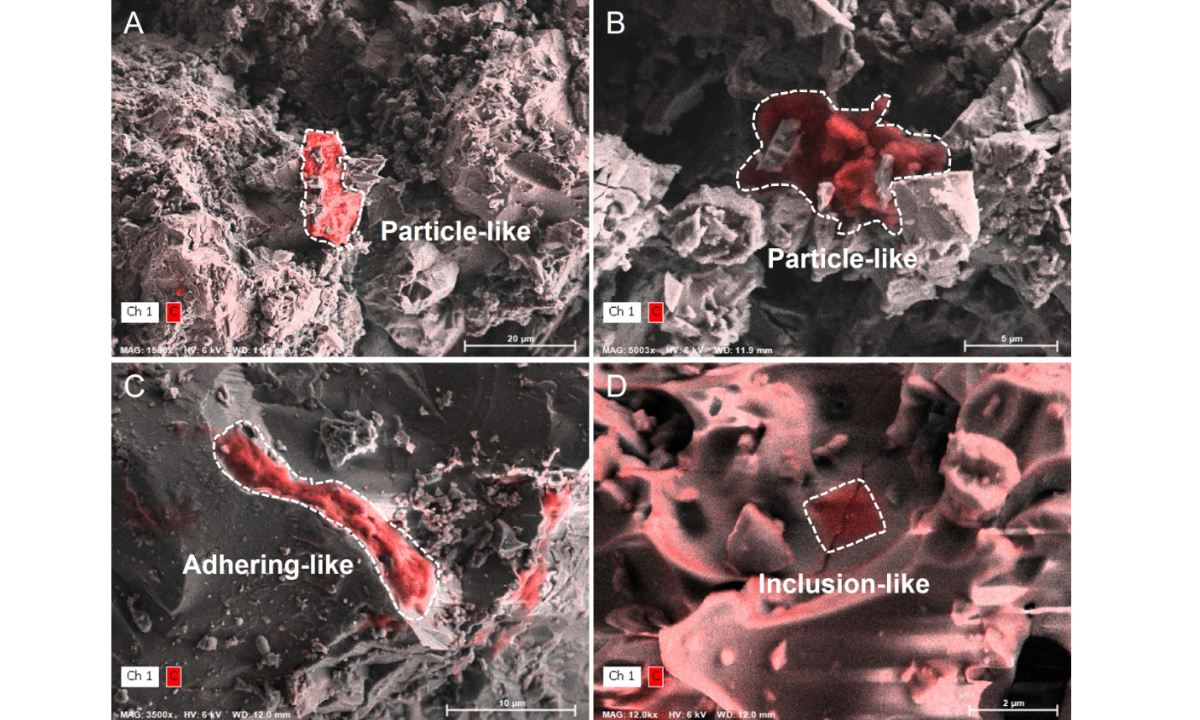
Representative organics identified in Chang'e-5 and Chang'e-6 lunar samples Photo: Courtesy of Institute of Geology and Geophysics, Chinese Academy of Sciences
A joint study by Chinese and international scientists has for the first time identified nitrogen-bearing organic matter in lunar soil samples returned by the Chang'e-5 and Chang'e-6 missions and revealed the organics' evolutionary processes in the solar system, the Institute of Geology and Geophysics of the Chinese Academy of Sciences (IGGCAS) announced on Thursday.
The findings suggest the moon has recorded the history of organic matter delivered to the inner solar system by asteroids and comets, and preserves evidence of further modification of these organics through impacts and irradiation on airless celestial bodies, according to the institute which published the research on academic journal Science Advances on Thursday.
According to the institute, asteroids and comets in the early solar system acted like "couriers" and continuously delivered organic materials and life-related elements such as carbon, nitrogen, oxygen, phosphorus, and sulfur, to terrestrial planets, potentially supplying some of the chemical ingredients for the origin and evolution of life on early Earth.
While Earth's active geological processes and biological activity have erased much of this record, the relatively inactive moon acts as a "time capsule," preserving information on the delivery of extraterrestrial organic matter and its evolution.
While carbon and nitrogen were previously found in lunar soil samples from the Apollo missions, scientists lacked a clear understanding of nitrogen-bearing organics in lunar soil. In this research, scientists analyzed lunar soil particles returned by the Chang'e-5 and Chang'e-6 missions using advanced microscopy and spectroscopy to trace the structure, chemistry, and isotopic composition of the organics.
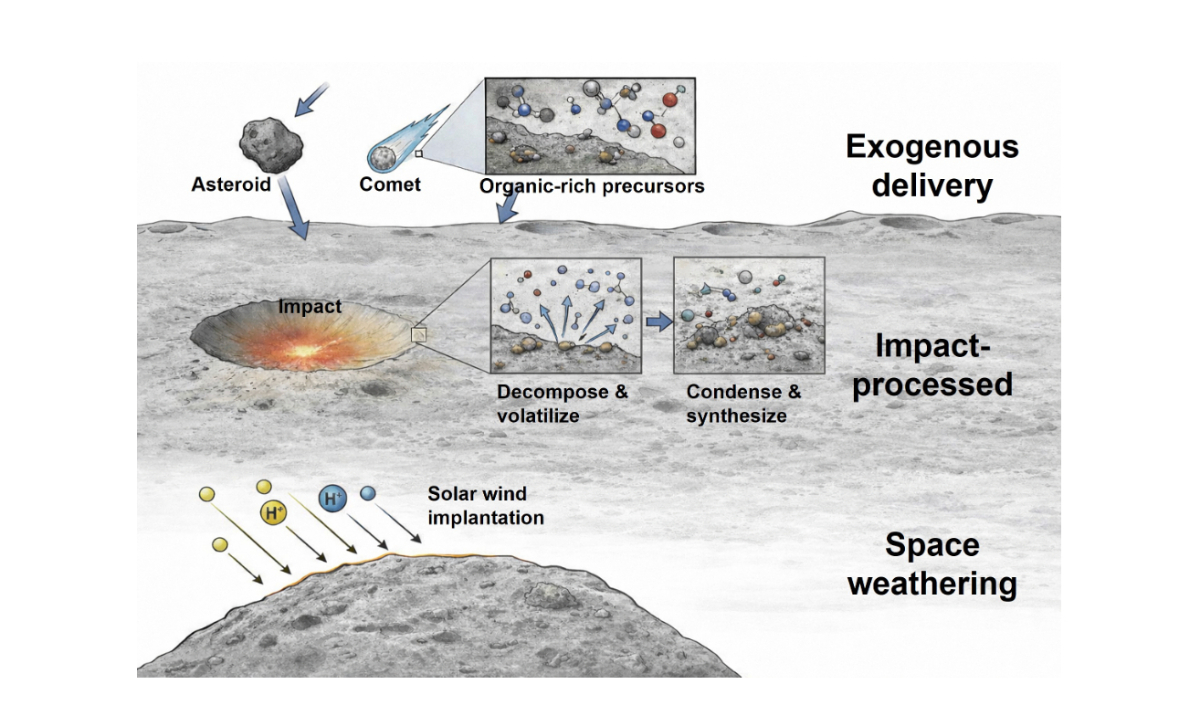
Schematic diagram of the formation and evolution of organic matter in lunar soil Photo: Courtesy of Institute of Geology and Geophysics, Chinese Academy of Sciences
According to Dong Mingtan, first-author of the research paper, the results show that lunar surface organics occur as submicron- to micron-scale particles, coatings, and inclusions rich in carbon, nitrogen, and oxygen, with amorphous structures and occasional amide functional groups, evidence of complex chemical reprocessing.
Isotopic data show these organic substances are "lighter" than those in meteorites, supporting a scenario in which asteroid and comet impacts both deliver and transform organics through evaporation, migration, and recondensation on the moon, according to Dong.
The research team also, for the first time, identified signatures of solar wind in lunar organic matter. They found that variations in hydrogen isotopes and hydrogen-to-carbon ratios in some organic coatings suggest prolonged surface exposure and irradiation by the solar wind.
These solar wind signatures - distinctive "fingerprints" left by solar wind particles interacting with and modifying lunar surface materials - further rule out the possibility that these organics originated from terrestrial contamination, Hao Jialong, corresponding author of the research paper, told the Global Times on Thursday.
According to the researchers, this study can support future deep-space sample return missions. The established technical route for the identification and evolutionary analysis of microregion organic matter is expected to support the identification and interpretation of organic matter and volatiles in samples returned from the Tianwen-2 asteroid sampling mission.
Technologically, the study revealed the continuous evolution of lunar organics - from exogenous delivery to impact-driven reprocessing and subsequent space weathering. It offers new insights into small-body evolution and early solar system organic matter transport.
RELATED ARTICLES