Humanoid robot half-marathon approaches; China's robotics sector grows as new product hits 10 m/s sprint speed
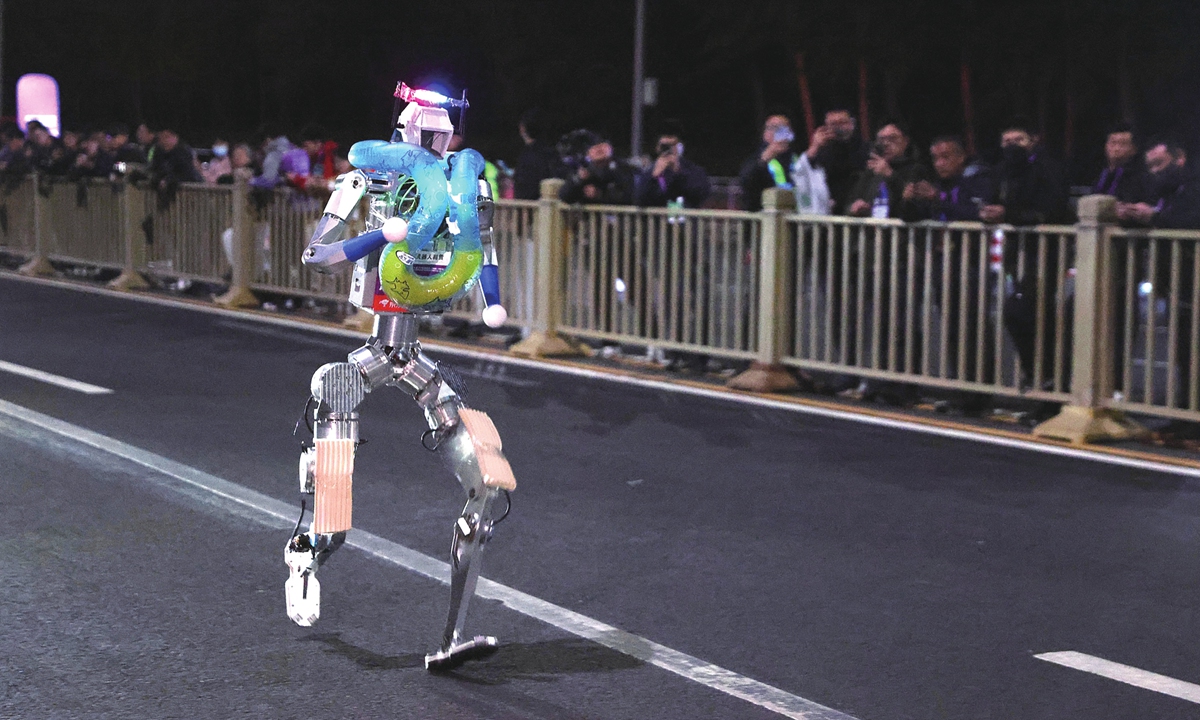
A humanoid robot conducts late-night testing in Beijing on April 11, 2026, as it prepares for the upcoming half marathon event held in the city. Photo: VCG
As the capital city sheds its daytime bustle, rhythmic footsteps echo across a quiet track under the cover of night. This weekend, a group of unusual "runners" took to the course for adaptive training ahead of next week's half marathon event held in Beijing Economic-Technological Development Area (E-Town).
However, these "runners" are not the human athletes, but the humanoid robots conducting real-world simulations to familiarize themselves with the race route.
The night drill, organized in Beijing E-Town, simulated the full competition process, including route navigation, scheduling coordination, multi-device collaboration, and emergency response. More than 70 teams participated, including four international entrants, with both autonomous-navigation robots and remote-controlled robots tested side by side, local authorities told the Global Times via a statement.
Now in its second edition, the event is widely regarded as the world's first humanoid robot half marathon. In last year's inaugural race, the Tien Kung Ultra robot, developed by China's National and Local Co-built Embodied AI Robotics Innovation Center, was crowned champion with a time of around 2 hours and 40 minutes.
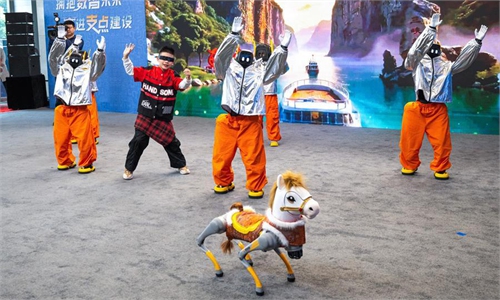
Analysts note that the public expectations for this year's race have surged, fueled by a string of high-profile breakthroughs in embodied artificial intelligence (AI) since the beginning of 2026. From diverse humanoid robot performances at the 2026 Spring Festival Gala to advanced martial arts demonstrations and coordinated group control displayed by Chinese firm Unitree Robotics, the sector has captured widespread attention. Observers are now looking to the upcoming race for further "jaw-dropping" demonstrations of real-world capabilities.
Significant upgrade
Footage released by CCTV News on Sunday shows multiple robots accelerating rapidly from the starting line upon command. Engineers and maintenance staff had to follow on electric carts or motorcycles to keep pace. One robot was even seen smoothly navigating a turn before accelerating again to chase a competitor ahead.
Videos circulating on Chinese social media platform Xiaohongshu reveal stark differences in robot designs, including variations in size, stride frequency, and arm movement used for balance. Some models lean forward with fluid arm swings, closely resembling human running posture.
The 2026 Beijing E-Town Half Marathon and Humanoid Robot Half Marathon will officially kick off on April 19. Compared with the last edition, the number of participating teams has surged nearly fivefold to over 100, with close to 40 percent competing in the autonomous-navigation category, according to Beijing E-Town.
The large-scale debut of autonomous navigation technology stands out as both a highlight and a key challenge. In complex and dynamic environments, robots must process real-time perception and decision-making tasks, placing enormous demands on computing power, said the statement by the local authorities.
Competition rules have also been adjusted to favor autonomous systems. Autonomous teams are ranked based on actual completion time, while remote-controlled teams face a 1.2 coefficient penalty. Operators in the remote category are restricted from unnecessary intervention, with rules discouraging human accompaniment, in a clear push toward full autonomy, according to previous reports.
Chen Jing, vice president of the Technology and Strategy Research Institute, told the Global Times on Sunday that this shift of competition rules marks a critical upgrade, with embodied AI moving from "remote-controlled puppets" in laboratories to autonomous "silicon-based agents" capable of operating in open environments.
While remote control limits robots to pre-set trajectories, autonomous navigation enables them to function as general-purpose mobile platforms adaptable to real-world scenarios such as warehouse inspection, disaster response, and industrial manufacturing, according to Chen.
"The scaling of autonomous navigation signals that the 'brain' of embodied AI is finally catching up with the 'body,'" Chen noted, adding that the sector is approaching a commercialization inflection point.
Long-distance running imposes stringent requirements on robots' endurance, energy management, dynamic balance, and gait control. High-speed sprints and sharp turns further demand adaptive locomotion and millisecond-level posture correction. To encourage breakthroughs, the competition has introduced specialized awards in categories such as endurance, gait, design, and perception.
Some teams predict that finishing times could approach those of elite human runners, reflecting rapid gains in short-distance speed and overall system performance. Observers believe the targeted rule design will accelerate innovation in key areas such as energy efficiency, motion stability, and autonomous control, providing a precise boost to the embodied AI industry.
Running faster
On Saturday evening, Unitree Robotics announced a new world record in humanoid robot sprint speed via a video clip, which showed that its H1 robot reached a velocity of around 10 meters per second. The speed approaches the peak human sprint speed of 10.44 meters per second achieved by Jamaican legend Usain Bolt during his 9.58-second 100-meter world record.
Wang Xingxing, CEO of Unitree Robotics, previously said at the 2026 Yabuli Entrepreneurs Forum that humanoid robots could break the 10-second barrier in the 100-meter dash by mid-2026, potentially surpassing human limits, according to the Beijing-based Securities Times. The company has not yet confirmed whether it will participate in this year's humanoid half marathon competition.
Chen said the breakthrough signals a generational leap in power and control systems, driven by advances in dynamic motion algorithms, motor power density, and lightweight structural design.
According to the video clip, the H1 robot features a combined thigh and calf length of 80 centimeters and weighs around 62 kilograms -parameters comparable to an average human.
"Such specifications enable the robot to sustain an exceptionally high stride frequency while maintaining stability, effectively addressing the global challenge of bipedal robots being prone to imbalance at high speeds," Chen said.
China's rapid progress in humanoid robotics is underpinned by its expanding industrial base. Data from the Ministry of Industry and Information Technology (MIIT) shows that by 2025, the country had more than 140 humanoid robot manufacturers, with over 330 models released.
Leveraging its manufacturing strengths, China is scaling up production while driving down costs.
A production line in South China's Guangdong Province, built by Leju Robotics, has achieved an annual capacity of over 10,000 units, with a new robot rolling off the line every 30 minutes. In October 2025, Chinese robotics firm Noetix introduced its consumer-grade "Bumi" humanoid robot priced at 9,998 yuan ($1,464.27), accelerating consumer adoption.
To ensure healthy industry development, MIIT established a technical committee of Humanoid Robots and Embodied Intelligence Standardization in late 2025, followed by the release of the standard system for the humanoid robots and embodied AI on March 1, 2026, which marks China's first top-level framework covering the entire industrial chain and lifecycle, signaling a transition toward standardized growth.
Against the backdrop of expanding application scenarios of humanoid robots, Chen emphasized that endurance races for humanoid robots such as half marathons are far from symbolic. They provide a dual test of peak performance and sustained operation under complex conditions, evaluating both speed and robustness.
"Different robot types are expected to serve distinct roles. Slower models are well suited for static scenarios such as warehouse inspection and guided tours, while faster, explosive humanoid robots could play critical roles in disaster response, hazardous material handling, and border patrol, where speed can be decisive," he said.
As humanoid robots prepare to line up alongside human runners next week, the race is shaping up to be more than a technological spectacle; it is a high-stakes proving ground for the next phase of embodied AI commercialization, Chen noted.
RELATED ARTICLES