Beijing steps up control of poplar and willow catkins with intelligent tech and specialized equipment: GT learned
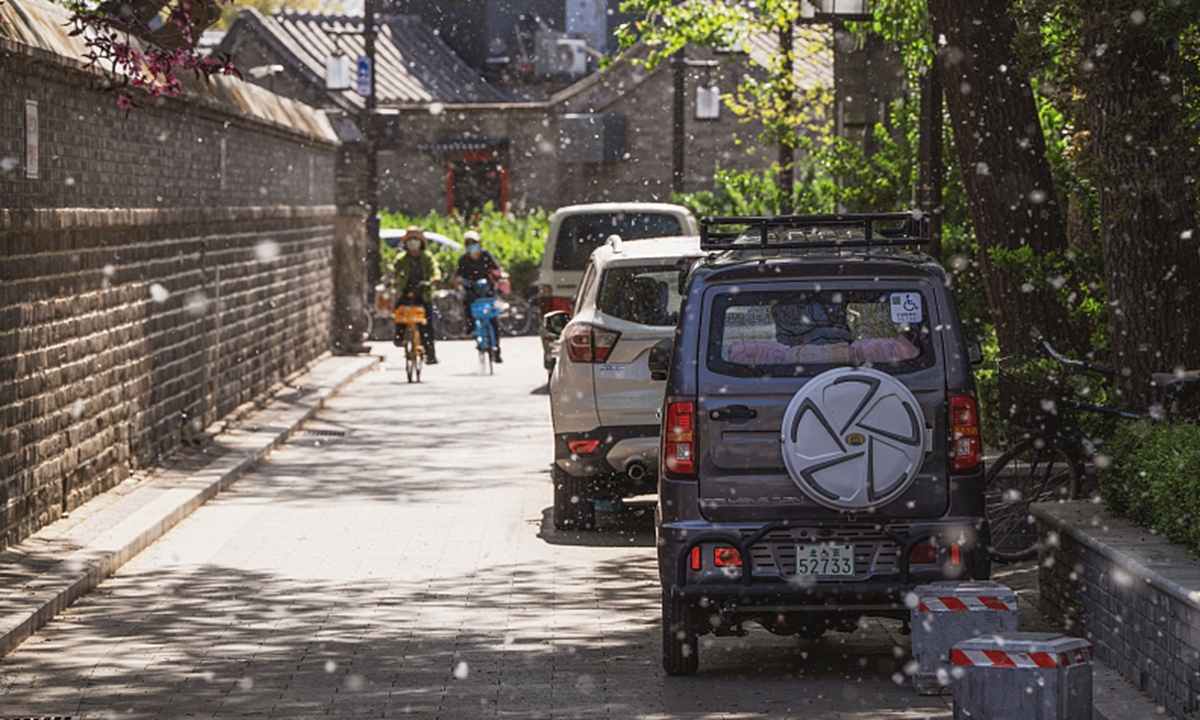
Poplar and willow catkins fill a hutong of Beijing, on April 10, 2026. Photo: VCG
As poplar and willow catkins begin drifting across many urban roads in Beijing this spring, the city has launched prevention and control efforts using a combination of technological measures to reduce disruptions to daily life, including the use of the coagulant and the portable absorber, the Global Times learned from the local forestry and parks bureau on Monday.The flying period of poplar and willow catkins in Beijing will last until late May, with the catkin period being about 50 days. The first peak is expected around mid-April, according to the bureau.
Some Weibo users have posted recent photos of Beijing streets covered in catkins, commenting that those unfamiliar with the scene might mistake them for "snow."
Beijing has leveraged technological innovation to deploy a variety of intelligent control technologies and specialized equipment for the existing female poplar and willow trees across the city that have reached maturity and cannot be replaced immediately, Jiang Yingshu, director of the science and technology division of the Beijing Municipal Forestry and Parks Bureau, told the Global Times on Monday.
A coagulant developed by the Beijing Academy of Forestry and Landscape Architecture can form an "ecological film" on the crown surface, bonding and shrinking the catkins before they burst and causing them to lose their ability to disperse after spraying, Jiang said. A single spray can reduce the catkin emissions of a single female poplar or willow tree by more than two-thirds.
"It is a non-toxic, harmless, and environmentally friendly polymer compound, suitable for various spraying equipment such as high-pressure fog cannons and drones. The coagulant is also readily degradable, which can decompose naturally under rain washing and natural light, without affecting tree growth and the surrounding ecological environment," Jiang said.
Also, a portable catkin absorber has also been fully put into use, Jiang said. The equipment enables precise, directional absorption of catkins without removing other debris, which can efficiently clean fallen catkins in areas where manual cleaning is difficult such as residential areas and road corners, and eliminate fire hazards caused by catkin accumulation.
The city has built a real-time monitoring and forecasting platform for poplar and willow catkins, enabling street-level monitoring and accurate forecasting in core areas. Over 100 special monitoring points have been set up across the city to track the whole-cycle development of female poplar and willow inflorescences, Jiang added.
The city has also strengthened seed source research to support the germplasm foundation of catkin-free management. So far, Beijing has collected nearly 400 excellent poplar and willow germplasm resources with little or no catkins, and selected 16 superior varieties. It has also broken through tissue culture technology for Populus tomentosa, enabling the propagation of about 1 million seedlings within 2-3 years, with 100,000 high-quality seedlings bred.
Willows and poplars were widely planted in Beijing for historical reasons. Many of the city's poplars and willows were planted in the 1960s and 1970s, when Beijing was highly vulnerable to wind and sand, the Beijing Municipal Forestry and Parks Bureau told the Global Times. The trees helped to curb sandstorms and lay the foundation for Beijing's sound ecological environment today.
Although every tree species has its strengths and weaknesses, willows have the longest green period among broadleaf trees used in Beijing's urban greening. Without them, Beijing's green season would be shortened by around 30 days. Poplars grow tall and straight, often reaching 20-30 meters. Without these trees, Beijing's green skyline would drop 5-10 meters.
Mature poplar and willow trees cannot be felled on a large scale at once. Most 30 cm wide poplars are over 30 to 40 years old. New saplings need decades to reach full size, leaving ecological functions temporarily unreplaced, according to Science and Technology Daily.
For the upcoming May Day holiday, Beijing has rolled out a special control plan. The city will deploy more workers and increase cleaning frequency in busy areas, including parks, scenic spots, shopping malls, and transport hubs, Jiang said.
No research so far suggests that catkins themselves cause allergies, though they may trigger itchiness and other discomfort in sensitive individuals, who are advised to take full protective measures when going out, Jiang addded.
RELATED ARTICLES