Orban concedes defeat in election under global attention amid speculations of sharp policy shift
By Li Yu and Published: Apr 13, 2026 10:10 PM

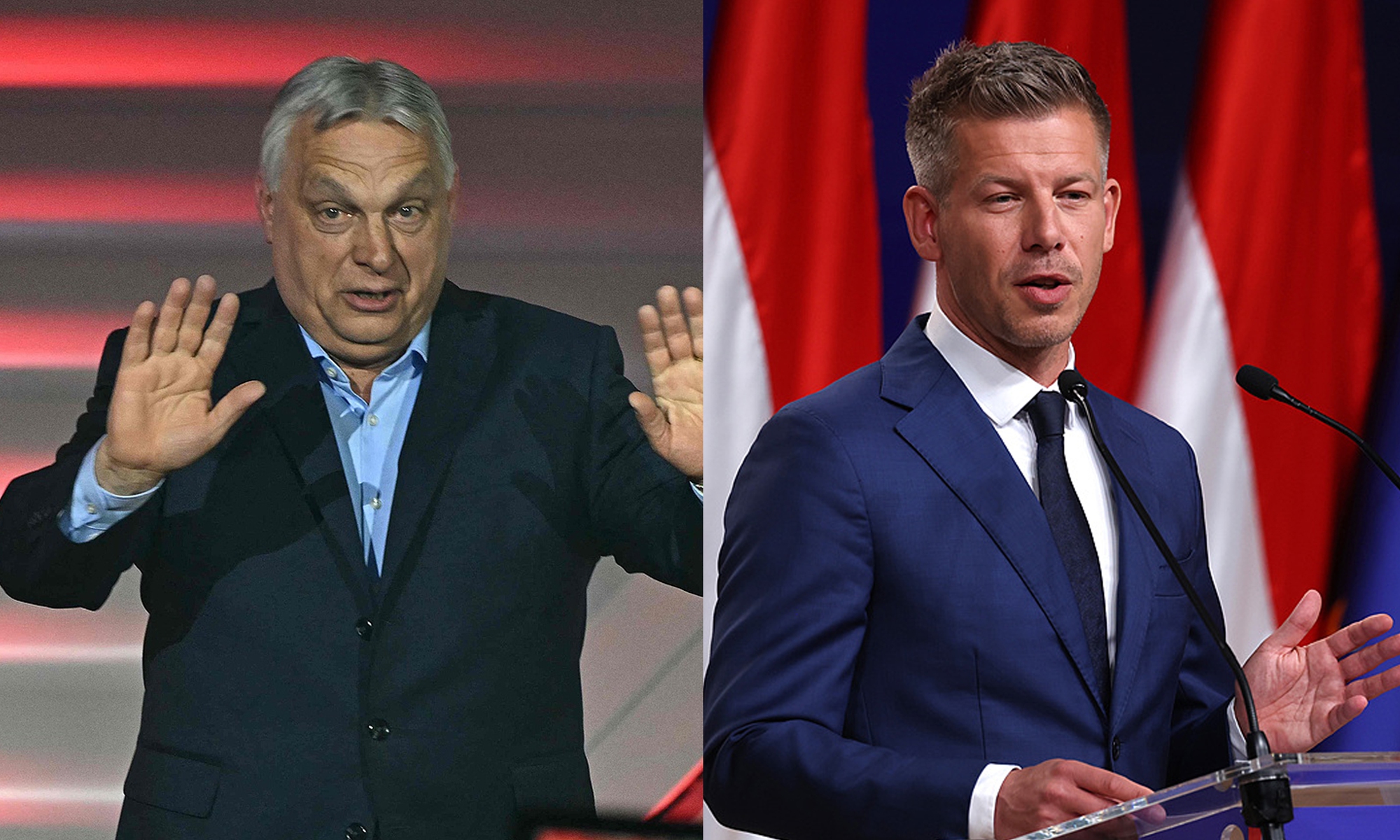
Left: Hungary's Prime Minister Viktor Orban addresses supporters at the Balna center in Budapest on April 12, 2026. Right: Peter Magyar, lead candidate of the Tisza party, speaks in front of Hungarian and a EU flag after Tisza victory over rival Fidesz in Hungarian parliamentary elections on April 13, 2026. Photos: VCG
"The election result is painful for us, but clear," Hungarian Prime Minister Viktor Orban said at the Fidesz party campaign offices, conceding defeat on local time Sunday in a major election loss - signaling the imminent end of his 16 consecutive years in power, as the Xinhua News Agency reported - as results showed Peter Magyar's center-right Tisza party winning a majority, per media reports.
Tisza was projected to win 138 of the 199 parliament seats, exceeding the two-thirds threshold. Orban's ruling Fidesz-KDNP alliance was projected to win 55 seats, according to Xinhua.
Over the development, Chinese Foreign Ministry spokesperson Guo Jiakun stated Monday that China congratulates the Tisza party led by Mr. Peter Magyar on the parliamentary election victory in Hungary. China deeply values its ties with Hungary and stands ready to work with the new Hungarian government on the basis of mutual respect, equality, and mutual benefit to enhance high-level exchanges, deepen political mutual trust, expand practical cooperation and people-to-people exchanges, and deliver more benefits to both peoples, the spokesperson said.
This election has received wide attention as it will not only affect the future of Hungary, but also carries implications for the European country's relations with the US, Russia and the EU, with influence on wider geopolitical scope, Chinese observers said.
But no matter how policy adjustment is made, the core issues of security, energy and economic development remain unchanged and shall be the priority of the new government, they said.
A sharp turn?
According to CNN, Magyar was a member of the Fidesz party and had previously been married to Judit Varga, who was one of the party's rising stars. But in early 2024, Varga was also involved in a scandal concerning coverup of abuse of underaged children, which rocked Fidesz. Magyar broke from the party and Orban in February 2024. Later that year, Magyar joined the Tisza party and quickly rose up the ranks to become its leader. Under his leadership, Tisza unexpectedly won almost 30 percent of the Hungarian votes in the European Parliament election in June 2024, making Magyar an MEP.
The 45-year-old election winner Magyar, who had campaigned against corruption and on everyday issues like health care and public transport, has pledged to rebuild Hungary's relationships with the EU and NATO - ties that frayed under Orban, AP reported on Monday.
The New York Times (NYT) also reported Monday that Magyar and his Tisza party have struck a friendlier tone toward the EU and NATO alike. Most immediately, the new leadership is widely expected to clear the path for a 90 billion euro loan to Ukraine that has been frozen for weeks because of Orban's objections, per NYT.
Magyar's campaign agenda has shown major contrast to Orban, who has long been distancing from the EU while maintaining ties with both the US and Russia, according to Chinese analysts.
Yet political news and commentary website Talking Points Memo, or the TPM, wrote three days ahead of the election result that even if Magyar wins the election, "the road to full de-Orbanization remains long, arduous, and uncertain."
In the process of advancing so-called "de-Orbanization," the new government will need to differentiate among existing policies rather than simply negate them all, Cui Hongjian, a professor at the Academy of Regional and Global Governance at Beijing Foreign Studies University, told the Global Times on Monday.
Even if adjustments are made in Hungary's relations with the EU and NATO, it does not mean Hungarian policy will undergo a fundamental shift, Cui said, noting that a more likely scenario is limited adjustments within the framework of national interests, seeking balance among different policies - a process that will require time to advance gradually.
For Hungary, whether it is Orban or Magyar, both must confront pressing real-world issues, including economic difficulties, energy challenges, and the long-standing historical and practical contradictions with Ukraine. Hungary's policy toward Ukraine differs from that of many other European countries, largely due to deep historical grievances between the two nations. This difference is unlikely to change fundamentally because of a single election result, Jiang Feng, a researcher at Shanghai International Studies University and president of the Shanghai Regional Studies Association, told the Global Times.
Similarly, the core issues facing Europe - security, energy, and the economy - remain unresolved. This election was largely a response to voters' emotions and frustrations, rather than a solution to these underlying problems. Therefore, Orban's departure doesn't mean the mentioned problems in Europe have been solved, nor will Hungary's development direction undergo any fundamental shift, Jiang said.
Though the biggest impact should be on Hungarian domestic politics and its relationship with the EU, Japanese media outlet Sankei Shimbun deliberately linked it to China, claiming that "Viktor Orban was the EU leader who most enthusiastically engaged with China and with the change of government in Hungary, China may be forced to reconsider its strategy toward the EU."
Chinese analysts shrugged over such speculation and hypes by the Japanese press which has long been unfriendly with China, saying that it is not surprising they would take advantage of such change of power in any country and use it for hostile narrative against China.
In fact, the election campaigns were focused on domestic issues such as anti-corruption and economic challenges, as well as EU relations and stance over the Russia-Ukraine crisis, they added.
According to German media DW on April 10, during the large rallies, Magyar promises closer EU ties, while Orban warns the vote will shape Hungary's stance on Ukraine and stability.
More than domestic
The Hungarian elections have carried wide attention beyond its borders, with some media describing it as the closing of a significant chapter in Hungarian and European politics.
The Washington Post described Orban as a darling of MAGA-aligned American conservatives, an ally of the Kremlin and a proud antagonist of EU leaders in Brussels. The Guardian also concluded that the power change ushers in a new period for Hungary's relations with the EU, US and Russia.
This election has transcended the boundaries of a purely domestic Hungarian contest. It has evolved into a broader geopolitical showdown centered on the Russia-Ukraine conflict and the future direction of Europe, Jiang said, explaining why the parliamentary election of the country with relatively modest size and population has captured worldwide attention.
After the elections, congratulatory messages for Magyar poured in from mainstream European political leaders, for whom Orban was often a major frustration as he wielded his country's veto power to block key EU initiatives, including most recently a 90 billion euro loan for Ukraine, the Washington Post reported.
According to CNN, European Commission President Ursula von der Leyen said on social media that "Hungary has chosen Europe." European Parliament President Roberta Metsola congratulated election winner Peter Magyar, saying: "Hungary's place is at the heart of Europe."
Other European country leaders including French President Emmanuel Macron, German Chancellor Friedrich Merz, and UK Prime Minister Keir Starmer also offered congratulations, emphasizing Hungary's role in Europe and mentioned a stronger and more united Europe.
Jiang added the campaign was not only a matter for Hungarian voters; various forces from across Europe and even the US were involved - media reported that Vice President Vance visited Budapest last week to show support for Orban. On the surface, the stage was set in Hungary, but in reality, it also represented a high-stakes contest over the strategic future of the European continent.
Also coming just ahead of the election, the Hungarian government signed an agreement with Russia to expand the two countries' economic, trade, energy and cultural ties, according to documents drawn up by the Russian government and obtained by POLITICO, per a report by POLITICO on April 8.
The Orban government has long pursued a pluralistic and balanced great-power diplomacy, which enabled it to secure a certain degree of support from both Russia and the US, said Jiang.
In the current European political context, Russia is viewed as a force undermining peace, while the US is also seen by some EU voices as disrupting existing rules. "Against this backdrop, if the new Hungary administration chooses to improve ties with the EU and move closer to Brussels as the core direction of its foreign policy, its relations with both the US and Russia will inevitably undergo adjustments," Jiang added.
RELATED ARTICLES