Illustration: Liu Rui/GT
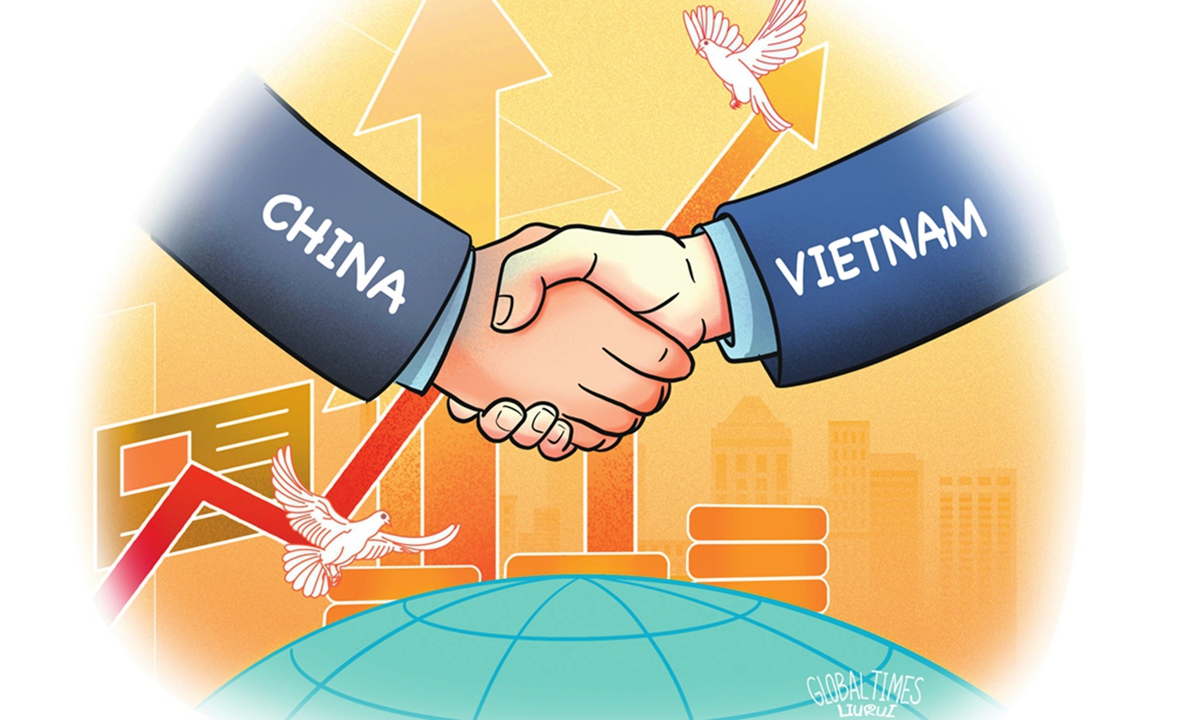
General Secretary of the Communist Party of Vietnam Central Committee and Vietnamese President To Lam will pay a state visit to China from Tuesday to Friday. This is To Lam's first overseas trip following his election as president at the first session of Vietnam's 16th National Assembly - a clear signal of Vietnam's strong emphasis on its relations with China. The visit also falls one year after General Secretary of the Communist Party of China Central Committee and Chinese President Xi Jinping's state visit to Vietnam, lending special significance to what has become a tradition of landmark reciprocal visits between the two countries' top leaders.The unique character and strategic importance of China-Vietnam relations speak for themselves. Both countries are socialist states that are pressing full steam ahead with their respective modernization drives. Deepening all-round cooperation and jointly advancing the building of a community with a shared future is not only the choice history has handed down - it is a practical necessity that serves the fundamental interests of both nations.
According to the Vietnam News Agency, the Vietnamese top leader is scheduled to hold talks with his Chinese counterpart and meet with other senior Chinese leaders. He will deliver a policy speech at Tsinghua University and attend cultural and exchange activities aimed at strengthening public ties. In an interview with the news agency, Vietnamese Ambassador to China Pham Thanh Binh expressed his confidence that Vietnam-China cooperation still holds vast potential, driven by complementary development strategies, especially as Vietnam has begun to realize the Resolution of the 14th National Party Congress and China is deploying the 15th Five-Year Plan (2026-30).
Clearly, To Lam's visit to China is no routine trip; it builds on the past while mapping out the future - a "strategic synchronization" and "strategic resonance" between two neighboring socialist countries navigating a complex international environment. Translating high-level consensus into real-world cooperation - specifically, driving the concrete implementation of comprehensive, results-oriented cooperation between the two countries and advancing that cooperation to higher levels, across broader domains, and in greater depth - will be the defining theme of China-Vietnam relations as they enter this new stage of development.
In this process, economic and trade cooperation is expected to serve as the centerpiece of practical China-Vietnam cooperation. In 2025, China remained Vietnam's largest trading partner, second-largest source of foreign investment and largest source of international tourists. These facts paint an encouraging picture of China-Vietnam economic and trade cooperation.
For Vietnam, right now is a critical juncture in its all-out economic push. The country has set an ambitious target of sustained annual GDP growth of over 10 percent. Achieving this demanding goal needs China's support in various aspects. China is not merely a partner; it is the most stable and accessible reservoir of resources that Vietnam can draw upon amid global turbulence. Vietnam, as a country whose economy is heavily export-oriented, simply cannot go it alone in a volatile international environment. Maintaining a solid relationship with China is itself a form of risk management.
It is therefore imperative to achieve more efficient alignment between the two countries on regional development planning, strategic infrastructure, supply chains, economic corridors and logistics systems. Advancing the construction of standard-gauge railway lines, smart border crossings and cross-border economic cooperation zones will be among the priority tasks that must be jointly tackled as China-Vietnam relations enter this new stage of development.
Going forward, China and Vietnam will also need to strengthen cooperation in new growth areas and key sectors, including scientific and technological innovation, energy security, digital transformation and AI applications, high-quality agriculture, education and training, and the development of a high-caliber workforce. By driving high-quality development across the digital economy, green economy and knowledge economy, the two countries can achieve breakthroughs in comprehensive, results-oriented cooperation.
In sum, To Lam's trip to China will become unquestionably one of the most consequential bilateral diplomatic events of 2026 for the two parties and two states. The consensus to be reached by both sides' senior leaders during this visit is expected to provide strategic-level guidance to propel China-Vietnam party and state relations to a higher level, and will thereby inaugurate a new stage in the development of China-Vietnam good-neighborly friendship, their comprehensive strategic partnership and the building of a China-Vietnam community with a shared future.
The author is a distinguished research fellow at the Center for Regional and Country Studies, Guangxi Minzu Normal University and a former board member of the China-Vietnam Friendship Association. opinion@globaltimes.com.cn
RELATED ARTICLES