Philippine side staging of so-called ‘cyanide stunt’ has no credibility: FM spokesperson
By Published: Apr 13, 2026 11:28 PM

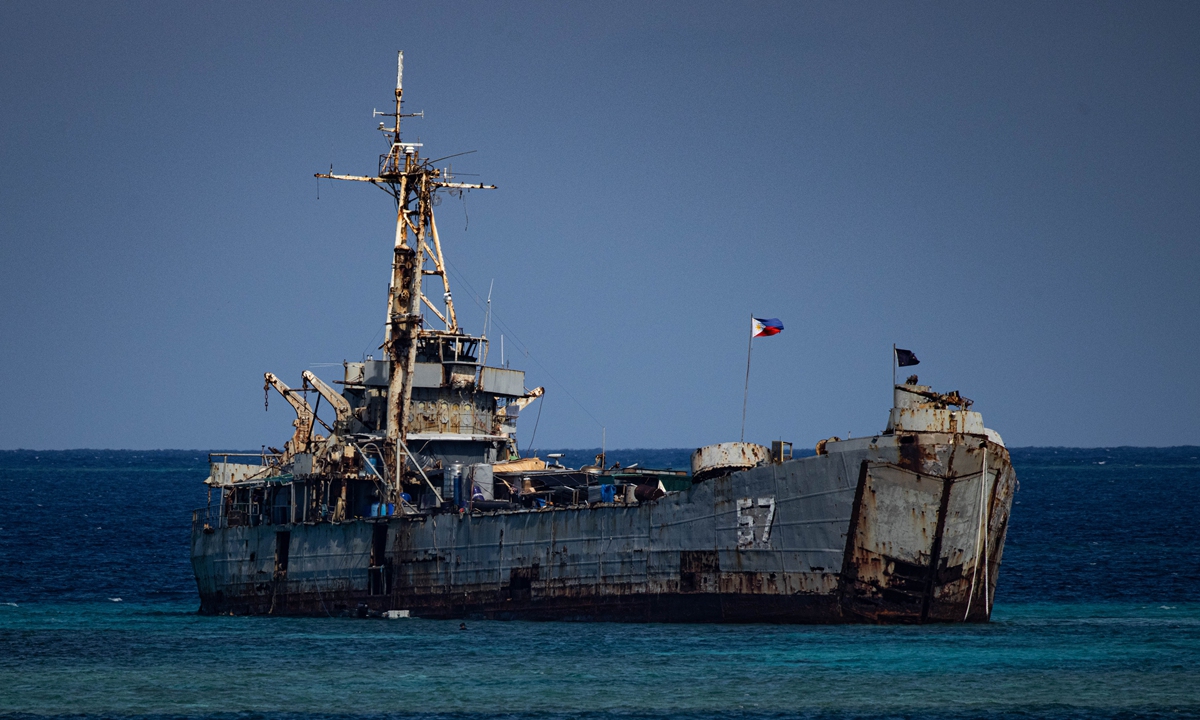
The Philippine illegally grounded warship BRP Sierra Madre at Ren'ai Jiao Photo: China Coast Guard
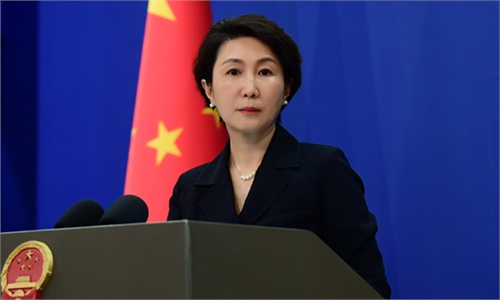
"There is no credibility whatsoever to their story," Chinese Foreign Ministry spokesperson Guo Jiakun said on Monday in response to a question about the Philippines' National Security Council claimed at a briefing that cyanide was found in bottles recovered from Chinese boats near Ren'ai Jiao in February and October 2025.Guo said that Ren'ai Jiao is part of Nansha Qundao and belongs to China. The Philippines illegally grounded its vessel on Ren'ai Jiao and has caused great damage to the eco-environment there, which has been confirmed by relevant reports.
The Philippine side illegally harassed the Chinese fishing boats conducting normal fishing, grabbed the fishermen's living supplies, and staged this so-called cyanide stunt, Guo added.
The Philippine authority claimed on Monday that a laboratory analysis confirmed that bottles recovered from Chinese boats near Ren'ai Jiao in February and October 2025 contained cyanide, Bloomberg reported on Monday.
It is not the first time that the Philippines has staged the so-called "cyanide stunt" against China.
The 2025 Investigation and Assessment Report on Marine Ecology and Environment Status of Huangyan Dao in the South China Sea released by China's Ministry of Ecology and Environment in November 2025 pointed out that no cyanide has been detected in seawater, sediments or fish samples, as the Philippines has tirelessly but groundlessly smeared Chinese vessels, claiming that they used cyanide to fish in waters of Huangyan Dao since 2024.
The hype over alleged detection of cyanide used by the Chinese vessels at Ren'ai Jiao highlights the tendency of certain anti-China forces in the Philippines to "rehash old stories", Ding Duo, director of the Research Center for International and Regional Studies at the National Institute for South China Sea Studies, told the Global Times on Monday.
"The so-called 'cyanide' stunt is nothing new and has long been a stale topic; it is resurfacing now amid the Philippines' current domestic challenges, such as energy shortages. As a result, some anti-China elements can only resort to reviving narratives like 'maritime poisoning' to generate public attention and shape opinion," Ding said.
In recent days, there have been mixed signals in China-Philippines relations. On March 28, Vice Foreign Minister Sun Weidong co-chaired the 24th China-Philippines Foreign Ministry Consultations (FMC) with Foreign Affairs Undersecretary for Policy and ASEAN SOM Leader of the Philippines Leo M. Herrera-Lim in Quanzhou, Fujian, according to the Chinese Foreign Ministry.
The two sides had a candid and in-depth exchange of views on China-Philippines relations and international and regional issues of common concern, the ministry said.
Also in the last month, Philippine President Ferdinand Marcos Jr. claimed in an interview with Bloomberg that the country is open to restarting talks with China on a joint oil and gas project in the South China Sea, saying the war in Iran may provide the impetus for a breakthrough.
However, in addition to smearing plot, the Philippines military and its coast guard continued their provocative actions in the South China Sea. Senior Captain Zhai Shichen, spokesperson for the PLA Southern Theater Command, said in a release published by the theater command on Monday that the Philippines rallied extraterritorial countries to organize so-called "joint patrols", which disrupted the South China Sea and undermined regional peace and stability. The theater command's forces will resolutely defend China's territorial sovereignty and maritime rights and interests, and firmly safeguard regional peace and stability, said the spokesperson.
RELATED ARTICLES