Vietnam's top leader starts state visit to China, visiting Xiong'an New Area after arriving in Beijing
Efforts to draw on experience from China in advancing high-quality development: Chinese expert
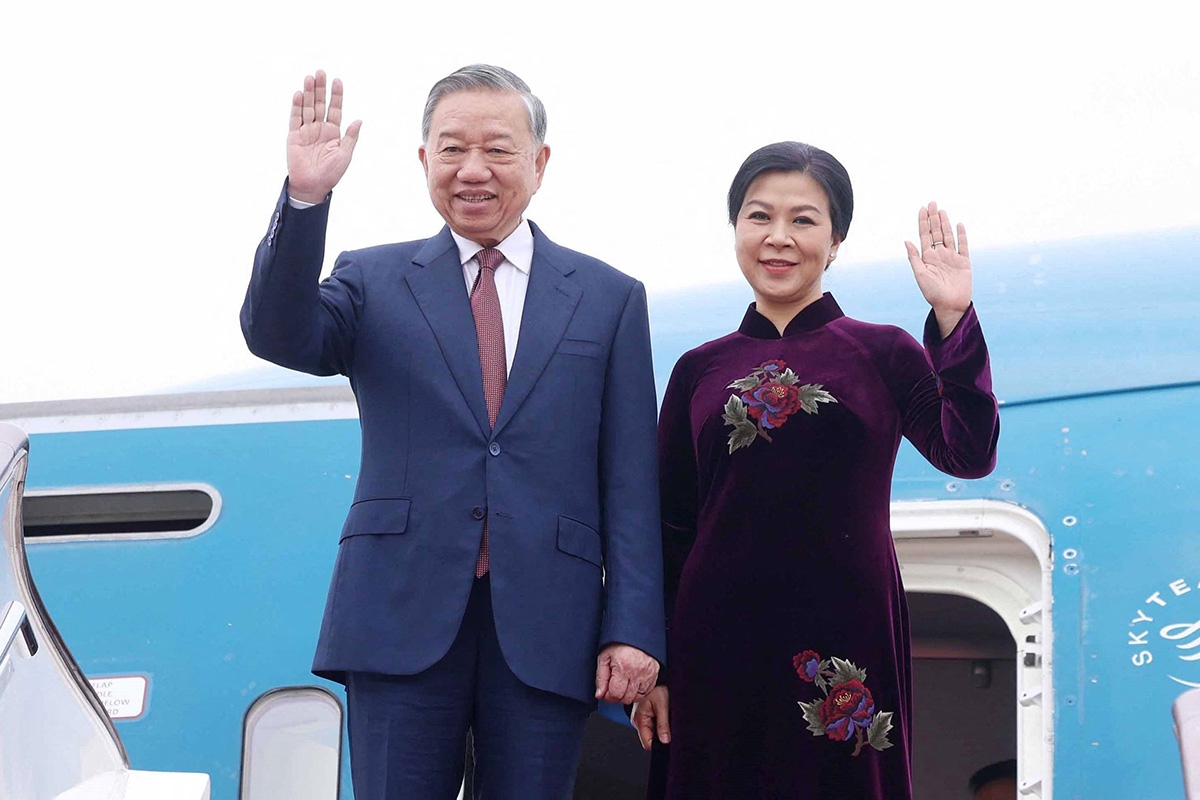
To Lam, general secretary of the Communist Party of Vietnam Central Committee and president of Vietnam, arrives in Beijing on April 14, 2026. Photo: VCG
To Lam, general secretary of the Communist Party of Vietnam Central Committee and president of Vietnam, arrived in Beijing on Tuesday for a state visit to China through Friday, the Xinhua News Agency reported. After arrival, Vietnam's top leader boarded a high-speed train to visit Xiong'an New Area, according to Xinhua.China is the first country To Lam visits following his recent election as Vietnamese president, according to Xinhua. Some Chinese experts told the Global Times on Tuesday that such arrangement underscores the great importance the two sides place on the China-Vietnam relations, reflecting Vietnam's efforts to draw on experience from China in advancing high-quality development.
China's top political advisor Wang Huning met with General Secretary of the Communist Party of Vietnam Central Committee and Vietnamese President To Lam in Beijing on Tuesday, Xinhua reported.
According to Xinhua, Wang, a member of the Standing Committee of the Political Bureau of the Communist Party of China Central Committee and chairman of the National Committee of the Chinese People's Political Consultative Conference, welcomed To Lam's visit to China, saying that in recent years, the top leaders of the two parties and countries have maintained close strategic communication, providing fundamental and strategic guidance for the development of China-Vietnam relations.
To Lam said Vietnam has always followed and sincerely congratulated China on its theoretical explorations and practical achievements in reform, opening up and socialist modernization, Xinhua reported.
During a ride on the Fuxing high-speed train to Xiong'an New Area, To Lam said China's newly approved 15th Five-Year Plan has opened a new chapter for China's development, and Vietnam is also implementing the resolution of the 14th National Congress of the Communist Party of Vietnam. The two parties and the two countries should strengthen strategic synergy and pursue common development, according to China Media Group.
Since China announced plans to establish the Xiong'an New Area in April 2017, the city has evolved from a blueprint into a vibrant city, Xinhua reported on March 29.
The visit to Xiong'an New Area, a manifestation of China's pursuit of high-quality development, would help Vietnam explore pathways and draw on experience in pursuing high-quality and sustainable development and turning the development blueprint into concrete actions, Xu Liping, director of the Center for Southeast Asian Studies at the Chinese Academy of Social Sciences, told the Global Times on Tuesday.
As a hub of diverse emerging industries and relieving Beijing of functions that are not essential to its role as national capital, Xiong'an New Area provides valuable experience in urban development and showcases industrial growth as a modern new area developed in a planned, step-by-step manner, Ge Hongliang, vice dean of the ASEAN College at Guangxi Minzu University, told the Global Times. Vietnam may draw insights from it to align the country's advancement and promote bilateral strategic coordination, he added.
The visit to China also comes at a crucial moment as this year marks the beginning of China's 15th Five-Year Plan (2026-2030), and the conclusion of the 14th National Congress of the Communist Party of Vietnam, Xu said, and this opens ways for alignment and coordination.
In a signed article published in the People's Daily on Tuesday, To Lam stated that he wished to convey the sincere friendship, high respect, and top priority that the Party and State of Vietnam, and the earnest wish of the Vietnamese people to work together with the Communist Party of China, the Chinese government and the Chinese people to continue to carry forward and promote the traditional friendship, enhance the strategic alignment between the two countries, and jointly draw up a new vision for the development of Vietnam-China relations in the new era.
This visit reflects the institutionalization of high-level exchanges between China and Vietnam, Xu said.
According to Xinhua, China became the first country to establish diplomatic ties with Vietnam in 1950. In 2008, China also became the first country to forge a comprehensive strategic cooperative partnership with Vietnam. In 2023, the two sides agreed to build a China-Vietnam community with a shared future that carries strategic significance on the basis of deepening the comprehensive strategic cooperative partnership.
For China, Vietnam is a key priority in its neighborhood diplomacy, highlighting the significance and strategic nature of bilateral ties, Xu said.
A report by Vietnam News Agency (VNA) noted on Tuesday that the state visit marks a new beginning in the bilateral relations as both countries enter a new stage of development. The report also noted that the trip is expected to elevate strategic connectivity and open up a new phase in relations between the two Parties and countries.
Singapore's Channel News Asia noted on Tuesday that To Lam's visit, his first overseas visit as head of state, signaled "Hanoi's foreign policy priorities" under his leadership.
To Lam noted in the article published in the People's Daily that, in response to the new requirements of the times and the new development tasks facing both countries, he believes that the two sides need to work together to focus on four key things.
First, to continue consolidating the political foundation of Vietnam-China relations and make it even more solid. Second, to promote greater transformation in practical cooperation, taking concrete outcomes as the key benchmark, To Lam wrote.
Third, to further strengthen the public support underpinning bilateral relations. Fourth, while expanding cooperation, the two sides should continue to safeguard a peaceful and stable environment, properly manage differences, and appropriately address existing issues.
Ge said that amid the complex global landscape, it is highly valuable that China and Vietnam uphold the need to properly manage differences and appropriately address existing issues, and steadily promote the robust development of their ties.
Such practice is highly valuable and of great significance to both regional and global stability, Ge added.
RELATED ARTICLES