Xi urges closer, stronger China-Russia strategic coordination to defend interests, uphold Global South unity
By and Qi Xijia Published: Apr 15, 2026 08:56 PM

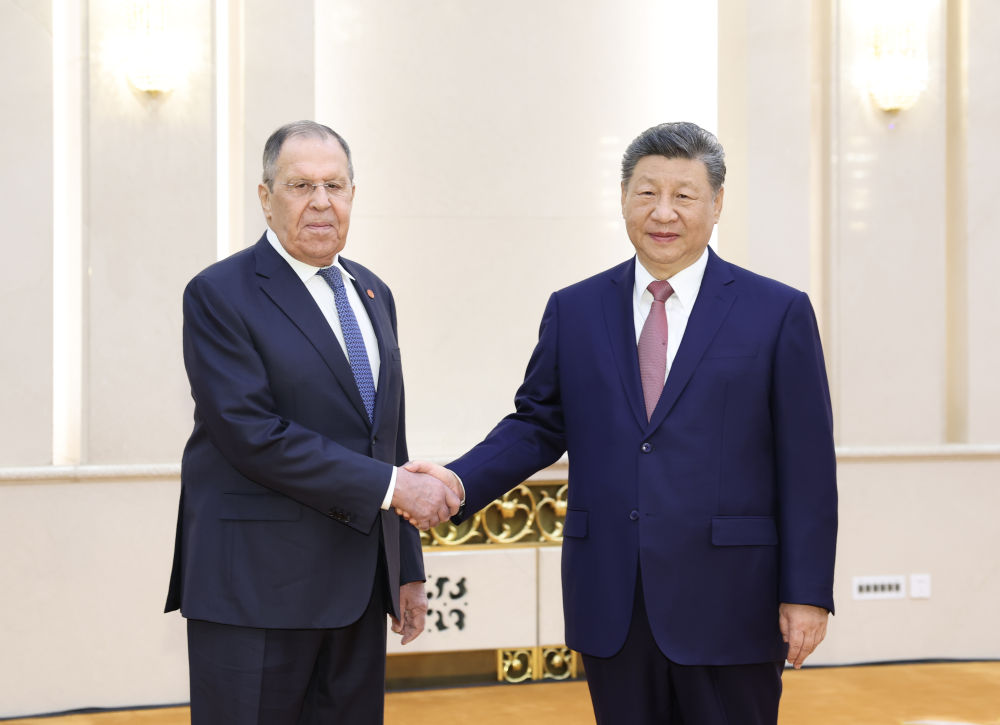
Chinese President Xi Jinping meets with Russian Foreign Minister Sergei Lavrov at the Great Hall of the People in Beijing, capital of China, April 15, 2026. (Xinhua/Huang Jingwen)
Chinese President Xi Jinping on Wednesday urged closer and stronger strategic coordination between China and Russia to firmly defend their legitimate interests and safeguard the unity of Global South countries, according to the Xinhua News Agency.
Xi made the remarks when meeting with Russian Foreign Minister Sergei Lavrov in Beijing, Xinhua reported.
Noting the stability and certainty of China-Russia relations are particularly valuable in a changing and turbulent international situation, Xi called on the two countries to shoulder their responsibilities as major countries and permanent members of the United Nations Security Council, per Xinhua.
Against the backdrop of an increasingly turbulent and interconnected world, China and Russia, as permanent members of the United Nations Security Council and emerging major powers, have set a model for a new type of major-country relations, some Chinese experts said.
The mature, resilient and steady China-Russia relations have strengthened the two countries' capacity to respond to risks and challenges, while also providing significant support for maintaining global strategic stability, they noted.
Much-needed stability
Asking Lavrov to convey sincere greetings to President Vladimir Putin, Xi hailed the development of the China-Russia comprehensive strategic partnership of coordination at a high level, yielding fruitful results across various fields, adding that the China-Russia Treaty of Good-Neighborliness and Friendly Cooperation has shown greater vitality and exemplary significance, Xinhua said.
He urged both sides to fully implement the important consensus reached by the two heads of state, enhance strategic communication, strengthen diplomatic coordination, and elevate the China-Russia comprehensive strategic partnership of coordination to a higher level in a steadier, more sustained manner, per Xinhua.
Xi stressed that China and Russia should maintain strategic resolve, trust and support each other, and pursue common development. It is necessary for the two sides to fully leverage the advantages of proximity and complementarity, deepen cooperation on all fronts, and enhance the resilience of their respective development, he added, according to Xinhua.
While conveying Putin's sincere greetings and best wishes to Xi, Lavrov said that under the strategic guidance of the two heads of state, Russia-China relations have shown a high degree of resilience amid a complex external environment, with sound momentum in trade and investment cooperation and increasingly intensive cultural and people-to-people exchanges.
He said Russia is ready to work with China to earnestly implement the important consensus reached by the two heads of state, maintain high-level exchanges, strengthen practical cooperation, promote cultural and people-to-people exchanges, and safeguard international fairness and justice, to work for further progress in the development of Russia-China relations, and make greater contributions to world peace and stability, Xinhua reported.
The stability and resilience of China-Russia relations have bolstered the two countries' ability to address risks and challenges, while also contributing significantly to global strategic stability, Wang Xiaoquan, an expert with the Institute of Russian, Eastern European and Central Asian Studies of the Chinese Academy of Social Sciences, told the Global Times on Wednesday.
"The stability and certainty of bilateral relations are reflected in their solid legal foundation, such as the Treaty of Good-Neighborliness and Friendly Cooperation between the two countries, as well as in the endogenous momentum that drives their sustained high-level development," Wang said, noting that the two countries have also reached extensive strategic consensus on safeguarding world peace and stability and on building a more just and equitable new international order, continuously deepening their strategic coordination.
During a press conference on Wednesday, Lavrov said that relations between Russia and China are "unshakable in the face of any storms," according to Russian media RIA Novosti.
He also revealed during the press conference that Russian President Vladimir Putin is expected to visit China in the first half of 2026, RIA Novosti reported.
China and Russia will seize the trend of the times, fully implement the important consensus reached by the two heads of state, and bring to a new height the China-Russia comprehensive strategic partnership of coordination and our mutually-beneficial cooperation in various fields, Chinese Foreign Ministry spokesperson Guo Jiakun said on Wednesday in response to a question about how China assesses Lavrov's latest visit to China.
Against the backdrop of the ongoing Russia-Ukraine conflict and the US- and Israel-launched war against Iran, unilateralism and hegemonism have brought numerous risks and shocks to the world, and the global order is facing growing uncertainty. Under such circumstances, China and Russia need to strengthen communication and coordination, and, through timely alignment on key issues, Zhang Hong, a research fellow at the Institute of Russian, Eastern European, and Central Asian Studies at the Chinese Academy of Social Sciences, told the Global Times on Wednesday.
"While the current international order is in a process of restructuring, China and Russia are expected to play a more important role in shaping the future international order. By relying on multilateral mechanisms such as the Shanghai Cooperation Organisation (SCO), BRICS, and the G20, they can expand their experience in regional governance to the level of global governance," Zhang said.
Global South unity
During his visit to China, Lavrov outlined Russia's expectations regarding the US' stance in the Middle East, noting that against the backdrop of a blockade of the Strait of Hormuz, Russia is able to make up for the shortage of energy resources faced by China and other relevant countries, according to RIA Novosti.
On April 7, Russia and China vetoed a United Nations Security Council (UNSC) resolution that "strongly'' encouraged states interested in the use of commercial maritime routes in the Strait of Hormuz to coordinate efforts of a defensive nature to contribute to ensuring the safety and security of navigation across the strait.
The strait has been de facto shut down to most maritime traffic by Iran since shortly after the US and Israel launched their war on February 28, while the US military said on Tuesday that its forces have now completely blockaded all Iranian ports in a move designed to force Tehran to accept US conditions for a ceasefire, Al Jazeera reported on Wednesday.
In response to media inquiry on China-Russia energy cooperation in light of Russian Foreign Minister Sergei Lavrov's remarks in Beijing that Russia can compensate for the shortfall in resources that has arisen for China and other countries due to the Strait of Hormuz being blocked, Chinese Foreign Ministry spokesperson Guo Jiakun said on Wednesday that China made clear its position on the Strait of Hormuz.
China and Russia engage in practical cooperation in various fields, including energy, on the basis of mutual respect and mutual benefit, Guo said.
During the meeting, Xi also urged the two countries to strengthen multilateral cooperation, firmly uphold and practice multilateralism, join hands to revive the authority and vitality of the UN, engage in closer coordination and cooperation within the frameworks of the SCO and BRICS countries, and promote the development of the international order in a more just and reasonable direction, Xinhua reported.
From the Russia-Ukraine crisis to the situation surrounding Iran and a series of other issues, it's clear that some Western countries act primarily from the perspective of their own interests when handling international affairs, often neglecting the concerns of other countries, especially those of developing nations, Zhang Hong said.
"Therefore, in the process of advancing reforms of the global governance system, it is necessary to strengthen coordination and cooperation among Global South countries. In this regard, China and Russia may be able to play a certain leading role," Zhang added.
RELATED ARTICLES