ARTS / CULTURE & LEISURE
Chinese, Greek scholars call for deeper co-op in higher education
Chongqing Initiative underlines value orientation
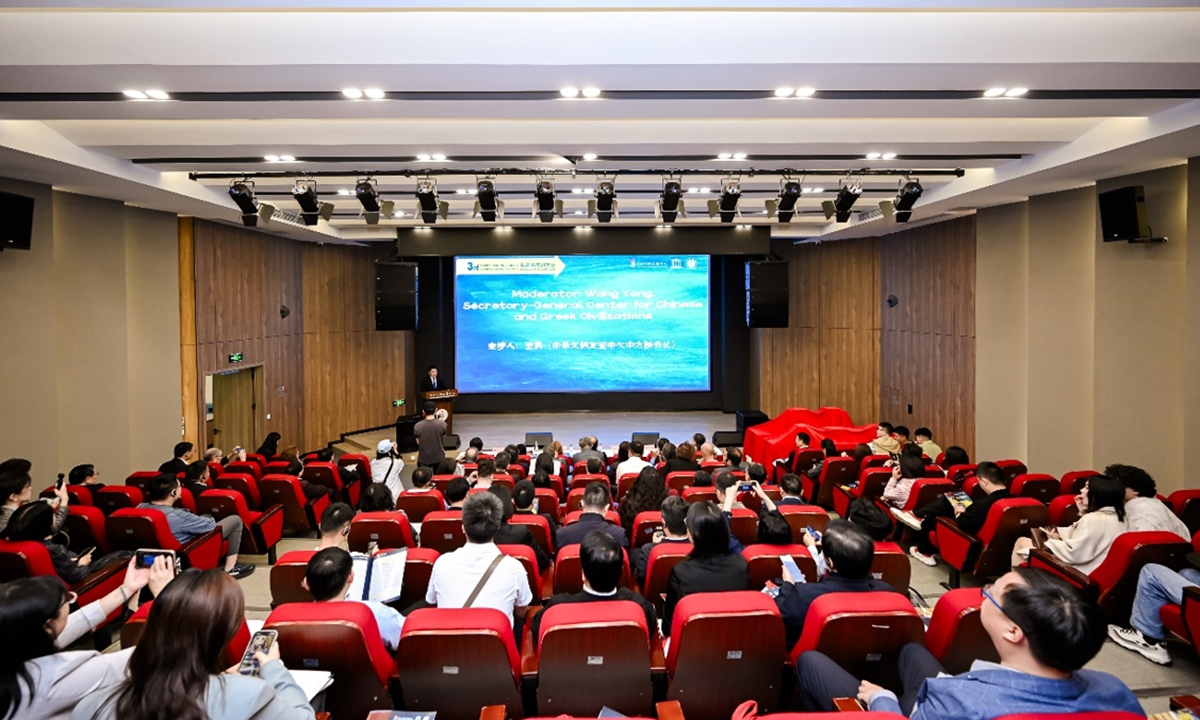
Wang Yong, the Chinese secretary-general of the Center for Chinese and Greek Civilizations, delivers a speech at the Third Global Forum on Mutual Learning among Civilizations forum. Photo: Courtesy of Southwest University
The Third Global Forum on Mutual Learning among Civilizations was co-hosted by the Center for Chinese and Greek Civilizations and UNESCO. It brought together academics and students under the theme "Education and Civilizational Exchange: Pathways to Mutual Learning and Shared Development," exploring potential paths for China-Greece cooperation in higher education in the AI age, as well as the role of classical wisdom in global education.
At the center of the discussions was the Chongqing Initiative, an eight-point framework calling for deeper international cooperation in education and a renewed emphasis on cultural dialogue in a digitally driven world.
Participants emphasized that, amid the rapid development of AI, education must place greater importance on value orientation and the humanities.
The initiative calls for a more inclusive and equitable approach to international education. It states that universities are not only centers of knowledge production, but also play a key role in shaping values and fostering mutual understanding among peoples.
"As two major sources of Eastern and Western civilizations, China and Greece should adopt a more proactive approach to strengthening educational cooperation and civilizational exchange, contributing new intellectual resources and practical pathways to global development," according to the initiative.
A key focus of the initiative is the establishment of a China-Greece University Alliance for Mutual Learning Among Civilizations, designed to "build an open, collaborative, and sustainable platform to enhance resource sharing and long-term cooperation."
The proposed China-Greece University Alliance is expected to "foster closer ties between universities in China and Greece and promote greater integration of higher education resources between the two countries," Wang Yong, the Chinese secretary-general of the Center, told the Global Times.
It aims to encourage mutual learning and exchanges among institutions in both nations, supporting the high-quality development of universities on both sides, said Wang. The alliance also seeks to leverage the strengths of universities in the two ancient civilizations, contributing unique insights and perspectives to the future development of global education.
On advancing education through civilizational exchange, the statement proposes integrating this approach into education systems and talent cultivation. It urges deeper, multi-level cooperation in higher education between China and Greece by expanding joint academic programs, increasing student and faculty mobility, and promoting collaborative research, while shifting from short-term, project-based cooperation toward more institutionalized and systematic frameworks.
The initiative emphasizes coordinated approaches to internationalization in higher education, including curriculum development, faculty mobility and experimentation with transnational education models.
"We call upon universities and educational institutions worldwide to join efforts in advancing education and civilizational exchange, and to contribute wisdom and strength to the shared development and peaceful future of humanity," said the statement.
According to Wang, the most important step in implementing the initiative is "a greater awareness within Chinese higher education institutions of their role in promoting civilizational exchange."
The practical significance of the initiative lies in "promoting concrete cooperation among universities through exchanges and mutual learning," noted Wang. By mobilizing the resources of higher education institutions, he added, the initiative aims to "strengthen dialogue between the Chinese and Greek civilizations and enhance mutual understanding between China and the wider world, as well as between Eastern and Western cultures."
Beyond bilateral ties, the framework proposes expanding cooperation among universities representing other ancient civilizations, with the aim of building a broader multilateral network grounded in shared cultural heritage.
"At a time when cooperation and dialogue among peoples are increasingly essential, initiatives such as today's forum carry particular significance," Ioanna Kakalidi, head of the Public Diplomacy Office of Greek Embassy, said in her opening speech. "They enhance mutual understanding and meaningful exchanges, especially in the field of education, which remains a cornerstone for the progress and prosperity of our societies."
During the keynote session, participants held in-depth discussions on the "practical pathways for China-Greece higher education cooperation" and the "future of global education through civilizational exchange."
Looking ahead, scholars broadly agreed that amid the rapid development of AI and profound shifts in the global landscape, universities in China and Greece, as inheritors of two ancient civilizations, should not only serve as producers of knowledge, but also take on a broader responsibility in shaping global values and fostering sincerity of purpose and moral integrity.
RELATED ARTICLES