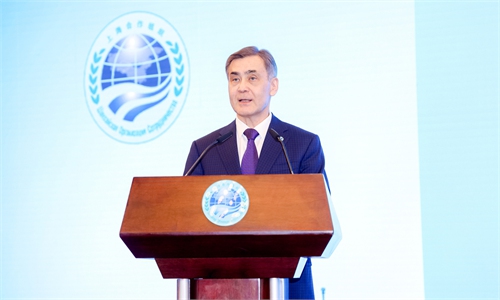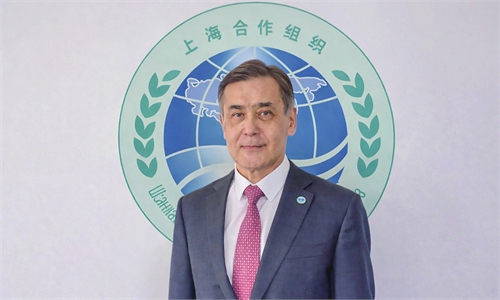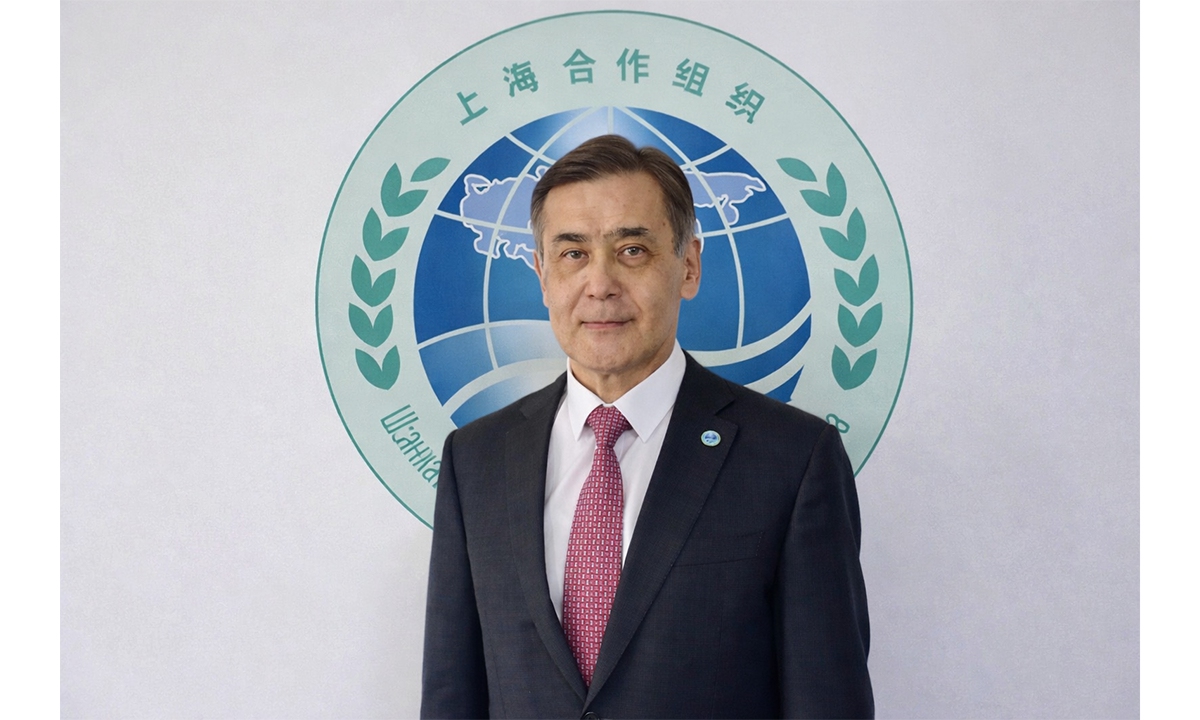
Nurlan Yermekbayev, secretary general of the Shanghai Cooperation Organisation Photo: Courtesy of the SCO Secretariat
In a recent exclusive interview, Nurlan Yermekbayev, secretary general of the Shanghai Cooperation Organisation (SCO), told the Global Times that China's 15th Five-Year Plan is largely consonant with the SCO Economic Development Strategy for the period until 2030. Both programmatic documents channel efforts in the same direction, thereby opening up new horizons for cooperation within the Shanghai Cooperation Organisation as well, he said.
According to Yermekbayev, China's 15th Five-Year Plan for socioeconomic development has outlined the country's key strategic directions for the period from 2026 to 2030. It focuses on advancing Chinese modernization through high-quality development, ensuring that economic growth follows a sustainable and healthy trajectory, and achieving comprehensive social progress.
"I believe that this planhas not only outlined a promising outlook for China's own development, but also opened up new horizons for expanding mutually beneficial cooperation between China and other countries - particularly those belonging to the 'SCO community,'" he wrote.
In accordance with the plan, China's economy will maintain rational growth in the next five years, placing emphasis on strengthening innovation-driven growth, fostering green and low-carbon development, and expanding domestic demand. The objective is to further enhance the well-being of citizens and ensure national security - including security in the food and energy sectors, Yermekbayev elaborated.
Yermekbayev said that in the year 2026 profound changes are taking place globally amid intensifying geopolitical competition and persistent security challenges, which is impacting the spheres of political, economic, and social relations. On the one hand, new prospects are emerging for the development of states and for mutually beneficial international cooperation; on the other hand, geopolitical confrontation - along with challenges and threats to security and stability - is intensifying. The global economy is experiencing severe turbulence.
Against this backdrop, China - as one of the world's leading powers and a responsible member of the UN Security Council - together with other member states of the Shanghai Cooperation Organisation and countries of the Global South, firmly upholds the supremacy of international law, equality, and justice, and consistently advocates for multilateral approaches. This serves as a crucial stabilizing factor in the turbulent international environment, Yermekbayev noted.
Notably, in recent years, Chinese President Xi Jinping has put forward a number of important initiatives and ideas that demonstrate strategic foresight, he continued.
It is significant that the Global Governance Initiative was unveiled by President Xi specifically at the SCO Summit in Tianjin on September 1, 2025. It received high acclaim and a strong response from many members of the international community.
The "Shanghai Spirit" - serving as a kind of ideological and moral core of the SCO - encompasses the fundamental principles of mutual trust, mutual benefit, equality, consultation, respect for diversity of civilizations and pursuit of common development. The Initiative on Global Governance underscores the necessity of upholding sovereign equality, the primacy of international law, multilateralism, a human-centered approach, and an action-oriented focus - principles that share a great deal in common with the "Shanghai Spirit," Yermekbayev wrote.
SCO member states are committed to upholding the principles and purposes of the UN Charter in their entirety and interconnectedness, and firmly and consistently advocate for strengthening the role and status of the United Nations as the central coordinating institution within the system of international relations. At the same time, a growing consensus is emerging globally that, in order to maintain the authority and effectiveness of the United Nations, it is essential to ensure broader representation for developing countries through a comprehensive reform of the organization, including its Security Council, he said.
The same applies to the Global Security Initiative, put forward by President Xi in April 2022. In this regard, the approaches of the SCO and Beijing are also very closely aligned, Yermekbayev stressed.
Throughout its 25-year existence, the SCO has striven to ensure peace, security, and stability in the region, with the aim of creating a favorable environment for socio-economic prosperity and enhancing the well-being of the peoples of its member states.
In essence, all the foregoing resonates both with the political statements and the practical actions of the SCO. Member states invariably underscore the necessity of adhering to a course that eschews confrontational approaches, as well as the unacceptability of attempts to ensure one's own security at the expense of others', noting that cooperation within the SCO framework can serve as a foundation for establishing an architecture of equal and indivisible security in Eurasia, according to Yermekbayev.
The SCO considers the development of a shared vision of geopolitical processes to be a matter of pressing relevance. In this context, initiatives such as the proposal by Russia and Belarus to draft the Eurasian Charter of Diversity and Multipolarity in the 21st Century, Beijing's concept of building a Community with a Shared Future for Mankind, New Delhi's "One Earth, One Family, One Future" concept are of particular interest. Taken together, all these initiatives harmonize seamlessly with the overarching paradigm of the "Shanghai Spirit" and remain a constant focus of attention for the organization's member states.
"We are convinced that the SCO - as an authoritative participant in international cooperation, a part of the Global South, and a member of the constructively minded global majority - will continue to make a significant contribution to enhancing global governance mechanisms and fostering security in Eurasia and worldwide," Yermekbayev said.