IN-DEPTH / IN-DEPTH
Distorted reading in ulterior motive: Multiple sources refute Western media's lie of 'Chinese fishing boasts militarily massing in East China Sea'
By Fan Wei and Published: Apr 16, 2026 10:39 PM

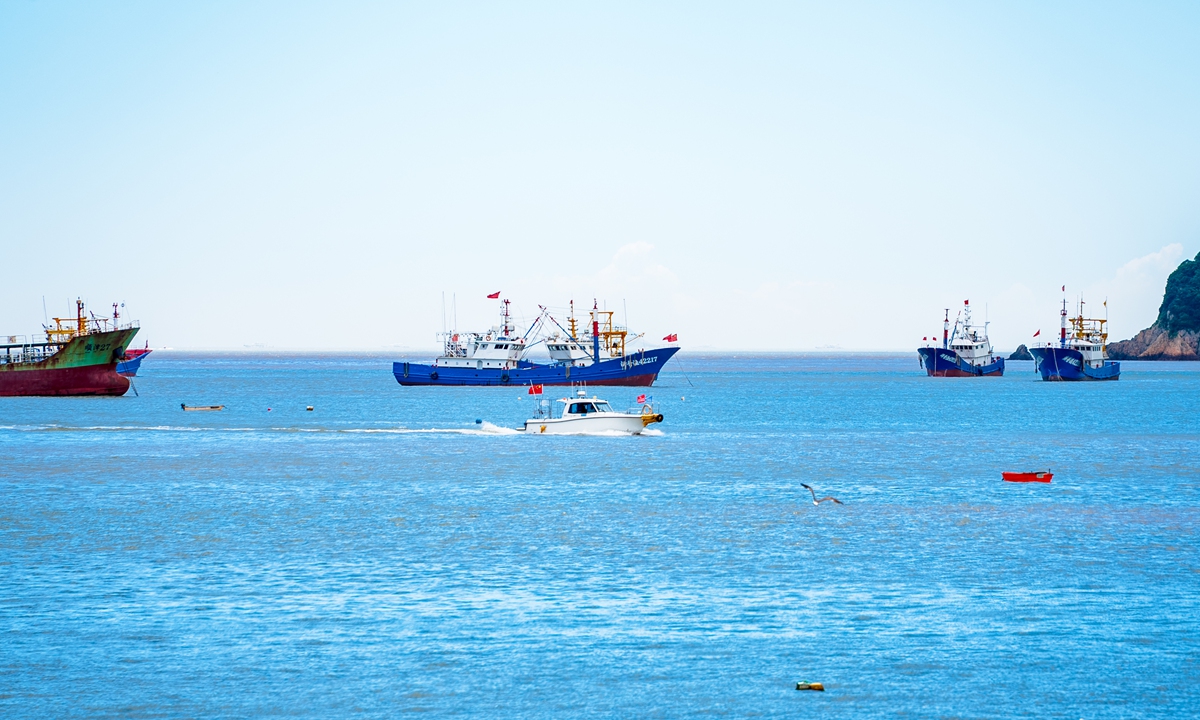
Fishing boats set sail for fishing in Zhoushan, East China's Zhejiang Province, on June 20, 2025. Photo: VCG
Chen Yanping, a 62-year-old fisherman from Zhoushan, East China's Zhejiang Province, never imagined that after a lifetime of fishing, he would one day be linked to "military operations."
When Global Times reporters told him that, according to some Western media reports, he and many other Chinese fishermen working in the East China Sea had become part of a "maritime military force," the usually serious veteran fisherman burst into laughter: "Isn't this pure fantasy?"
Domestic institutions and several industry insiders reached by the Global Times also presented relevant data and refuted the deliberate smear by certain foreign media and organizations from the perspectives of fishery resource distribution and the development of fisheries technology.
Malicious hype in succession
September to the end of April is the prime fishing season in the East China Sea. During this period, Chen and many fishermen from Zhoushan set out on time to fish in China's East China Sea waters. Common seafood on Chinese dining tables, such as Zhoushan hairtail and large yellow croaker, all come from the hard work of fishermen.
"At this time of year, the East China Sea is the perfect place to catch species such as horse mackerel, white croaker and cuttlefish. Not only are the fish and shrimp plump and delicious, but the variety is also rich," said Chen.
However, starting from the end of December 2025, this traditional working pattern of Zhoushan fishermen began to be maliciously hyped by some Western media one after another - arbitrarily given a "military attribute."
In mid-March, a report by AFP claimed that a US intelligence analysis company named ingeniSPACE, through analyzing vessel data of automatic identification systems (AIS), which is a GPS-type signal that commercial ships use to avoid collisions, discovered that in March this year, "roughly 2,000 fishing boats among thousands of vessels" massed in a certain sea area of the East China Sea. The vessels, which were "as close as 500 meters to each other, held their positions for about 30 hours in near gale-force winds and then suddenly scattered," according to the report.
Using ingeniSPACE as the data source as well, in mid-January, a report by The New York Times claimed that a combination of vessel AIS data and satellite imagery showed that in early January, "about 1,400 Chinese vessels abruptly dropped their usual fishing activities or sailed out of their home ports and congregated in the East China Sea. By January 11, they had assembled into a rectangle stretching more than 200 miles," describing the formation as "dense." The report also claimed that the January 11 maneuver followed a similar operation in December, when about "2,000 Chinese fishing boats assembled in two long, parallel formations on Christmas Day in the East China Sea, with each stretched 290 miles long."
In the eyes of experienced fishermen like Chen from Zhoushan, these seemingly "detailed" reports are pure nonsense. "For fishermen, the boats always follow the fish," said Chen. He is very familiar with the patterns of fishing in the East China Sea and told the Global Times that "if a large number of fishing boats gather in the same sea area during a certain period, it is mainly because different seasons bring different fishing seasons. When fishing boats discover a concentration of fish in a certain sea area, they will swarm there."
Taking the fishing company he works for as an example, Chen said that during the fishing season, the company sends nearly 50 100-ton-class fishing boats to the East China Sea, and in Putuo district of Zhoushan, where he lives, there are thousands of such boats operating in the East China Sea. "Experienced captains know when to go to which sea area to catch which fish," he added.
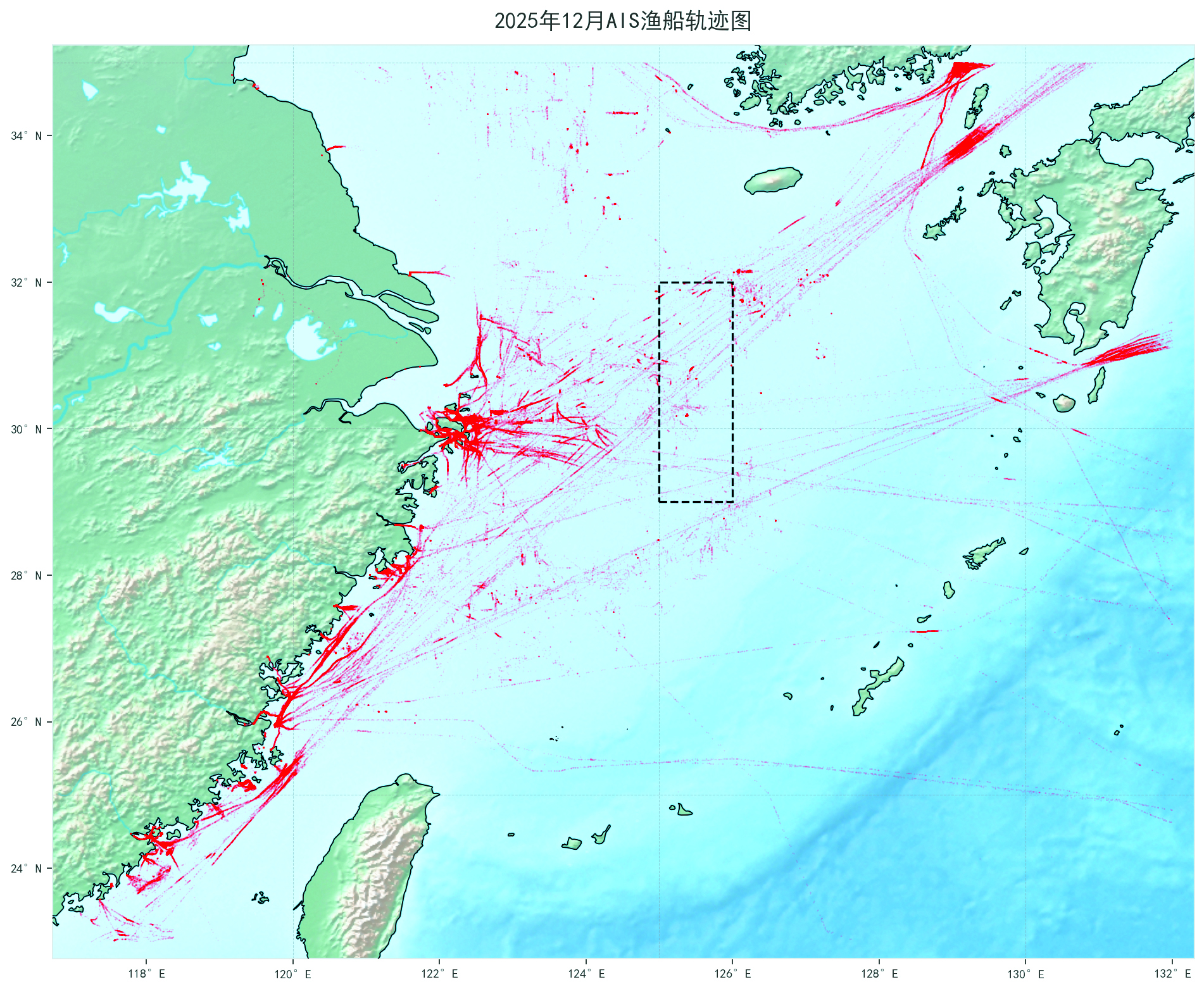
Data chart in December 2025 from the data center of the Shanghai Ocean University (SHOU) shows that some Western media's claim that about "2,000 Chinese fishing boats assembled in two long, parallel formations on Christmas Day in the East China Sea, with each stretched 290 miles long" is false. Photo: Courtesy of the SHOU
High technology behind 'mysterious force'
After analyzing these foreign media reports, Wang Jintao, a squid resource assessment expert with the North Pacific Fisheries Commission and associate professor at the College of Marine Living Resource Sciences and Management of Shanghai Ocean University, found that the fishing boat gathering areas marked by foreign media are mainly located between 125-126 degrees E longtitude and 29-32 degrees N latitude. This sea area lies on the eastern side of the Zhoushan fishing ground, at the junction of the outer Zhoushan fishing ground and the Yangtze River estuary fishing ground.
"This is one of the core areas with the richest fishery resources in the East China Sea and a traditional fishing ground for Chinese fishermen. It serves as a habitat for multiple fish species," Wang analyzed.
According to China's summer fishing moratorium system, to protect fishery resources such as fish in surrounding seas during their summer spawning and growth period, the fishing ban in the East China Sea runs from May 1 to mid-September each year, while the open fishing season is from September 16 to April 30. The East China Sea officially enters its prime fishing season, which coincides with the "active period of fishing boats" hyped by some Western media.
The "tactical coordination" speculated by some Western media - that Chinese fishing boats are under the unified command of some "mysterious force" and simultaneously head to the same sea area - is in fact most likely driven by China's advanced fisheries technology.
The Global Times learned from some industrial experts that fishermen today can access accurate fishing ground predictions provided by fisheries institutions based on satellite remote sensing and marine environmental data. In addition, shipborne fish finders enable precise location of fish schools. It is precisely thanks to these technological tools that fishermen can clearly know where the fish are in the vast ocean.
"At present, China has developed various fishery forecasting systems. For example, the squid and tuna forecasting systems developed by Shanghai Ocean University can help distant-water fishing vessels locate fish schools and conduct precise operations," Wang said.
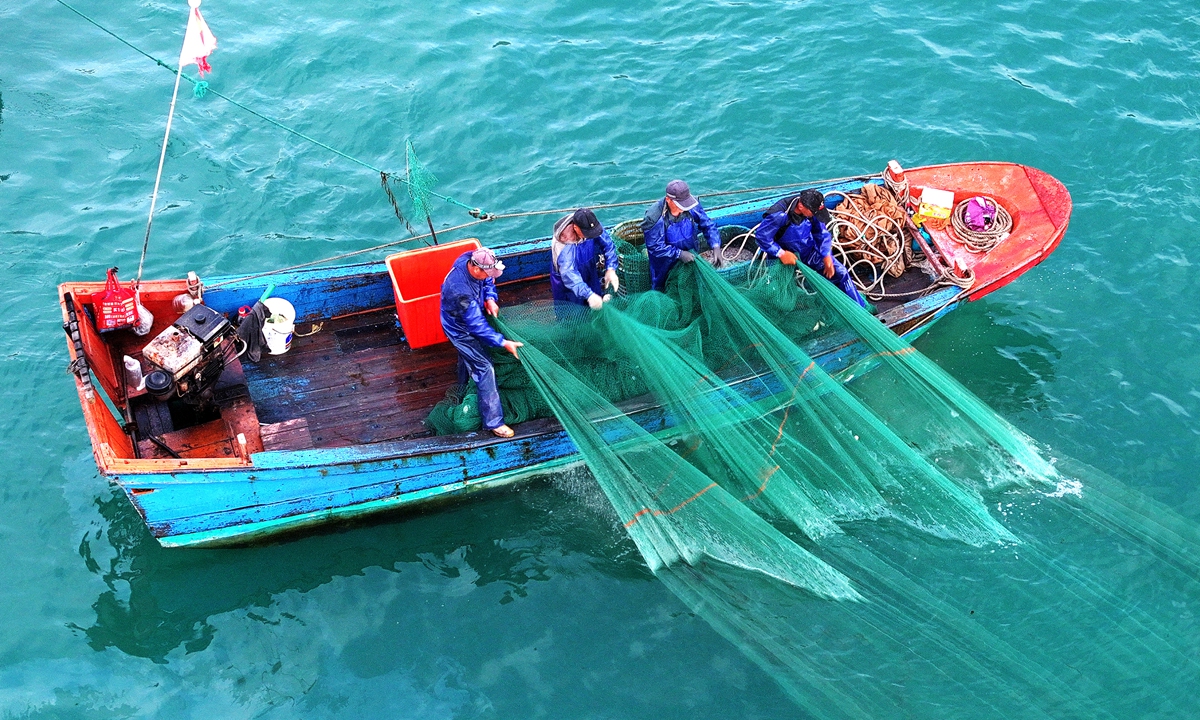
Fishermen catch fish at the fishing dock in an island in Zhoushan city, East China's Zhejiang Province, on May 4, 2024. Photo: VCG
Contrary to common sense
Some foreign media outlets have drawn trajectory maps of Chinese fishing boats "massing" at sea based on AIS data, and created visually striking diagrams showing large numbers of vessels "arrayed in formation" to form a "floating barrier." However, to industry insiders, such speculation simply cannot stand up to scrutiny.
"It is practically impossible for fishing boats to moor side by side in orderly rows at sea, let alone form a long queue," Chen explained in detail how collective fishing works in the East China Sea. The main types of vessels operating there are trawlers, gillnetters, light boats and stow netters. Only pair trawlers - which work together to tow a single net to catch demersal species such as hairtail and small yellow croaker - may sail parallel at a certain distance. All other boats operate independently and must maintain sufficient separation to avoid entangling their nets. "Normally, fishing boats keep a distance of about 10 to 20 nautical miles from each other," he emphasized.
A data map provided by the data center of Shanghai Ocean University shows that the scenario described in Western media reports of "thousands of Chinese fishing boats massing in December 2025 to form two parallel formations hundreds of kilometers long" did not occur. In the AIS hotspot distribution map of Chinese coastal fishing vessels drawn from actual AIS data, no dense concentration of boats appears in the area designated by foreign media.
"In December last year, there was no 'floating barrier' formed by Chinese fishing boats in the sea area hyped by some Western media," Wang analyzed. The images produced by overseas institutions based on so-called "AIS data" may have involved selective thinning and filtering of the vessel signals, ultimately presenting a deliberately crafted illusion.
Militarization hype a habitual smear tactic
Relevant experts pointed out that the sinister motive behind some Western media's groundless hype - claiming that "China quietly mobilized thousands of fishing boats to form massive floating barriers" - is obvious.
Yang Xiao, a researcher at the Institute of Peaceful Development of the Chinese Academy of Social Sciences, told the Global Times that China's fisheries sector has long been a prime target of Western media smears. These accusations are in fact deliberate, long-term efforts by foreign forces with ulterior motives to distort and suppress China's fisheries development, especially its distant-water operations. The latest attempt to link routine fishing activities by Chinese fishermen in the East China Sea with "military operations" is even more far-fetched.
Yang believes that Western media's tactic of packaging preconceived conclusions with "scientific methods" ultimately serves the goal of cognitive warfare. By repeatedly hyping various "fishery anomalies" and manufacturing topics such as illegal fishing, boundary-crossing or even military actions, the real intention remains to smear China.
"These hyped narratives are ultimately aimed at undermining the legitimacy of China's normal fishery rights and activities, labeling ordinary Chinese fishermen and fishing boats with a 'black tag,' and deliberately setting traps for violent enforcement and confrontational conflict," Yang said.
Looking ahead to the future of the fishing industry, Chen is full of expectation. "Nowadays, our fishing boats are equipped with advanced information systems, including the BeiDou navigation system. The technological content of our vessels is getting higher and higher, becoming increasingly intelligent. Both production conditions and the safety environment for maritime operations have seen continuous improvement," he said.
RELATED ARTICLES