Vietnam’s top leader To Lam continues China visit; 10-hour high-speed train ride spotlights connectivity agenda, underscores railway cooperation: Chinese expert
By and Zhang Wanshi Published: Apr 16, 2026 11:30 PM

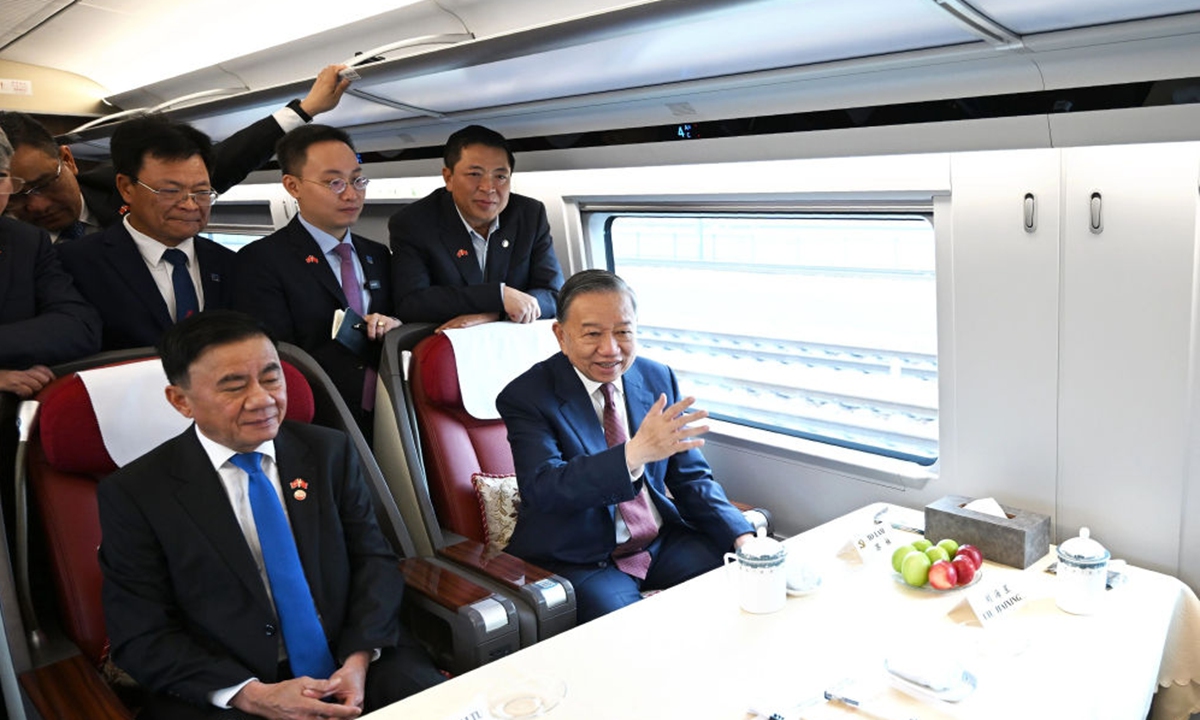
General Secretary of the Communist Party of Vietnam (CPV) Central Committee and Vietnamese President To Lam, departs Beijing by high-speed train for Southwest China's Guangxi Zhuang Autonomous Region on April 16, 2026. Photo: Xinhua
General Secretary of the Communist Party of Vietnam (CPV) Central Committee and Vietnamese President To Lam, departed Beijing by high-speed train for Southwest China's Guangxi Zhuang Autonomous Region on Thursday morning, continuing his China visit, according to the Xinhua News Agency. After around 10 hours, To Lam arrived in Nanning of Guangxi at around 19:15, per Xinhua.
To Lam is paying a state visit to China from April 14 to 17. Upon his arrival in Beijing, he took a high-speed train to visit Xiong'an New Area of North China's Hebei Province on April 14.
After taking a Fuxing high-speed train to visit Xiong'an New Area, To Lam once again chose to take high-speed train for his trip to Guangxi. His two rides on China's high-speed trains during this visit fully demonstrate his keen interest in China's high-speed rail development, a Xinhua report noted.
During the trip to Guangxi, To Lam described his China visit this time as "particularly special," noting that he traveled by high-speed train from north to south. He said he kept the curtains open throughout the journey to observe the scenery, and noticed China's high level of urbanization. Although he only passed through several provinces, he said he could still feel the relatively balanced development across regions, which reflects China's strong performance in coordinated regional development, according to Xinhua.
He also praised China's railway technology, saying that few countries in the world are capable of operating railways at an altitude of 4,000 meters, and described China's railway achievements as deeply impressive, per Xinhua.
The high-speed train from Beijing to Guangxi travels through several provinces, covering a distance of more than 2,400 kilometers in about 10 hours. The trip offers a firsthand view of China's vast territory and the momentum of its modernization drive, per Xinhua.
It is relatively rare for a foreign leader to take the high-speed train twice during a single visit to China, with the total journey lasting more than 10 hours. Passing through multiple provinces, the arrangement offered a broad view of China's infrastructure development and broader economic and social achievements, providing a useful reference for Vietnam's own development, Ge Hongliang, vice dean of the ASEAN College at Guangxi Minzu University, told the Global Times.
The itinerary also closely aligned with To Lam's focus on connectivity and his willingness to prioritize rail cooperation as part of practical cooperation during this visit. It could provide a reference for Vietnam's domestic infrastructure development, China-Vietnam cross-border rail links, and the long-term planning of the Pan-Asia Railway, said Ge.
Footage released by Xinhua showed To Lam learning about the development and operation of China's high-speed rail system during the ride on Thursday.
A Vietnamese youth who was waiting to welcome To Lam in Guangxi was cited by China News Service as saying that China's high-speed train is very comfortable and fast. She also expressed hope to take such high-speed train in Vietnam one day.
As China's only provincial-level region linked to Vietnam by both land and sea, Guangxi serves as a key frontier for exchanges and cooperation between China and Vietnam, as well as between China and ASEAN, per Xinhua.
Guangxi occupies a unique position in deepening ties between the two countries, while also promoting cross-border economic development. Citing the example of Pinglu Canal, Ge said that it further underscores Guangxi's role as an important corridor in the area of infrastructure connectivity.
Initiated in August 2022 and scheduled to start operation by the end of 2026, the Pinglu Canal is a flagship project on the New International Land-Sea Trade Corridor, an important trade and logistics passage jointly built by provincial-level regions in western China and ASEAN members, per Xinhua.
As Guangxi advances development in emerging sectors such as artificial intelligence, including through ASEAN cooperation, Vietnam also has an urgent need for greater alignment in these fields. By deepening sub-national cooperation with Vietnam's northern provinces and beyond, Guangxi is poised to play an important role, said Ge.
Ge also noted that the current cross-border exchanges between China's Guangxi and Vietnam are extensive, with frequent personnel movements and a large number of Vietnamese students studying in Guangxi. People-to-people exchanges, including the "Red Study Tours" initiative, play a vital role in bilateral ties.
Launched in May 2025, the "Red Study Tours" initiative seeks to facilitate exchanges between young people in China and Vietnam. From May 2025 to March 2026, a total of eight themed camps across 10 provincial-level regions in China were organized under the initiative, providing more than 1,000 Vietnamese youths with the opportunity to experience China firsthand, according to Xinhua.
To Lam's visit to China and his exchanges with Chinese leader show that China-Vietnam relations are entering a more multidimensional and substantive stage,Pan Jin'e, a research fellow with the Chinese Academy of Social Sciences, told the Global Times.
The visit also reflects the elevation of bilateral cooperation to a higher strategic level, with stronger political mutual trust, deeper practical cooperation in areas such as the economy and technology, and firmer people-to-people ties. It also sends a strong strategic signal for the future development of bilateral relations, said Pan.
RELATED ARTICLES