China ensures stable oil supply amid global changes, demonstrating progress in new energy system: NDRC official
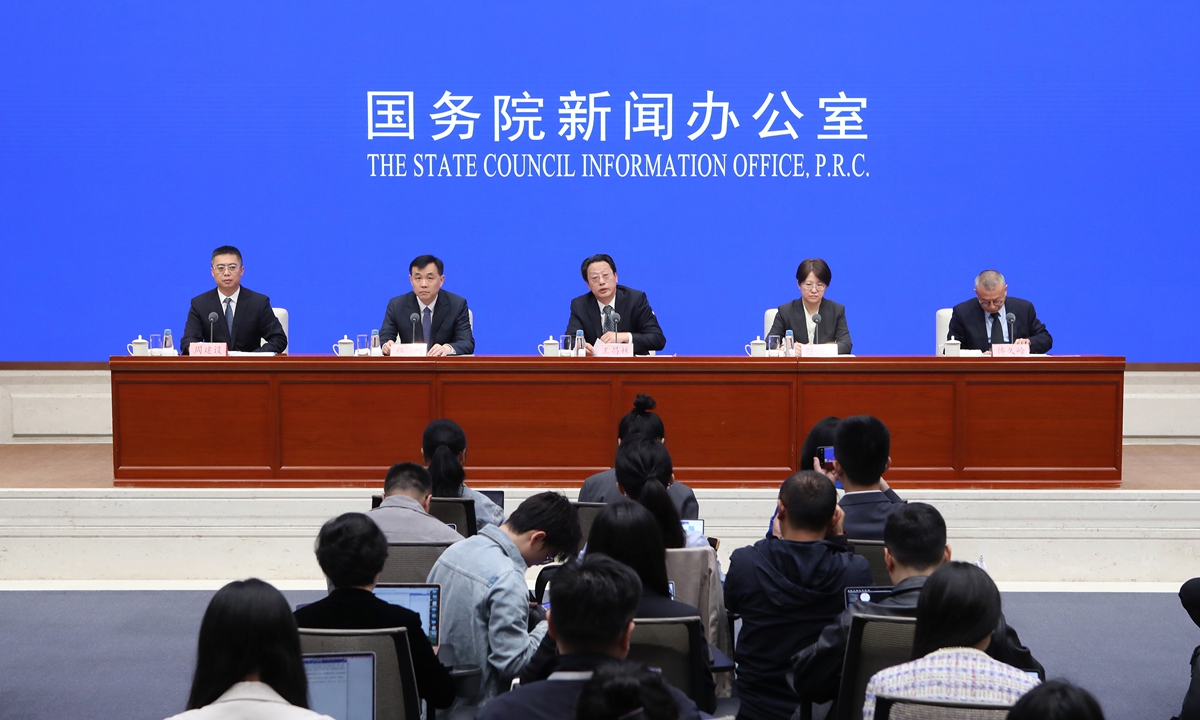
A press conference on promoting the high-quality economic and social development during the 15th Five-Year Plan period (2026-30) is held on April 17, 2026. Photo: VCG
In response to the impact of changes in the international situation on China's oil and gas imports, the country has adopted comprehensive measures to effectively ensure sufficient domestic oil supply and stable market operations. This fully demonstrates the achievements in building China's new energy system, Wang Changlin, deputy head of the National Development and Reform Commission (NDRC), said on Friday.
Wang made the remarks during a press conference on promoting the high-quality economic and social development during the 15th Five-Year Plan period (2026-30).
When asked for explanation on the implementation of doubling the nation's non-fossil fuel capacity by 2035 in the outline of China's 15th Five-Year Plan, Wang said it is an important lever for building China's new energy system.
Compared with the traditional energy system, China's new energy system is one in which non-fossil energy serves as the primary source of supply, fossil energy provides a bottom-line guarantee, the new-type power system acts as the key pillar, and green, smart, and efficient consumption serves as the guiding principle. It is a clean, low-carbon, safe, and efficient energy system. "This represents the only viable path for China to achieve a green and low-carbon energy transition. It is also a strategic choice to safeguard national energy security," Wang noted.
By the end of the 14th Five-Year Plan period (2021-25), China had preliminarily established the basic framework of its new energy system. Total energy production exceeded 5 billion tons of coal equivalent, annual electricity consumption surpassed 10 trillion kilowatt-hours, and the world's largest clean and low-carbon energy system was built. The share of non-fossil energy in total energy consumption reached 21.7 percent, providing "ample quantity, high quality, and stable prices" energy support for socialist modernization, according to the official.
During the 15th Five-Year Plan Period, the NDRC will accelerate the high-quality development of non-fossil energy. It will make every effort to expand the scale of non-fossil energy generation and consumption, and actively promote the non-electric application of non-fossil energy, Wang said.
By 2030, it is projected that the supply scale of non-fossil energy will see significant growth compared with 2025, and by 2035, it will double compared with 2025, according to Wang.
In addition, the NDRC will promote the safe, reliable, and orderly substitution of fossil energy. We will expand domestic energy production, strengthen the development of petroleum and natural gas reserves, and continuously consolidate the foundational role of traditional energy in ensuring supply, the official said.
Moreover, efforts will be made to continue to advance electricity substitution in key sectors such as transportation, industry, and construction, accelerate the promotion and application of new-energy heavy-duty trucks, and push forward the peaking of petroleum and coal consumption, Wang added.
We will also promote the iteration of new energy power generation technologies, and carry out major technology research and breakthroughs in long-duration energy storage and controllable nuclear fusion, the NDRC official noted.
Wang said the NDRC will actively participate in global climate governance and encourage enterprises to engage in international energy cooperation. "We will continue to advance the diversification of energy imports," Wang noted.
At the same time, we will adhere to bottom-line thinking and worst-case scenario planning, and take stronger measures to enhance domestic production and supply capacity, increase energy reserves, in a bid to comprehensively improve our ability to respond to all kinds of emergencies, so as to better safeguard national energy security, Wang noted.
Global Times
RELATED ARTICLES