Cutting-edge technologies take center stage at consumption expo in Hainan
By , Yin Yeping and Ni Hao in Haikou Published: Apr 17, 2026 08:45 PM

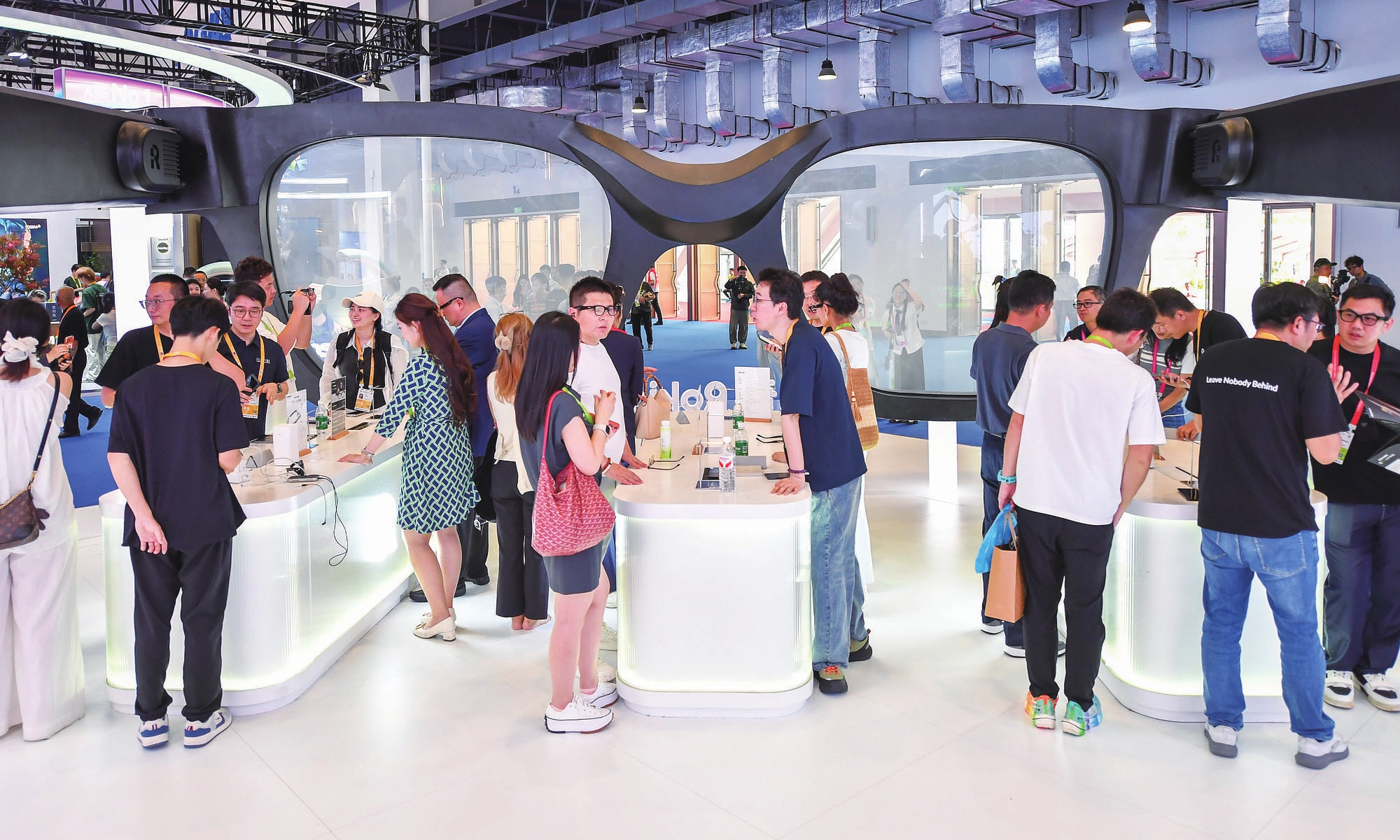
Visitors experience AI glasses at the 6th China International Consumer Products Expo on April 13, 2026 in Haikou, South China's Hainan Province. Photo: VCG
Chen Xuhan, a student from South China University of Technology, spent nearly an entire morning on Wednesday exploring cutting-edge technologies on display in Hall 1 of the China International Consumer Products Expo (CICPE) held in Haikou, South China's Hainan Province.
He traveled from Guangzhou, South China's Guangdong Province, to Haikou, stopping at nearly every AI glasses booth to experience the latest technologies.
"When trying on the glasses, I felt a sense of the future, or to be more precise, it felt pretty cool," he told the Global Times on Wednesday.
Behind Chen stood the Rokid booth, where its core exhibit, the Rokid AI glasses, drew public attention.
The glasses, the world's lightest mass-produced full-function AI+AR model, look no different from ordinary eyewear, weighing just 49 grams. Equipped with diffractive waveguide technology, they are comfortable enough for all-day wear.
Powered by a Qualcomm AR1 chip, the glasses support a wide range of functions across various scenarios including photo and video capture, smart teleprompter, translation in 89 languages, real-time navigation, AI Q&A, glance-and-pay, and meeting transcription. Notably, users can access different large AI models, freeing the interactive experience from being confined to a single algorithmic framework.
Throughout this year's CICPE, AI glasses have become a major highlight across the exhibition hall, drawing large crowds. Not far from the Rokid booth is the iFlytek exhibition area. iFlytek has brought its core AI product matrix to the expo, making its domestic debut with an all-new hardware product, the iFlytek AI Glasses.
According to information the company shared with the Global Times, the glasses support real-time translation of 122 languages (including dialects). With the dual power of voice translation and visual translation, they transform "translation capability" from a standalone tool into a wearable, always-accessible function, effectively serving as a "personal interpreter before your eyes" for consumers.
Recognition accuracy
A visitor surnamed Guo, a first-time wearer of AI glasses, shared her experience. "Putting on the glasses one would feel very novel. When I spoke Chinese, English subtitles appeared in the glasses — it was a new experience for me. When communicating with foreigners, wearing the glasses also prevents any awkwardness," she said.
As AI glasses enter a period of rapid development, the sixth CICPE has brought together nearly all of China's leading AI glasses brands under one roof.
INMO, a company that has been involved in making AI glasses for five years, also showcased its products. A representative Lucy from INMO told the Global Times on Wednesday that in a simulated "overseas guest reception" experience, users simply need to speak naturally.
The system uses AI voice-cloning translation to convert Chinese into real-time English audio, which is broadcast to the other party using the user's own voice. Meanwhile, the other person's English reply is instantly recognized by the glasses and transcribed into Chinese subtitles displayed directly in the user's field of vision, creating a synchronized "voice translation + subtitle prompt" experience.
Lucy explained that the device employs directional pickup technology, which accurately captures speech and effectively reduces background noise interference, thereby improving recognition accuracy.
The gathering of this "all-star lineup" of AI glasses brands at the expo not only underscores CICPE's role in shaping global consumer innovation trends and marks a shift for AI glasses — from concept to practicality, and from standalone gadgets to an integrated ecosystem. It provides an important showcase window and industry bellwether for the upgrading of the consumer electronics sector and the transformation of future lifestyles, Ma Jihua, a veteran market analyst told the Global Times on Wednesday.
Beyond AI glasses
However, CICPE is about more than just AI glasses. In Hall 1, the main venue of this year's expo, the focus is on cutting-edge product launches and innovative scenario implementations, showcasing a wider array of achievements.
Two products from Dreame on display, the AI Smart Ring and the Glow Ring, became some of the most talked-about highlights in the smart wearable category at this year's expo.
Dreame has established a clear product matrix in the AI smart ring industry, with the AI smart model focusing on "vibration interaction" and the Glow model centering on "ECG monitoring," creating a complementary and differentiated product line-up.
According to the company, the Dreame AI Smart Ring was officially launched in November 2025. By the first quarter of 2026, its gross merchandise value across all channels had surged by 616 percent quarter-over-quarter, making it the fastest-growing core product in the smart wearable segment.
Tongcheng Travel also made a strong showing, unveiling multiple AI-driven travel innovations. The company highlighted two key scenario-specific solutions: the "AI Face-to-Face Translation Screen" and "AI Audio Guide."
The AI Audio Guide is built around the service concept of "one phone, one QR code scan, full AI companionship," offering scenic areas a lightweight, zero-renovation, quick-to-deploy intelligent tour service. Visitors can access high-definition park maps, real-time location-based navigation, and multi-style voice commentary simply by scanning a QR code — no app download required.
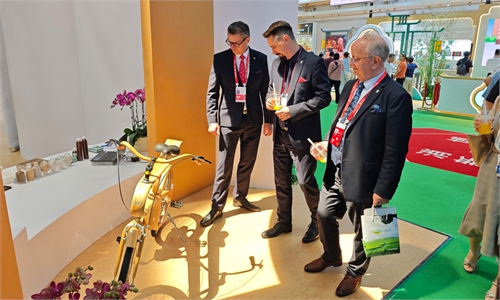
As a leading figure in China's sports industry and a service provider for eight Olympic Games, Taishan Sports once again appeared in Hall 1 of the expo, marking its sixth consecutive participation.
Wang Chunqing, from Shandong Taishan Pardus Composite Materials Co, which is under Taishan Sports, told the Global Times that the company started with professional competitive bicycles. Its product development strictly adheres to Chinese ergonomics, with continuous refinement driven by feedback from professional athletes during actual use. The company views CICPE as an important window and platform, hoping to use technology to benefit ordinary consumers.
In conversations with the company, a common theme emerged: a strong emphasis on technological innovation and expansion into the domestic market.
Currently, the company has an annual production capacity of 200,000 units, with overseas markets accounting for half of total output. As it aggressively expands its domestic presence, it has achieved nationwide coverage with store openings in Lhasa. The company's best-selling civilian model is the advanced-tier bicycle priced between 10,000 yuan ($1,466) and 20,000 yuan. Looking ahead, the company plans to further increase its share of the Chinese market, Wang said.
The veteran analyst Ma said that Chinese technology enterprises are always at the forefront of industry and serve as the primary driving force behind a massive technological evolution.
RELATED ARTICLES