What do foreign leaders experience when riding China’s high-speed rail?: Global Times editorial
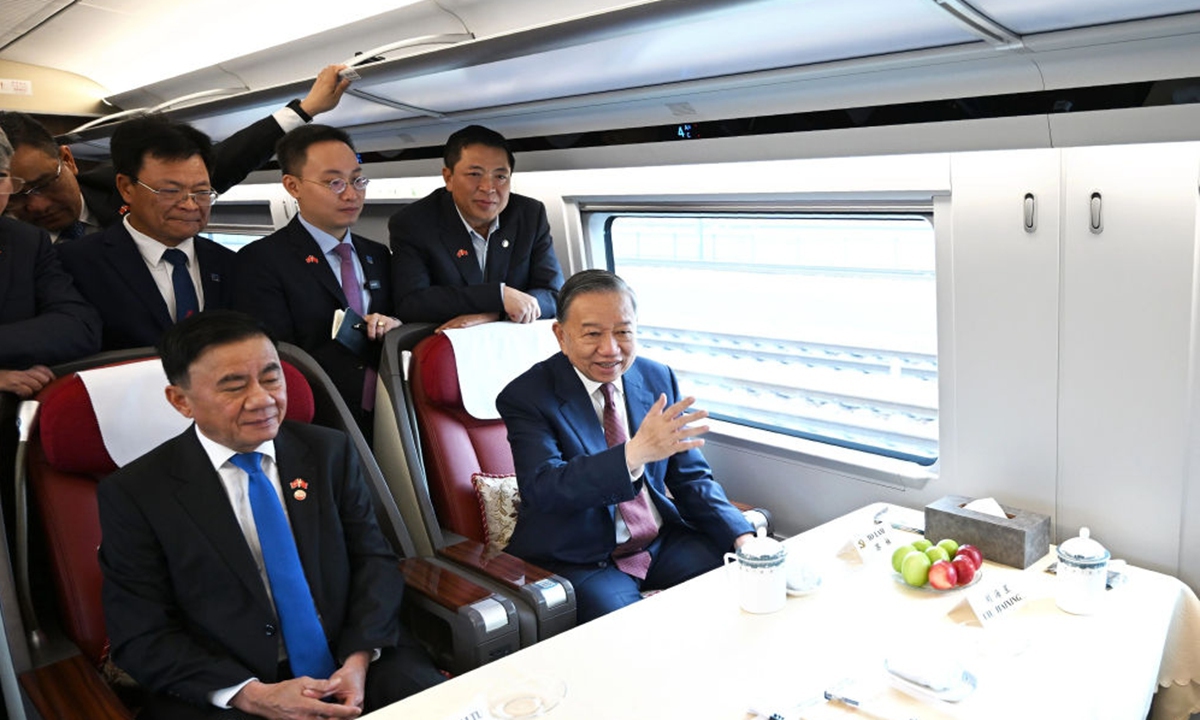
General Secretary of the Communist Party of Vietnam (CPV) Central Committee and Vietnamese President To Lam, departs Beijing by high-speed train for Southwest China's Guangxi Zhuang Autonomous Region on April 16, 2026. Photo: Xinhua
During his visit to China, General Secretary of the Communist Party of Vietnam Central Committee and President of Vietnam To Lam twice chose to travel on China's "Fuxing" bullet train, spending a total of nearly 12 hours on board. This detail has attracted wide international attention. In fact, riding China's high-speed rail is no longer a novelty for visiting foreign leaders. International dignitaries such as Russian President Vladimir Putin, UN Secretary-General Antonio Guterres, and Kazakh President Kassym-Jomart Tokayev have all chosen to travel by China's high-speed rail during their visits. In this sense, high-speed rail has become a "shining calling card" of China's manufacturing in the new era, offering the international community a direct way to experience it.
Why do so many foreign leaders choose to experience China's high-speed rail? The answer goes far beyond simply feeling its remarkable speed. At a deeper level, they view modern railway construction as a way to observe "key code" behind China's high-quality development. In China, high-speed rail functions like a network of powerful arteries, tightly connecting once-distant regions. It facilitates the efficient flow and optimized allocation of production factors such as talent, capital, and technology nationwide, providing solid support for major regional strategies including the Beijing-Tianjin-Hebei region, the Yangtze River Delta, the Guangdong-Hong Kong-Macao Greater Bay Area, and the Chengdu-Chongqing economic zone. The success of China's high-speed rail system reflects a concentrated embodiment of institutional strengths, industrial capacity, and strategic planning.
Looking back around two decades, high-speed rail was still an expensive and scarce "luxury", mainly concentrated in Western Europe and Japan. No country had built a high-speed rail network longer than 3,000 kilometers. Its high construction and operating costs made it even more unattainable for many developing countries. Europe once operated its famous high-speed rail route from London in the UK to Avignon in France, covering about 1,150 kilometers. In Japan, the longest Shinkansen was the Hayabusa service from Tokyo to Shin-Hakodate in Hokkaido, at about 823 kilometers. Today, the global high-speed rail network spans more than 65,000 kilometers in total operating length, over 70 percent of which is in China. By contrast, the high-speed rail journey taken by General Secretary To Lam - from Beijing to Nanning - exceeds 2,400 kilometers in a single trip, a striking comparison in itself.
Through its own practice, China has fundamentally reshaped the global definition of high-speed rail, offering a reference model for modernization in Global South countries. Leveraging massive market demand, systematic technological integration, a comprehensive industrial system, strong manufacturing capacity and highly efficient engineering and construction management, China has significantly reduced the unit cost of high-speed rail, transforming it from a "technological showcase" into an "accessible nationwide network." China has not only built the world's largest high-speed rail system, but has also pioneered a development path tailored to its national conditions - efficient and intensive in nature - forming a complete system of technical standards, construction management models, and industrial supply chains. This replicable and scalable experience holds crucial reference value for Global South countries seeking infrastructure modernization and industrialization.
Railway construction, particularly high-speed rail, plays a vital role in promoting "closer people-to-people ties" among different countries. Compared to aviation, railways are more cost-effective, have broader coverage, and offer greater transport capacity; compared to highways, they are more stable, safer, and offer greater economies of scale. Students, tourists, scholars, media professionals, border residents, and small business owners can cross into neighboring countries more frequently thanks to new rail connections. Once such movement becomes routine, mutual understanding between neighboring nations and their peoples will increasingly be built on real-life interactions and concrete experiences, bringing the two societies from simply "knowing each other" to genuinely "drawing closer to each other", thus narrowing the psychological distance between their peoples.
China has always adhered to the principles of extensive consultation and joint contribution for shared benefit in railway cooperation, which is a vivid reflection of its open attitude and sense of responsibility as a major country. The Jakarta-Bandung High-Speed Railway has ushered Indonesia into the era of high-speed rail; the China-Laos Railway has become a "golden route" linking China with Southeast Asia, and core systems and equipment have been successfully applied in European countries such as Hungary and Serbia. In their joint statement, China and Vietnam agreed to make railway cooperation a highlight of their strategic partnership, which has also drawn widespread attention. More and more examples clearly show that China's high-quality development not only benefits its own people but also contributes to global infrastructure development and improves the well-being of local communities.
This year marks the first year of China's 15th Five-Year Plan period. Looking ahead, by 2030, China's railway network is expected to reach approximately 180,000 kilometers, including about 60,000 kilometers of high-speed rail, and a world-class modern railway network will be basically built. The sustained development of railways will further drive industrial upgrades across upstream and downstream sectors, from new materials and high-end equipment manufacturing to information technology and modern logistics, creating new economic growth points. For the world, this means more technological cooperation, talent exchanges, and market opportunities. A French media outlet has marveled that China, once merely a testing ground for high-speed rail technology, has now become a key driver of regional integration.
The story of China's high-speed rail is but a microcosm. Behind it lies a glorious chapter of a major country mastering core technologies through self-reliance and hard work, achieving leapfrog development, and delivering benefits to its people. The speeding "Fuxing" bullet train carries the pride and confidence of the Chinese people, as well as China's sincere desire to share development opportunities with the world. The thundering China Railway High-speed trains are leading the trend of the times and racing toward an even broader future.
RELATED ARTICLES